The Prosecco Paradox: How Italy’s Greatest Wine Success Is Becoming Its Biggest Liability
667 million bottles sold. 40% of Italian wine in America. And a brand problem no one wants to talk about.
The Prosecco Paradox: How Italy’s Greatest Wine Success Is Becoming Its Biggest Liability
667 million bottles sold. 40% of Italian wine in America. And a brand problem no one wants to talk about.
Let’s start with what looks like a victory.
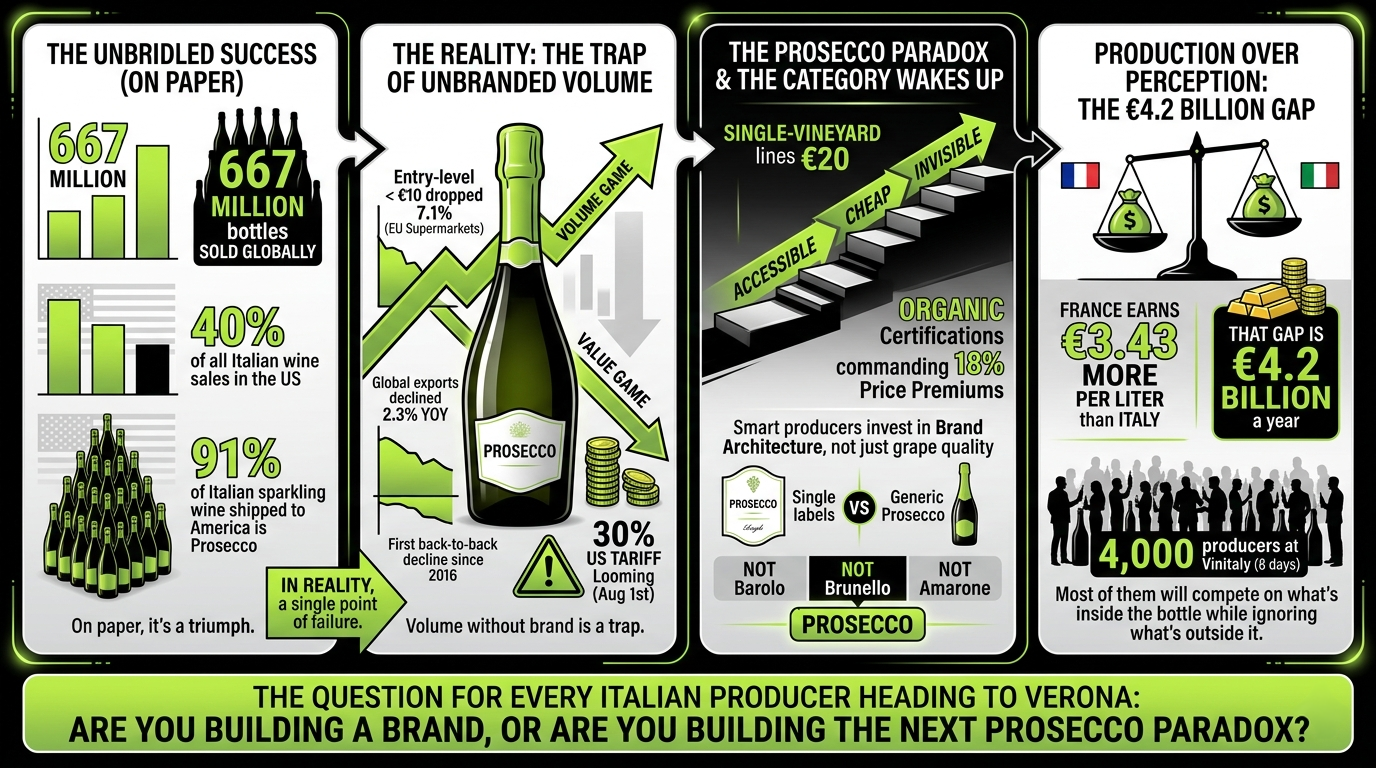
Prosecco sold 667 million bottles globally in 2024. It represents 40% of all Italian wine sales in the United States. 91% of Italian sparkling wine shipped to America is Prosecco. The category has been growing at over 10% annually for the better part of a decade.
By every conventional metric, Prosecco is the greatest success story in Italian wine.
And that’s exactly the problem.
When Winning Looks Like Losing
In early 2025, something shifted. Global Prosecco exports declined 2.3% year-on-year — the first back-to-back decline since 2016. Entry-level Prosecco under €10 dropped 7.1% in volume across European supermarkets. The US market, Prosecco’s crown jewel, faces a looming 30% tariff from August 1st that could reshape the entire export trajectory.
But these aren’t the real story. The real story is what happened to the brand.
Prosecco entered the global market as a joyful, accessible alternative to Champagne. It was fresh, affordable, and unpretentious. That positioning was brilliant — it created an entirely new consumer segment and opened doors that Italian wine had never walked through.
But accessible became cheap. Cheap became interchangeable. Interchangeable became invisible.
Today, for hundreds of millions of consumers worldwide, “Italian wine” means one thing: a pleasant sparkling wine that costs less than ten euros. Not Barolo, with its decades of aging potential. Not Brunello, with its Tuscan gravitas. Not Amarone, with its concentration and complexity.
Prosecco.
That’s the paradox. The wine that made Italian wine famous is now the lens through which the world sees all Italian wine. And that lens says: affordable, good value, nothing special.
The Anatomy of a Commodity Trap
How does a product with a real story and genuine quality end up as a commodity? The same way it always happens: by competing on volume instead of brand.
The Prosecco DOC zone covers 24,000 hectares of mostly flat, fertile plains across Veneto, Friuli, and Trieste. Production is largely mechanized. Maximum yields are set at 18 tonnes per hectare. The result, on the whole, is wine that is simple in style, occasionally dilute, and can lack the concentration that distinguishes a memorable bottle from a forgettable one.
This is not a quality problem — it’s a structural one. The DOC system was designed to scale, and scale it did. But scale without brand architecture doesn’t create value. It creates volume. And volume without perceived value leads to exactly one place: a race to the bottom.
The evidence is clear. Flat, industrially farmed DOC Prosecco fills supermarket shelves at €5–8 a bottle. The label says “Prosecco.” The consumer thinks “Prosecco.” There is no visual distinction, no brand story, no reason to pay more.
Meanwhile, hidden in the hills above the plains, there’s a different world.
The Wine Most People Don’t Know Exists
The Conegliano Valdobbiadene DOCG zone is everything the DOC is not.
8,100 hectares of steep hillsides — recently recognized as a UNESCO World Heritage site. Maximum yields of 13.5 tonnes per hectare, nearly 30% lower than DOC. Vineyards tended and harvested entirely by hand, because the slopes are too steep for machines. Microclimates and soil compositions that create wines with genuine complexity and character.
This is where Prosecco’s real story lives. This is terroir. This is craftsmanship. This is a product that deserves premium positioning.
And almost no one outside the wine trade knows it exists.
Why? Because to the consumer standing in a wine shop in New York or Hamburg or Tokyo, a bottle of Prosecco DOCG Superiore from Conegliano Valdobbiadene looks almost exactly like a bottle of industrial DOC Prosecco from the flatlands. Same word on the label. Same general aesthetic. Same shelf.
The hand-harvested wine from UNESCO hillsides and the machine-made wine from industrial plains share a name, and in the consumer’s mind, they share a value. The DOCG producers are being dragged down by the DOC’s commodity positioning.
This is what happens when an entire category invests in production and ignores brand.
What Champagne Understood 200 Years Ago
The contrast with Champagne is instructive — and painful.
In the 19th century, Champagne houses were already practicing what we would now call luxury brand architecture. They created vintage-dated wines — essentially limited-edition product lines. They positioned their wine as the drink of royals, then slowly opened it to aspirational consumption by the broader bourgeoisie.
In 1936, the marketing director of Moet & Chandon created the first prestige cuvee in history — a wine designed to be better than vintage, priced higher, and offered in luxurious packaging. This was brand strategy, nearly a century ago.
Today, Champagne houses deliberately limit allocation of prestigious cuvees. They select nano and micro-influencers whose values align with the brand. They invest in packaging as obsessively as they invest in winemaking. The allocation system itself has become a strategic tool — controlling not just who buys, but how much, and at what price.
The result: Champagne sells for multiples of what comparable sparkling wines command. Not because the liquid is always proportionally better. But because the brand justifies the price. Every touchpoint — the label, the box, the advertising, the distribution — tells the same story of quality, prestige, and occasion.
Prosecco never built this. And now, 667 million bottles later, the absence of brand architecture is the single biggest threat to its future.
The Premiumization Attempt
Some producers are waking up.
Bottega, one of the category’s most visible brands, recently launched “Bottega Originale” — a premium single-vineyard line priced at €19.90, compared to €12.90 for their core Gold range. Despite representing only 3% of production volume, the premium line captured 14% of total revenue and appeared on 87 Michelin-starred restaurant wine lists.
Read those numbers again: 3% of volume, 14% of revenue. That’s the return on brand investment, expressed in a single data point.
A 2025 NielsenIQ study found that 71% of Prosecco buyers aged 25–44 check for organic certification before purchasing, with sustainably certified bottles commanding an 18% price premium.
The market is telling us something. Consumers will pay more — significantly more — for Prosecco that gives them a reason to. The problem is that most producers aren’t giving them one.
Beyond Prosecco: The Symptom and the Disease
Here’s what the Italian wine industry needs to understand: Prosecco’s commodity problem is not unique to Prosecco. It’s the most visible symptom of a systemic disease.
Italy exports more wine than any country on Earth but earns €3.43 less per liter than France. That’s a gap of €4.2 billion every year. Prosecco didn’t create that gap. But it crystallizes it perfectly.
The disease is this: Italian wine, as an industry, has always prioritized production over perception. The assumption has been that quality speaks for itself — that a great wine will find its audience, that terroir stories told in words are enough, that design and brand architecture are decorative luxuries rather than strategic necessities.
Champagne proved that assumption wrong 200 years ago. The global premium wine market proves it wrong every day. And now, with export volumes declining and tariff threats looming, the Italian wine industry is learning the cost of that assumption in real time.
What Needs to Change
The path forward isn’t complicated. It’s just uncomfortable for an industry built on tradition.
First, separate the tiers visually. If Conegliano Valdobbiadene DOCG Superiore is genuinely a different product from industrial DOC Prosecco — and it is — then it needs to look like a different product. Same name, same shelf, same visual language means same perceived value. The DOCG producers need a visual identity that immediately signals: this is not what you think Prosecco is.
Second, invest in brand before you invest in the next vintage. The Bottega data proves the ROI. A premium line that represents 3% of volume but 14% of revenue is not a niche play — it’s a strategic model. But it requires investment in design, packaging, and positioning that most producers still view as optional.
Third, stop treating the label as decoration. The label is not a canvas for family crests and gold foil. It’s the first conversation your wine has with the world. Eye-tracking research shows that consumers decide in under three seconds whether to pick up a bottle. Three seconds. In that window, your label is your entire brand.
Fourth, think in systems, not bottles. A brand is not one label. It’s an identity that extends across every touchpoint — the bottle, the case, the website, the trade materials, the social media presence, the Vinitaly booth. Champagne houses understood this decades ago. Italian producers still treat each touchpoint as an isolated project.
The Clock Is Ticking
In eight days, nearly 4,000 Italian wine companies will gather in Verona for Vinitaly 2026. Among them will be hundreds of Prosecco producers — DOC and DOCG, industrial and artisanal, commodity and premium.
They’ll pour extraordinary wines. They’ll tell passionate stories about their land, their families, their craft.
And most of them will leave Verona exactly as invisible to the international market as they arrived.
Not because the wine isn’t good enough. It is.
But because the brand isn’t telling the story the wine deserves.
667 million bottles. 40% of Italian wine in America. A global success story that is quietly becoming a cautionary tale.
The Prosecco Paradox is not about Prosecco. It’s about an entire industry standing at a crossroads between volume and value, between production and perception, between tradition and strategy.
The wine is ready.
The question is whether the brand will ever catch up.
I’m Davide Pizzorno — Business Designer, founder, and author. For over 30 years, I’ve helped businesses close the gap between what they make and what the world sees. If you’re a wine producer who’s tired of competing on price when you should be competing on perception — let’s talk.
Follow me for more on brand strategy, business design, and the future of Italian wine.
메타데이터
- post_id
- 503e61d00391
- slug
- the-prosecco-paradox-how-italys-greatest-wine-success-is-becoming-its-biggest-liability-503e61d00391
- url
- https://medium.com/@davide.pizzorno/the-prosecco-paradox-how-italys-greatest-wine-success-is-becoming-its-biggest-liability-503e61d00391
- canonical_url
- https://medium.com/@davide.pizzorno/the-prosecco-paradox-how-italys-greatest-wine-success-is-becoming-its-biggest-liability-503e61d00391
- author_url
- https://medium.com/@davide.pizzorno
- status
- ok
- fetched_at
- 2026-06-24 04:09:36