I Did Everything Right. My Anxiety Got Worse.
Why forcing positivity backfires
EMOTIONAL HEALTH
I Did Everything Right. My Anxiety Got Worse.
Why forcing positivity backfires
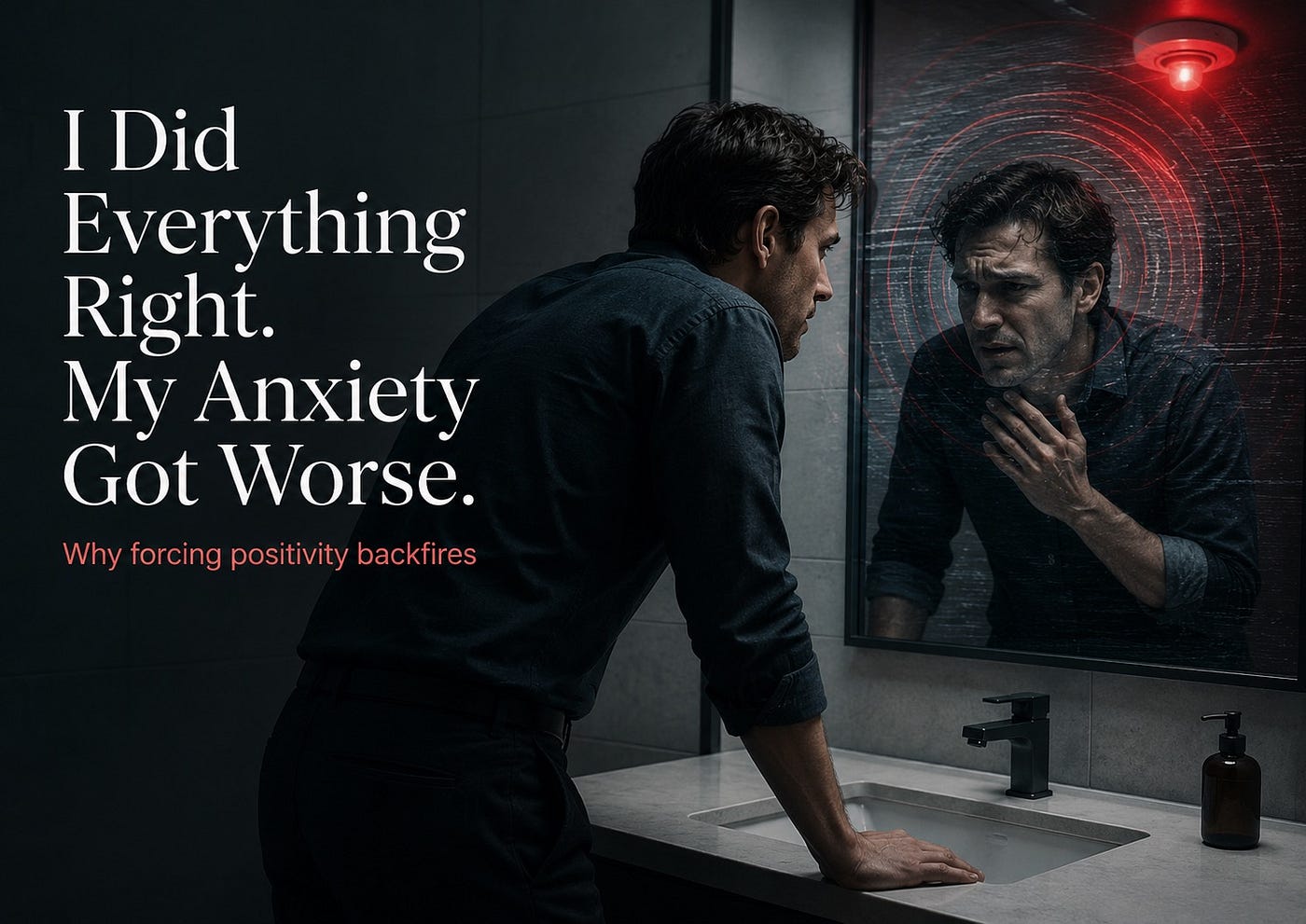
When calm becomes another performance, anxiety does not disappear. It gets louder. / Author created image using AI
There is a specific sound anxious people make in bathroom stalls. Not crying. Whispering.
“I am calm. I am fine. This is not a big deal.”
Three times, usually. Sometimes, with a hand pressed flat against the sink like it’s holding the sentence down. And every time, the heart rate climbs a little instead of dropping.
If you’ve made that sound, you weren’t doing anxiety wrong. You were arguing with a smoke detector.
The bar you can never clear
Somewhere along the way, positive thinking stopped being a mindset and became a mandate. Stay optimistic. Find the silver lining. Don’t give the bad feeling airtime, or it multiplies.
It sounds reasonable. It is also, according to a decade of research from UC Berkeley, often exactly the opposite.
Psychologist Iris Mauss ran a study that should worry the entire self-help industry. She found that people who placed a high value on being happy reported more depressive symptoms and lower well-being than people who didn’t fixate on happiness at all.
In a follow-up experiment, she primed one group to see happiness as important, then showed everyone a genuinely happy film clip. The group that had been told happiness mattered felt worse afterward. Not better. Worse.
The mechanism was disappointing. Once you set an internal bar for how good you’re supposed to feel, ordinary life rarely clears it. The gap between the standard and the reality becomes its own injury.
You don’t just fail to feel good. You fail at feeling good, on top of whatever you were already feeling.
Your body doesn’t know the difference
Positive thinking, in its most common form, isn’t really about generating a new feeling. It’s about shoving the old one down and standing a cheerful one in its place. Psychologists call this expressive suppression.
Researchers James Gross and Jane Richards at Stanford put this to the test. They asked people to suppress their emotional reactions while watching disturbing footage.
The suppressors’ heart rate and blood pressure spiked higher than those of the group that let their reactions show. Their memory for what happened during the footage got worse, too.
Suppression isn’t calm. It’s a workout. Your nervous system is bracing against something and performing “fine” at the same time, and it can’t tell the difference between a real threat and a feeling you’ve decided is inconvenient.
Other studies on suppression during conversation found something almost cruel: when one person hides how they’re actually feeling, the other person’s stress rises too, even though they can’t say why. You think you’re protecting the room. You’re leaking static into it instead.
The rebound nobody warns you about
Here’s the part that never makes it into the inspirational posts. Pushing a feeling away doesn’t erase it. It rehearses it.
Psychologist Daniel Wegner ran the famous “white bear” experiments decades ago. Tell someone not to think about a white bear, and the bear shows up more, not less, the moment they stop actively suppressing it.
Anxiety runs the same loop. Tell yourself not to think about the thing, and now you have to monitor for the thing constantly, just to keep not-thinking about it.
You cannot scan for a threat and rest at the same time. The body only has one setting for that.
This is the real engine behind what therapists now call toxic positivity. Not positivity itself. The demand that discomfort be replaced immediately, rather than being witnessed.
A friend who says “everything happens for a reason” thirty seconds after you share something painful is asking the feeling to leave the room. A friend who says “that sounds brutal” is letting it sit down. Only one of those actually helps it pass.
A different three minutes
Picture the bathroom stall again. Same person, same three minutes before the meeting. Different sentence.
“My body thinks this is dangerous. It isn’t. I can walk in there shaking and still do this well.”
Nothing about that manufacturer's calm. It does something more useful. It stops the argument.
That’s reappraisal, not suppression, and Gross’s research found it beats suppression on nearly every measure that matters: lower physiological stress, better memory, stronger connection to the people around you.
The second shift is acceptance. Research on experiential avoidance, the habit of trying to escape uncomfortable internal states, links it directly to higher rates of anxiety and depression. Therapies built on acceptance don’t aim for calm on command. They aim for willingness. Feel the anxious thing, and act anyway.
Paradoxically, that’s what tends to quiet it. The nervous system stops treating the feeling itself as an emergency.
What actually changes
You were never bad at positive thinking. You were handed a tool built to argue with a smoke detector, and told that if the alarm kept ringing, it was your fault for not arguing hard enough.
It wasn’t your fault. It was never going to work.
Let the alarm ring. Walk in anyway.
Sources
- Mauss, I. B., et al. (2011). Can Seeking Happiness Make People Happy? Paradoxical Effects of Valuing Happiness. Emotion.
- Richards, J. M., & Gross, J. J. (1999). Composure at Any Cost? The Cognitive Consequences of Emotion Suppression. Personality and Social Psychology Bulletin.
- Wegner, D. M., Schneider, D. J., Carter, S. R., & White, T. L. (1987). Paradoxical effects of thought suppression.Journal of Personality and Social Psychology.
Further reading to consider:
[embed]Your Bad Day Isn’t a Symptom You don’t need a diagnosis to believe your own feelings.medium.com
About the Author
Gary L. Fretwell is a #1 international best-selling author and practitioner of Intentional Living, blending neuroscience with Stoic philosophy to help creators and leaders build a life of lasting significance.
He’s the author of six books on intentional living and retirement, including the #1 international bestseller The Magic of a Moment, Intentional Retirement, Embracing Retirement, and Rewiring the Ring, which explores the cognitive science of tinnitus. His latest, The Identity Ghost, is a blueprint for designing a life of purpose through ancient wisdom and modern neuroscience.
On Medium, Gary founded and edits Illumination: Retirement, Aging & Legacy and Illumination Beyond Identity, and serves as an editor across the broader ILLUMINATION network.
Off the page, he serves as Board President for Prescott Meals on Wheels and mentors MBA students at Western Governors University.
📖 garyfretwell.com · 📬 The Wise Effort on Substack · ✍️ Follow on Medium
메타데이터
- post_id
- 54994f1cd4eb
- slug
- i-did-everything-right-my-anxiety-got-worse-54994f1cd4eb
- url
- https://medium.com/illumination-curated/i-did-everything-right-my-anxiety-got-worse-54994f1cd4eb
- canonical_url
- https://medium.com/illumination-curated/i-did-everything-right-my-anxiety-got-worse-54994f1cd4eb
- author_url
- https://medium.com/@gary_fretwell
- status
- ok
- fetched_at
- 2026-07-16 21:26:35