Beyond the Build
Beyond the Build

Technology is consuming our lives.
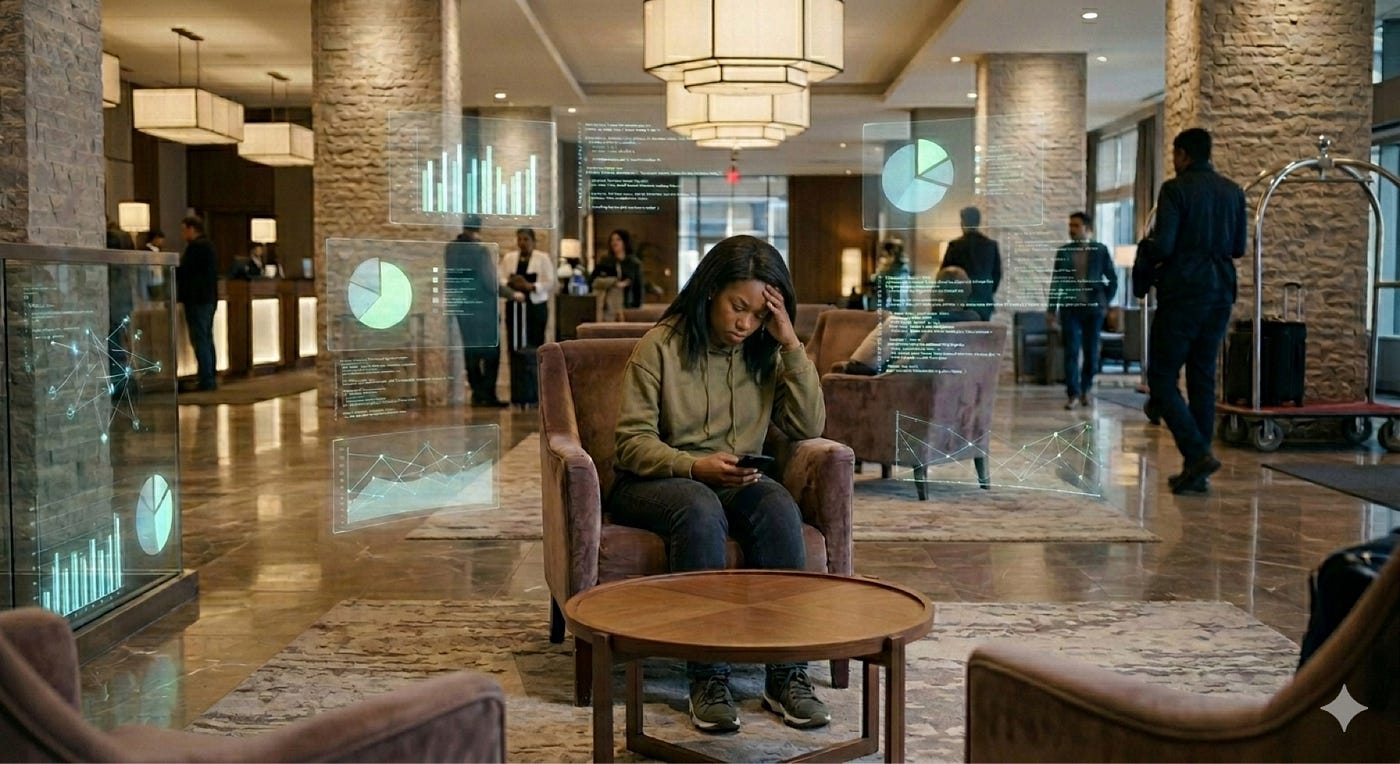
There is an app for almost everything now. Entertainment, banking, wellness, shopping, learning, relationships, productivity, even sleep. We move through our days tapping screens, speaking to platforms and trusting systems we barely think about anymore.
Then came AI.
Not the cold, robotic version we once imagined, but something far more immersive. AI that speaks naturally. AI that understands intent. AI that responds in ways that feel conversational, intuitive and increasingly human.
For brands and businesses, this changes the landscape entirely.
Consumers are no longer interacting with static systems. They are interacting with experiences. And in many cases, those experiences are happening across dozens of touchpoints in a single day. Notifications, chat interfaces, recommendation engines, voice assistants, automated support, personalised feeds… the volume is relentless.
In this environment, visibility alone means very little.
We grew up in an era where marketing was largely about awareness. If enough people saw your brand often enough, growth followed. That logic no longer holds the same power today. Consumers are overloaded, distracted and filtering constantly. Most messages disappear almost instantly.
The brands that break through now are not necessarily the loudest.
They are the clearest.
And that is where the conversation around brand building needs to evolve.
For years, organisations have treated brand builders as support functions sitting somewhere downstream from the “real” work. Engineering builds the product. Product teams shape the roadmap. Technology drives innovation. Brand and creative teams then enter later to package the story.
That hierarchy feels increasingly outdated.
Especially in a world where technology has become so advanced that most consumers no longer struggle with access, they struggle with understanding, trust and emotional connection.
The challenge is no longer simply building powerful technology.
The challenge is helping people make sense of it.
That requires a very different skill set.
The modern brand builder is not just someone designing campaigns or writing taglines. The best ones are translators between complexity and human behaviour. They take products filled with technical capability and frame them in ways people can emotionally relate to.
That work is far more strategic than many organisations acknowledge.
An engineer may build an exceptional AI-powered platform. But if nobody understands where it fits into their life, adoption slows. A product team may create something incredibly advanced, but if the experience feels intimidating, people hesitate. Features alone rarely change behaviour.
Human beings adopt what feels familiar, useful and emotionally safe.
That bridge between innovation and adoption is often built by brand strategists, storytellers, designers, communicators and cultural thinkers.
Yet we still undervalue that contribution.
In many companies, the reputational hierarchy remains heavily tilted towards technical capability. Engineers are seen as the architects of progress. Product builders are viewed as the creators of value. Meanwhile, the people responsible for shaping perception, simplifying complexity and driving cultural relevance are often treated as secondary.
That makes little sense in the current environment.
Particularly when the market is flooded with competing technologies that are becoming increasingly similar in capability.
The real differentiator now is not always what a product does.
It is how clearly people understand why it matters.
Look at the products and platforms that genuinely changed behaviour over the past decade. Very few succeeded purely because they were technologically superior. They succeeded because they made people feel comfortable adopting something new. They simplified the unfamiliar. They reduced friction. They made innovation feel accessible rather than overwhelming.
That is brand work.
Not surface-level aesthetics.
Not decorative marketing.
Strategic influence over adoption itself.
And in the AI era, this role becomes even more critical.
AI can generate content endlessly. It can automate communication. It can personalise interactions at scale. But AI alone cannot define meaning. It cannot decide what a brand should stand for. It cannot determine emotional positioning or cultural nuance with true conviction.
It can speak.
But it does not inherently know what deserves to be said.
That distinction matters more than organisations realise.
Consumers today are becoming increasingly sensitive to messaging that feels generic, manufactured or hollow. They want experiences that feel intentional. Human. Relevant to the way they actually live.
This is why the next generation of successful businesses will need to stop treating brand building as cosmetic work and start recognising it as commercial infrastructure.
The companies that win will be the ones where engineering, product and brand strategy sit at the same table from the beginning.
Not as separate worlds.
Not as competing functions.
But as interconnected disciplines shaping how technology enters people’s lives.
And perhaps that also means rethinking how we value creative and strategic talent internally.
Respect in organisations often follows measurable outputs. Engineers ship products. Developers solve visible technical problems. Their contribution is tangible and therefore easier to quantify.
Brand builders often influence outcomes in less direct but equally powerful ways. Trust. Adoption. Perception. Relevance. Emotional loyalty. Cultural fit. These are harder to measure neatly on a spreadsheet, yet they are often the very reasons products succeed or fail in crowded markets.
When every app starts looking similar…
When every platform claims to use AI…
When every service promises convenience…
The ability to create emotional clarity becomes a competitive advantage.
That deserves more recognition than it currently receives.
Perhaps even the same level of respect we instinctively give technical talent.
In a world saturated with technology, the real challenge is no longer building things people can use.
It is building things people want to let into their lives.
And increasingly, the people solving that challenge are the brand builders.
메타데이터
- post_id
- 5724d69dddbb
- slug
- beyond-the-build-5724d69dddbb
- url
- https://medium.com/@sanjinim/beyond-the-build-5724d69dddbb
- canonical_url
- https://medium.com/@sanjinim/beyond-the-build-5724d69dddbb
- author_url
- https://medium.com/@sanjinim
- status
- ok
- fetched_at
- 2026-06-27 23:56:40