The I.N.S.I.G.H.T.S. Brand Plan Framework: A Complete Guide for Indian Pharmaceutical Marketers
Introduction: Why Indian Pharma Needs a New Brand Planning Approach
The I.N.S.I.G.H.T.S. Brand Plan Framework: A Complete Guide for Indian Pharmaceutical Marketers
Introduction: Why Indian Pharma Needs a New Brand Planning Approach
The Indian pharmaceutical industry operates in a unique paradox.
We are the pharmacy of the world — producing 60% of global vaccines, supplying 40% of US generic demand, and manufacturing medicines for virtually every therapeutic category known to modern medicine.
Yet when it comes to marketing our own brands domestically, we often rely on frameworks borrowed from Western markets or, worse, no framework at all.
Consider the reality most Indian pharmaceutical brand managers face:
The Competitive Intensity: A single molecule like metformin has over 400 branded generic competitors. Atorvastatin has even more. In this environment, product differentiation is nearly impossible — everyone sells the same molecule with the same efficacy and the same approved claims.
The Access Challenge: The average meaningful interaction between a Medical Representative and a doctor has shrunk to 47 seconds. In that window, you’re expected to differentiate your brand from dozens of competitors.
The Channel Explosion: Post-COVID, pharmaceutical companies have rushed to add digital channels — email, WhatsApp, webinars, e-detailing, apps. But most have simply replicated their MR message across more touchpoints, creating omnichannel noise rather than orchestrated engagement.
The Measurement Trap: Success is still measured primarily by call averages and prescription share — lagging indicators that tell you what happened, not why or what to do next.
The Planning Ritual: Annual brand planning often devolves into a mechanical exercise — update the SWOT, adjust the targets, refresh the creative, add a patient support program, and hope for different results.
This isn’t strategy. It’s operational planning dressed up as strategy.
Read more:
[embed]**The One Question Your Brand Plan Doesn't Answer**
The I.N.S.I.G.H.T.S. Brand Plan Framework offers a different approach — one built specifically for the realities of Indian pharmaceutical marketing, integrating customer understanding, strategic differentiation, and orchestrated engagement into a coherent system.
What is the I.N.S.I.G.H.T.S. Framework?
I.N.S.I.G.H.T.S. is an eight-pillar brand planning framework designed for pharmaceutical marketers who want to move beyond operational competition toward genuine strategic differentiation.
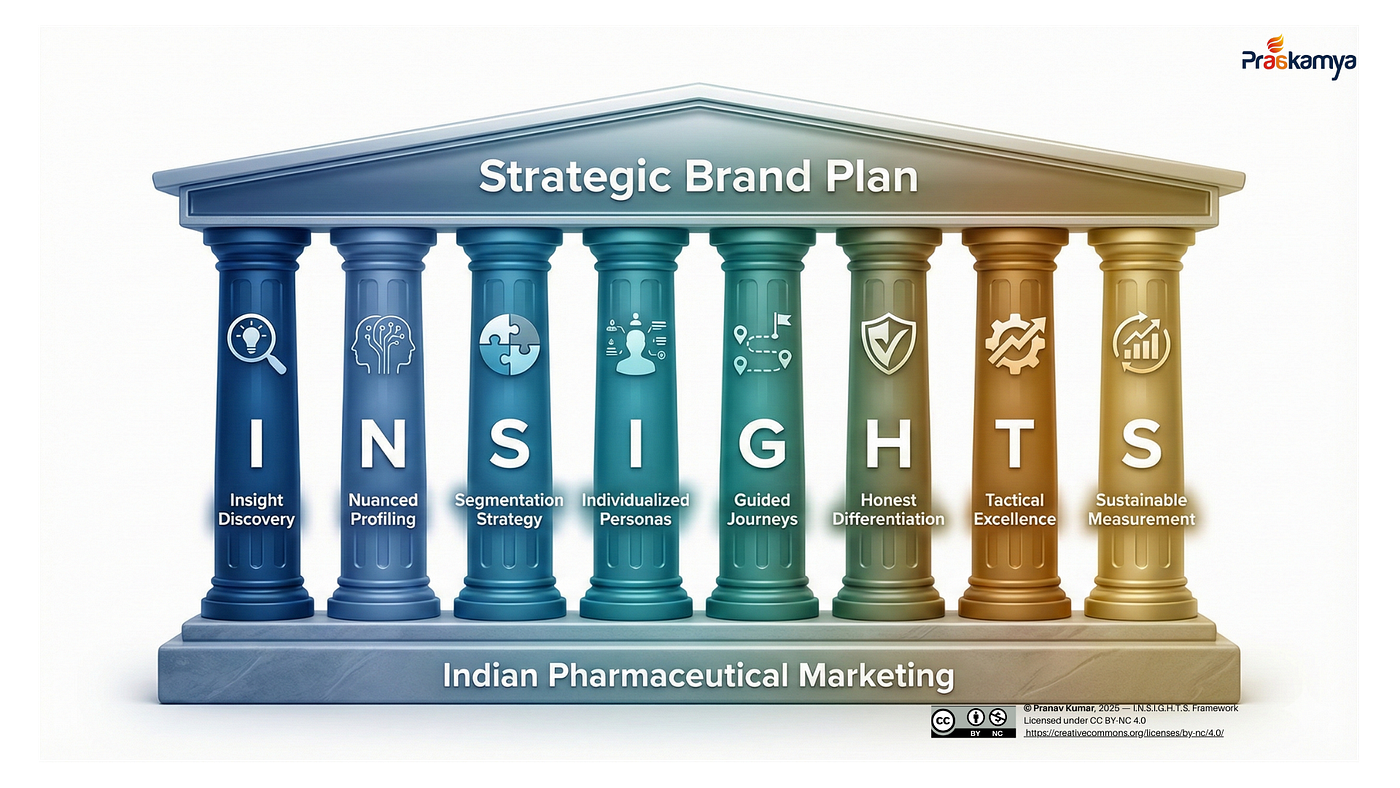
Each letter represents a critical pillar:
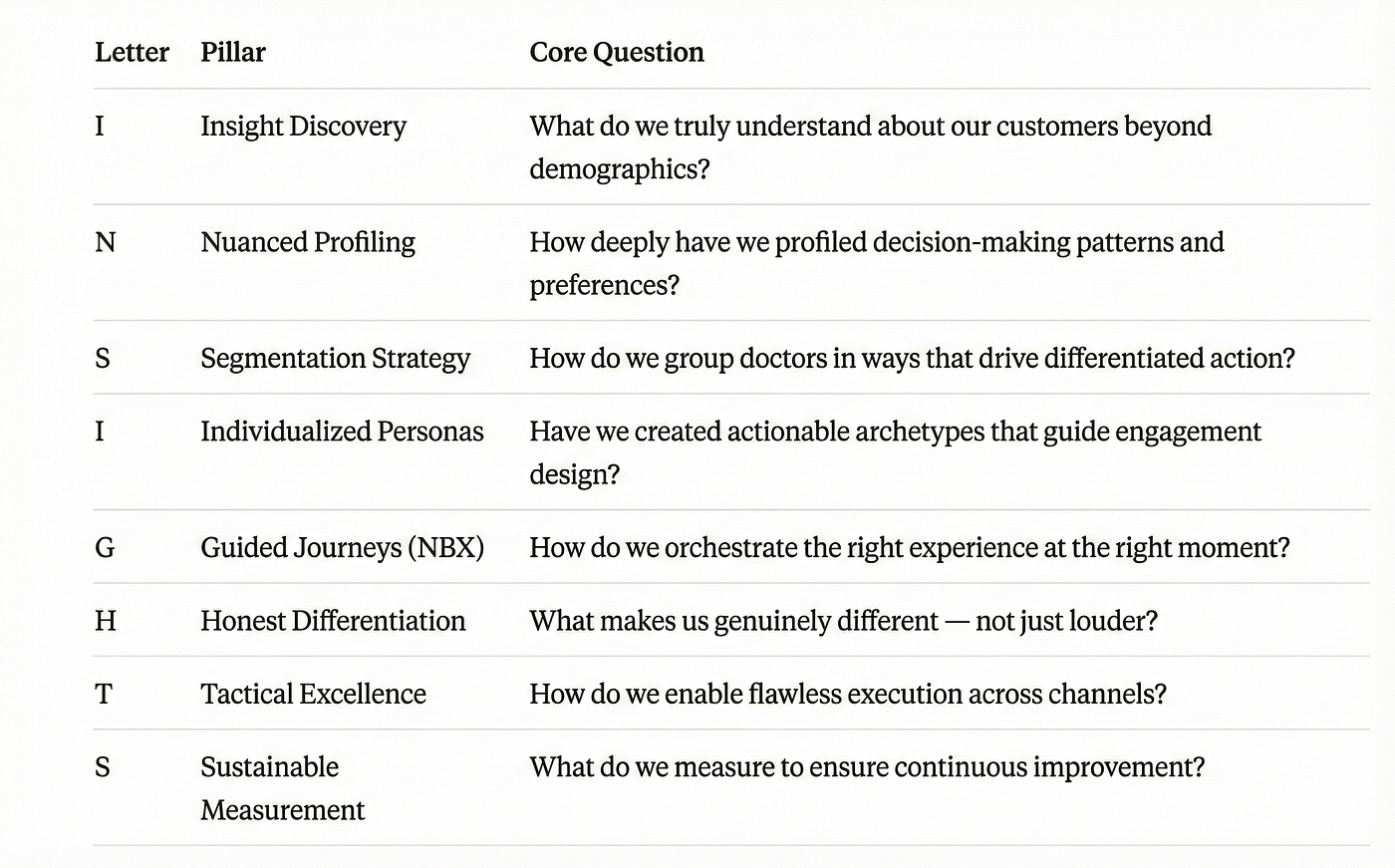
The framework flows logically: You cannot orchestrate journeys (G) without understanding personas (I). You cannot build personas without deep profiling (N). You cannot differentiate honestly (H) without knowing what customers actually value (I, N, S).
Each pillar builds on the previous ones, creating an integrated system rather than a collection of disconnected activities.
Let’s explore each pillar in depth.
Pillar 1: Insight Discovery — The Foundation of Everything
Core Question: What do we truly understand about our customers beyond demographics?
Most pharmaceutical brand plans begin with a customer section that looks something like this:
“Our primary target is cardiologists in metros and Tier-1 cities, with secondary coverage of general physicians. We will focus on high-prescribers (10+ Rx/month potential) in the cardiology segment.”
This is classification, not insight.
Classification tells you who to talk to. Insight tells you what to say and how to say it.
The Insight Gap
True insight answers questions like:
- What triggers a doctor to consider a new brand in this category?
- What concerns make them hesitate even when the data is compelling?
- What influences their prescribing beyond clinical evidence?
- How do they evaluate competing brands when efficacy claims are similar?
- What role do peers play in their decision-making?
- What practice challenges could your brand help solve — beyond the prescription?
These questions require primary research, not secondary data analysis. They require conversation, not just surveys. They require curiosity, not just confirmation.
Insight Discovery Methods
1. Ethnographic Observation
Spend a day in a doctor’s clinic — not detailing, just observing. Watch the patient flow. Notice the challenges. See how your brand (and competitors) are actually used. This generates insights no focus group can provide.
2. Deep-Dive Interviews
Go beyond structured questionnaires. Have open conversations with 20–30 doctors about their practice, their challenges, their decision-making process. Listen for what they don’t say as much as what they do.
3. MR Intelligence Mining
Your field force has thousands of daily conversations. Most of this intelligence evaporates because there’s no system to capture it. Create structured mechanisms to harvest insights from the field — not just call reports, but genuine observations about doctor behaviour, concerns, and preferences.
4. Digital Signal Analysis
If you have digital engagement data — email opens, webinar attendance, content downloads — analyse patterns. Which topics generate engagement? Which formats work for which doctors? What questions do they ask in webinars?
The Insight Canvas
Document insights in a structured format:
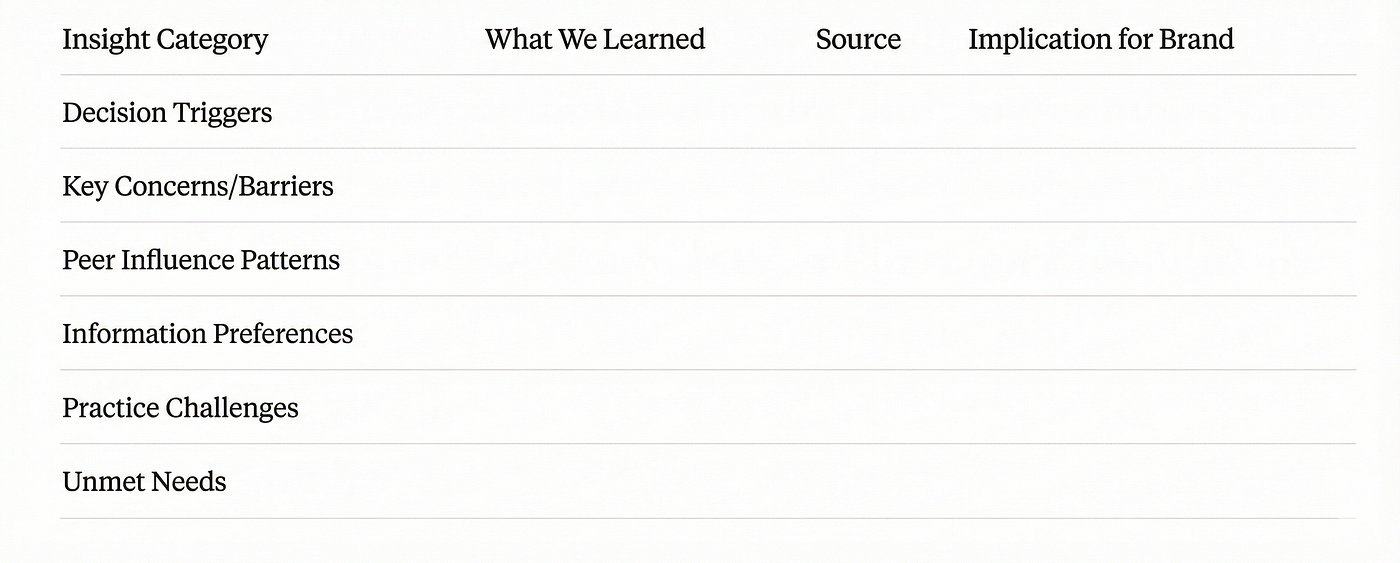
Insight Canvas
Pillar 2: Nuanced Profiling — Beyond Demographics and Potential
Core Question: How deeply have we profiled decision-making patterns and preferences?
Traditional pharmaceutical profiling focuses on two dimensions:
- Demographic/Practice Profile: Specialty, location, practice type, patient volume
- Prescription Potential: Current prescribing, category usage, brand share
This tells you how big a doctor is. It doesn’t tell you how they think.
The Psychographic Revolution
Nuanced profiling adds a third dimension: psychographic profiling — understanding how doctors make decisions, what they value, how they prefer to engage, and what influences them beyond data.
This includes:
Evidence Orientation
- How much clinical data do they need before prescribing?
- Do they want landmark trials or real-world evidence?
- How do they evaluate new data versus established practice?
Peer Influence Susceptibility
- Do they follow opinion leaders or trust their own experience?
- How connected are they to professional networks?
- Do they attend conferences? Participate in online communities?
Patient-Centricity
- How much weight do they give to patient affordability?
- Do they consider lifestyle factors in prescribing?
- How engaged are they with patient outcomes post-prescription?
Practice Efficiency Focus
- How time-pressed are they?
- Do they value efficiency over depth in engagement?
- What’s their tolerance for complexity in prescribing decisions?
Promotion Sensitivity
- How do they respond to promotional intensity?
- Do more touchpoints increase or decrease their receptivity?
- What’s their optimal engagement frequency?
Building the Profiling System
Profiling data can be gathered through:
- Structured Surveys: Administered through MRs or digital channels
- Behavioural Inference: Analysing engagement patterns (email response, webinar attendance, content consumption)
- MR Assessment: Trained observation by field force over multiple interactions
- Prescription Pattern Analysis: How prescribing behaviour correlates with engagement
The goal is to build a profile for each doctor that goes beyond “high-potential cardiologist in Mumbai” to something like:
“Dr. Sharma is an Evidence Seeker who requires substantial clinical data before adopting new therapies. He is moderately influenced by peers, particularly from his medical college network. He is highly patient-centric, often citing affordability concerns. He is promotion-sensitive — engagement beyond 4 touchpoints per quarter decreases his receptivity.”
This profile enables fundamentally different engagement than demographic classification alone.
Read More:
[embed]**Precision Profiling: From Demographic Data to Psychographic Intelligence**
Pillar 3: Segmentation Strategy — Groupings That Drive Action
Core Question: How do we group doctors in ways that drive differentiated action?
Segmentation is only valuable if different segments receive genuinely different treatment. If all segments get the same message through the same channels at the same frequency, segmentation is just an analytical exercise — not a strategic tool.
Beyond Potential-Based Segmentation
Traditional segmentation creates A/B/C classifications based on prescription potential:
- A Class: High potential, high frequency coverage
- B Class: Medium potential, medium frequency coverage
- C Class: Low potential, low frequency coverage
This drives resource allocation but not engagement differentiation. An A-class Evidence Seeker and an A-class Peer Validator both get high-frequency coverage — but they need completely different content, messages, and proof points.
Multi-Dimensional Segmentation
Effective segmentation combines:
- Value Dimension: Potential and current prescribing (traditional)
- Behavior Dimension: Engagement patterns and responsiveness
- Psychographic Dimension: Decision-making style and preferences
- Need Dimension: Practice challenges and unmet needs
This creates segments like:
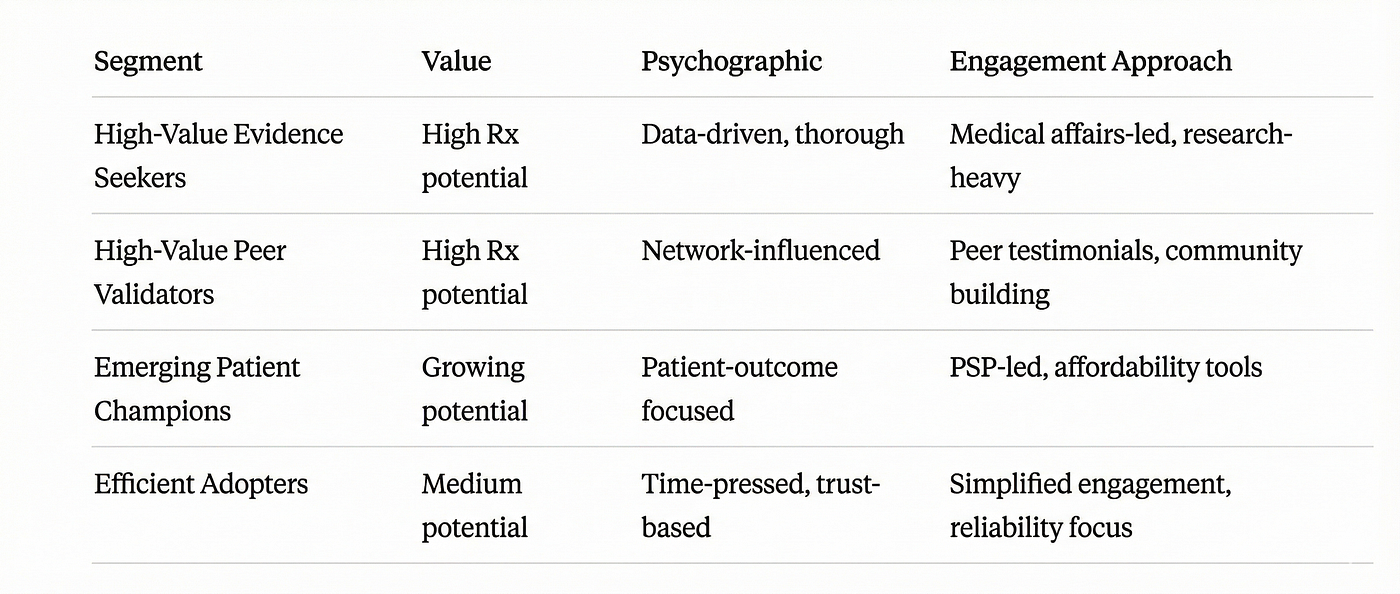
psychographic segment sample
Each segment receives a distinct strategy — not just different call frequencies, but different content, different proof points, different channels, different value propositions.
Pillar 4: Individualised Personas — Archetypes That Guide Design
Core Question: Have we created actionable archetypes that guide engagement design?
Segmentation tells you how to group doctors. Personas tell you how to design for them.
A persona is a composite archetype that brings a segment to life — giving it a face, a name, a story, and specific guidance for engagement.
The Four Core Physician Personas
Based on research across Indian pharmaceutical markets, four psychographic personas consistently emerge:
1. The Evidence Seeker
“Show me the data. All of it.”
- Requires comprehensive clinical evidence before prescribing
- Values landmark trials, meta-analyses, guideline recommendations
- Skeptical of promotional claims; trusts peer-reviewed sources
- Slower to adopt but highly loyal once convinced
- Prefers medical affairs engagement over promotional
Engagement Approach: Lead with science. Provide depth, not breadth. Respect their analytical process. Connect them with research, not just marketing.
2. The Peer Validator
“What are others doing?”
- Highly influenced by colleague behavior and expert opinions
- Values conference learning, peer discussions, KOL endorsements
- Adopts therapies that are gaining peer acceptance
- Active in medical associations and professional networks
Engagement Approach: Facilitate peer connections. Share adoption trends. Provide platform for colleague interaction. Leverage testimonials and case discussions.
3. The Patient Champion
“What’s best for my patients — all things considered?”
- Holistic view of therapy that includes affordability, adherence, lifestyle impact
- Deeply engaged with patient outcomes beyond the prescription
- Values patient support programs and compliance tools
- Considers socioeconomic realities in prescribing decisions
Engagement Approach: Lead with patient impact. Provide affordability solutions. Offer compliance support tools. Share real-world outcome data.
4. The Efficiency Optimizer
“I trust this brand. Don’t complicate it.”
- Values reliability and consistency over novelty
- Time-pressed; prefers streamlined engagement
- Loyal to established brands that have proven themselves
- Dislikes excessive promotion or complicated regimens
Engagement Approach: Respect their time. Provide predictable, low-friction engagement. Focus on reliability and supply consistency. Don’t over-promote.
Using Personas in Practice
Personas should guide:
- Content Development: Different content types for different personas
- Channel Selection: Preferred engagement channels by persona
- Message Framing: How to position the same product differently
- MR Briefing: Persona-specific conversation guides
- Campaign Design: Persona-appropriate touchpoint sequences
The goal is to move from “What do we want to tell doctors?” to “What does this type of doctor need to hear, and how?”
know more:
[embed]**From Profiles to Personas: Turning Doctor Data into Marketing Strategy**
Pillar 5: Guided Journeys — Next-Best-Experience Orchestration
Core Question: How do we orchestrate the right experience at the right moment?
This is where insight, profiling, segmentation, and personas translate into orchestrated engagement — what we call Next-Best-Experience (NBX).
The Omnichannel Illusion
Most pharmaceutical “omnichannel” is actually multi-channel broadcasting:
- Same message through MR
- Same message through email
- Same message through WhatsApp
- Same message through webinars
- Same message through e-detailing
This isn’t orchestration. It’s spam with extra steps.
True NBX means delivering the right interaction, at the right time, through the most effective channel, based on where the customer actually is in their journey.
The Three Orchestration Principles
1. Sequence Matters
A doctor who just attended a webinar on cardiovascular outcomes doesn’t need another awareness message. She needs a follow-up that acknowledges what she learned and offers the logical next step.
2. Timing Matters
Timing isn’t just clock time. It’s journey time. Where is the doctor in their decision process? Have they shown signals of interest? Of skepticism? Of readiness?
3. Trigger Matters
The best touchpoints aren’t scheduled — they’re triggered by behavior:
- Doctor downloads a clinical paper → Trigger: Offer a related webinar
- Doctor attends webinar but doesn’t engage with follow-up → Trigger: MR call to address concerns
- Prescription share drops → Trigger: Investigate, don’t promote harder
The Care-Before-Commerce Principle
Pehle seva, phir bechna. Service first, selling later.
Traditional pharmaceutical engagement leads with product promotion. NBX leads with value creation:
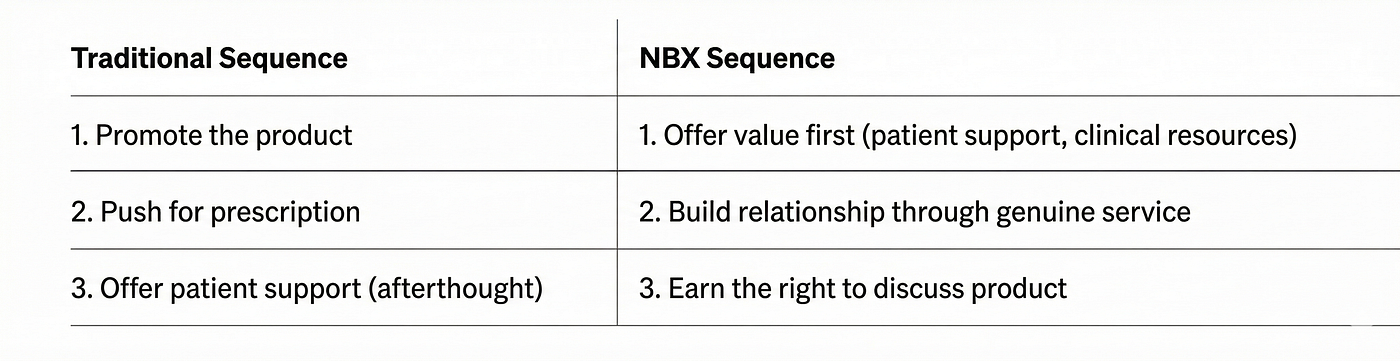
Difference between traditional and NBX
When your first touchpoint creates value for the doctor — before asking for anything — you transform from vendor to partner.
Promotion Sensitivity Scoring
Not all doctors respond to promotional intensity the same way:
- Promotion Receptive: Appreciate frequent engagement; more touchpoints = higher receptivity
- Promotion Sensitive: Prefer limited, high-value interactions; more touchpoints = lower receptivity
Applying the same frequency to both destroys value with one while leaving value on the table with the other.
Build a Promotion Sensitivity Score for each doctor based on:
- Historical engagement response patterns
- Behavioural signals (email opens, access changes)
- Prescription correlation with touchpoint frequency
- Explicit stated preferences
Then orchestrate accordingly.
know more:
[embed]**Next-Best-Experience - Why Your 'Omnichannel Strategy' Is Just Spam with Extra Steps**
Pillar 6: Honest Differentiation — Finding Your Blue Ocean
Core Question: What makes us genuinely different — not just louder?
This is perhaps the most challenging pillar, because it forces uncomfortable honesty about what we call “differentiation.”
The Differentiation Illusion
Most pharmaceutical differentiation is actually:
- Saying the same thing louder (more MR calls)
- Saying the same thing more often (higher frequency)
- Saying the same thing through more channels (omnichannel)
- Saying the same thing with prettier visuals (creative refresh)
- Saying the same thing with added services (PSP, adherence apps)
If competitors can replicate it within three months, it’s not differentiation. It’s operational competition.
The Blue Ocean Approach
Kim and Mauborgne’s Blue Ocean Strategy, largely ignored by pharmaceutical marketing, offers a powerful framework:
Instead of competing harder in crowded red oceans, create uncontested blue oceans by asking four questions:
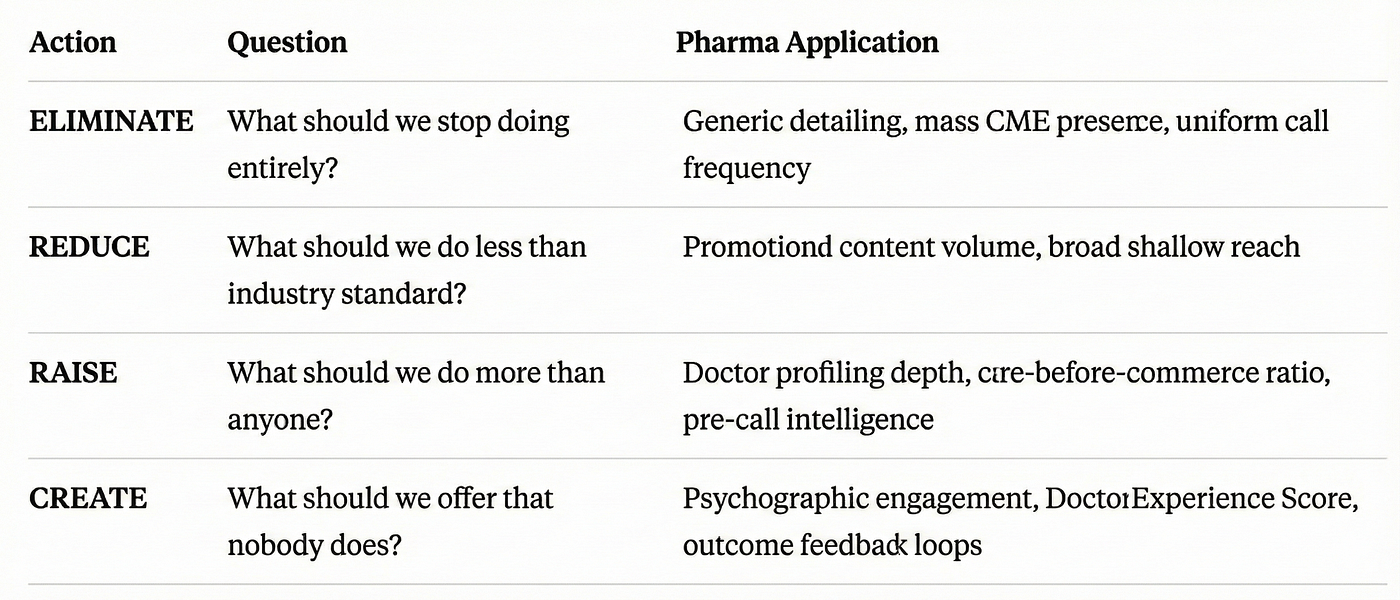
Blue Osean Canvas
The magic happens when all four are applied simultaneously — eliminating and reducing to cut costs while raising and creating to increase value.
The Three-Month Test
Before claiming differentiation, apply this test:
Can competitors copy it within three months?
- New visual identity? Yes → Not differentiation
- Patient adherence app? Yes → Not differentiation
- WhatsApp marketing? Yes → Not differentiation
- Psychographic engagement system built on 18 months of profiling? No → Real differentiation
Real differentiation takes time to build, which is precisely why it’s defensible.
Pillar 7: Tactical Excellence — Enabling Flawless Execution
Core Question: How do we enable flawless execution across channels?
Strategy without execution is hallucination. The best frameworks fail without operational excellence in implementation.
Field Force Enablement
The MR remains the primary channel in Indian pharmaceutical marketing. NBX doesn’t replace the MR — it supercharges them.
Pre-Call Intelligence:
Before every call, MRs should have access to:
- Doctor’s persona classification
- Recent digital engagement (emails opened, webinars attended)
- Prescription trends
- Promotion sensitivity score
- Recommended conversation approach
- Alerts (churn risk, competitive activity, special interests)
This transforms the MR from a message deliverer to an intelligent engagement partner.
Conversation Quality Focus:
Shift measurement from call quantity to call quality:
- Was the conversation persona-appropriate?
- Was insight captured and logged?
- Was the recommended approach followed?
- What was the doctor’s engagement level?
Continuous Capability Building:
MRs need new skills for NBX:
- Reading and using pre-call intelligence
- Adapting conversations by persona
- Capturing behavioral signals
- Moving from detailing to consulting
Content Strategy
Content should be:
- Persona-Mapped: Different content for different personas
- Journey-Staged: Different content for different stages
- Modular: Assembled and personalized at scale
- Channel-Optimized: Adapted for each channel’s strengths
The era of one visual aid for all doctors is over.
Technology Integration
NBX requires integrated systems:
- Unified Data Platform: Single view of each doctor across channels
- Marketing Automation: Trigger-based communication execution
- CRM/SFA Integration: Recommendations flowing to field force
- Analytics Layer: Continuous optimisation based on outcomes
Start with available tools. Prove value. Then invest in capability expansion.
Pillar 8: Sustainable Measurement — Beyond Call Average and Rx Share
Core Question: What do we measure to ensure continuous improvement?
Traditional pharmaceutical metrics are almost entirely lagging indicators:
- Prescription share (what happened)
- Call average (activity, not outcome)
- Sales vs. target (result, not driver)
These tell you the score. They don’t tell you how to play better.
The NBX Metrics Framework
Leading Indicators (Predictive):
- Engagement Quality Score by persona
- Trigger activation rate
- Care-to-commerce ratio
- Persona-appropriate interaction percentage
- Promotion sensitivity compliance rate
- Pre-call intelligence utilisation
Customer Health Indicators:
- Doctor Experience Score (DXS)
- Net Promoter Score (NPS) for brand engagement
- Access trend by segment
- Engagement response rates by channel
Outcome Indicators:
- Prescription initiation rate
- Churn rate (prescribers lost)
- Share of wallet growth
- Time to first prescription (new doctors)
The Doctor Experience Score
Perhaps the most important missing metric in pharmaceutical marketing: How do doctors experience engaging with your brand?
Create a simple periodic survey:
- How valuable do you find our engagement? (1–10)
- How relevant is our communication to your practice? (1–10)
- How differentiated is our approach versus other brands? (1–10)
- Would you recommend engaging with our brand to colleagues? (Yes/No)
Track this quarterly. Make it a KPI alongside prescription share.
Measurement Cadence:
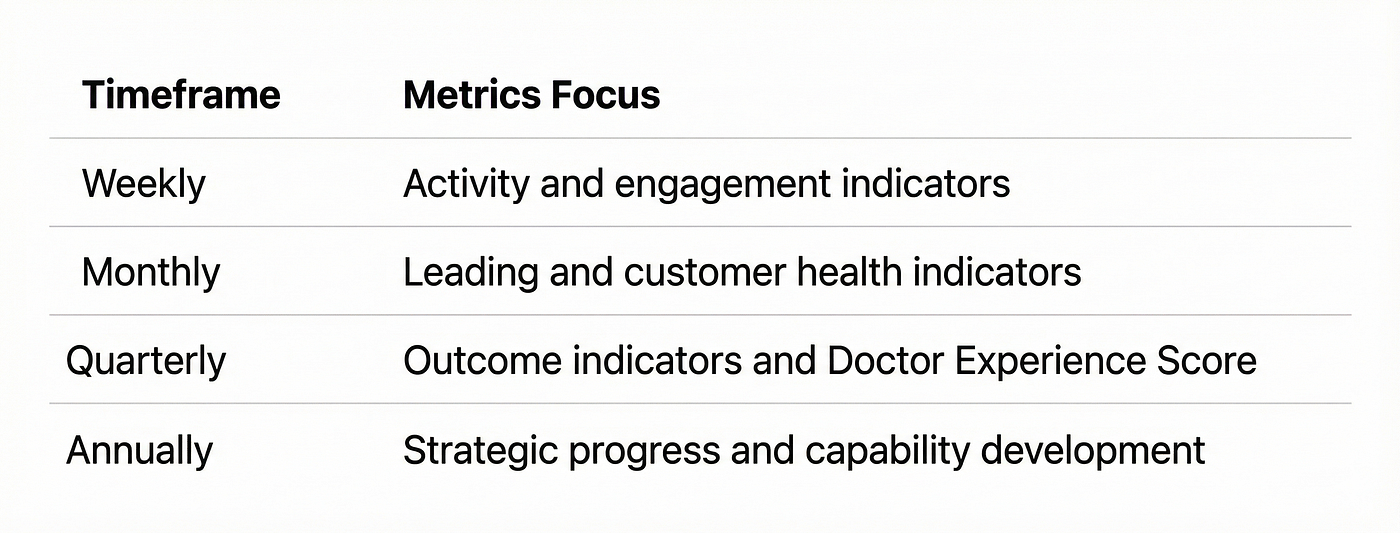
Measurement Cadence
Integrating the Eight Pillars: A Planning Process
The I.N.S.I.G.H.T.S. framework isn’t meant to be applied sequentially once a year. It’s an integrated system with different pillars activated at different frequencies.
Annual Brand Planning Cycle
Foundation Work (Annual):
- Insight Discovery refresh
- Segmentation strategy validation
- Persona refinement
- Blue Ocean strategy review
Campaign Planning (Quarterly):
- NBX journey design
- Content planning by persona and stage
- Channel mix optimisation
- Tactical execution planning
Continuous Operations (Ongoing):
- Pre-call intelligence delivery
- Trigger-based execution
- Field force enablement
- Real-time optimization
Cross-Functional Integration
The framework requires collaboration across:
- Brand Marketing: Strategy ownership, content development
- Sales/Field Force: Execution, intelligence capture
- Medical Affairs: Scientific engagement, KOL management
- Digital/Omnichannel: Channel orchestration, marketing automation
- Analytics: Data integration, measurement, optimisation
Silos kill I.N.S.I.G.H.T.S. The framework requires a unified view of the customer and coordinated action across functions.
Conclusion: The Choice Before Us
Indian pharmaceutical marketing stands at a crossroads.
One path leads deeper into the red ocean — more calls, more channels, more content, more noise. Fighting 436 competitors for 47 seconds of attention with the same messages everyone else uses.
The other path leads toward genuine strategic differentiation — understanding doctors as individuals, engaging them as partners, orchestrating experiences that create value, and building capabilities that competitors cannot easily replicate.
The I.N.S.I.G.H.T.S. framework offers a map for the second path.
It’s not easy. It requires investment in capability, patience for results, courage to eliminate what doesn’t work, and cross-functional collaboration that challenges organisational silos.
But for those willing to make the journey, the destination is worth it:
- Doctors who feel understood, not targeted
- Engagement that creates value, not noise
- Differentiation that lasts, not flash-in-the-pan tactics
- Relationships built on service, not just selling
Pehle samjho. Phir segement karo. Phir engage karo. Phir differentiate karo. Phir execute karo. Phir measure karo.
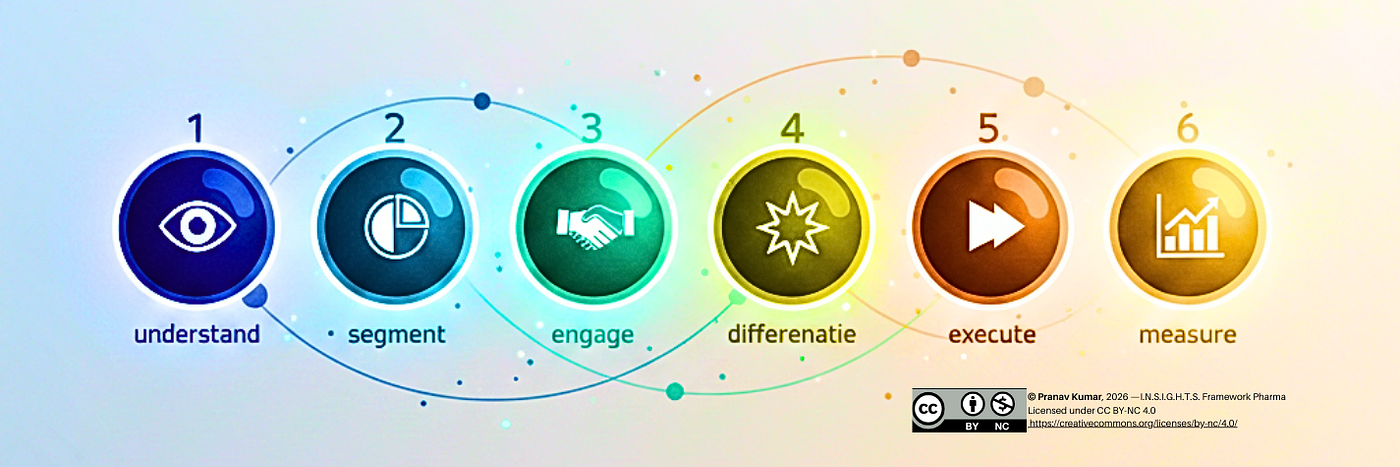
First understand. Then segment. Then engage. Then differentiate. Then execute. Then measure.
That’s I.N.S.I.G.H.T.S.
The blue ocean is waiting.
Resources and Tools
The following downloadable resources support I.N.S.I.G.H.T.S. implementation:
- **Doctor Persona Development Toolkit**
- **NBX Implementation Playbook**
- **Blue Ocean Strategy Canvas for Pharma**
- Strategic INSIGHTS Newsletter
Pranav Kumar is Chief Experience Designer at Praakamya CX Designers and was Chair of CXPA Asia Pacific from 2023 to 2025. With over 30 years of pharmaceutical industry experience spanning sales, marketing, and consulting, he developed the I.N.S.I.G.H.T.S. framework to address the unique challenges of Indian pharmaceutical brand planning. For workshops, consulting, and implementation support, contact pranav@praakamya.com
메타데이터
- post_id
- 64b640f2a23b
- slug
- the-i-n-s-i-g-h-t-s-brand-plan-framework-a-complete-guide-for-indian-pharmaceutical-marketers-64b640f2a23b
- url
- https://medium.com/customer-centricity-in-life-sciences/the-i-n-s-i-g-h-t-s-brand-plan-framework-a-complete-guide-for-indian-pharmaceutical-marketers-64b640f2a23b
- canonical_url
- https://medium.com/customer-centricity-in-life-sciences/the-i-n-s-i-g-h-t-s-brand-plan-framework-a-complete-guide-for-indian-pharmaceutical-marketers-64b640f2a23b
- author_url
- https://medium.com/@pranavcx
- status
- ok
- fetched_at
- 2026-06-25 07:00:49




