From Instruction to Identity. When learning stops being delivered and starts becoming lived
There is a moment in learning that rarely gets attention. It is quiet, almost invisible, and yet it changes everything.
From Instruction to Identity. When learning stops being delivered and starts becoming lived
There is a moment in learning that rarely gets attention. It is quiet, almost invisible, and yet it changes everything.
A student is working through an assignment, following steps, trying to get it right. Then something shifts. The question is no longer “is this correct?” but something more uncertain, more personal, “what am I actually doing here?” That is the point where learning stops behaving like instruction and starts behaving like experience.
Most education moves between two forces. One is the need for clarity, structure and direction. The other is the reality that real learning rarely stays within those boundaries. It bends, resists, loops back, and sometimes refuses to follow the plan.
We tend to treat this as a tension to solve. But it might be better understood as the space where learning actually happens.
Structure is often the first encounter. Explicit Direct Instruction gives learners something to hold on to. It reduces uncertainty, makes expectations visible, and creates a shared starting point. For many learners, especially when knowledge is new or complex, that clarity is not optional. It is what makes entry possible at all.
Yet structure also has a limit. It can show how to proceed, but it rarely explains why something matters beyond the task itself. At some point, repetition is no longer enough, and following steps no longer leads to understanding that feels alive. Then learning begins to move.
In maker education and design-based learning, that movement often appears through breakdowns. A prototype fails. An idea does not hold. A solution works in theory but not in reality. What looked stable becomes unstable.
Design thinking does not remove that instability. It works inside it. Empathy becomes necessary because assumptions no longer hold. Prototyping becomes a way of thinking rather than a step in a process. Testing becomes a conversation with reality rather than a final check.
Learning becomes iterative. Not a straight line, but a cycle of trying, adjusting, and trying again. And somewhere inside that cycle, something subtle begins to happen. Students stop asking only whether their solution works and start noticing how they are approaching problems in the first place. That is where reflection deepens.
It is no longer only about improving what is in front of them. It becomes a question about the thinking behind it. Why this idea? Why this assumption? Why this direction and not another?
This shift is often uncomfortable. It slows things down. It removes certainty as something to rely on. But it also opens a different kind of understanding, one that is no longer tied only to performance. And then the focus shifts again.
At a certain point, learning is no longer just about the task or even the thinking process. It becomes something more internal. Students begin to recognise patterns in how they learn. Some move quickly into experimentation, others need structure first, some avoid uncertainty, others depend on it.
The question quietly changes again, this time turning inward: who am I as a learner in this process? That is where learning starts to touch identity. Not as a concept, but as something that forms through experience. Confidence, hesitation, curiosity, resistance, all of it becomes part of how someone relates to learning itself.
From there, another possibility opens. Learning is no longer only something you follow or participate in. It becomes something you begin to shape. Not just what you learn, but how you learn, why you learn, and what direction it takes.
At that point, the role of teaching also shifts. Not away from guidance, but away from control. The teacher becomes someone who creates conditions, asks questions that disrupt certainty, and holds space for learners to stay with complexity without rushing it away.
There is still structure. There is still exploration. There is still reflection. But they are no longer separate stages. They begin to overlap, to interact, to form a layered system where each part influences the others.
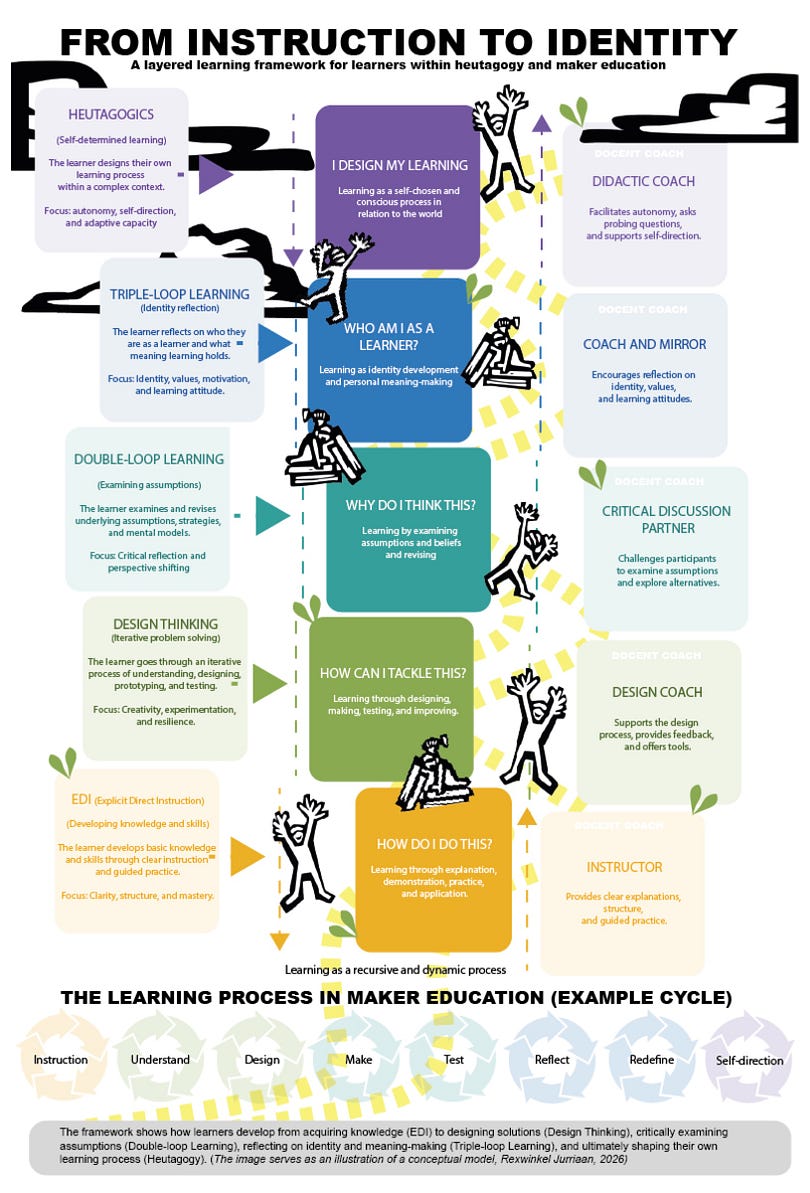
Explicit instruction creates entry. Design thinking creates movement. Reflection creates depth. Identity shapes direction. And self-determined learning brings it together in a way that cannot be fully planned in advance.
What emerges is not a method, but a shift in how learning is understood. Not as something that is delivered, but as something that is gradually taken over by the learner themselves. And at that point, learning is no longer just about understanding something new. It becomes about becoming someone who can keep learning in a world that does not stay still.
A more extended academic version of this perspective on heutagogy and maker education is available on Academia.edu (Rexwinkel, 2026).

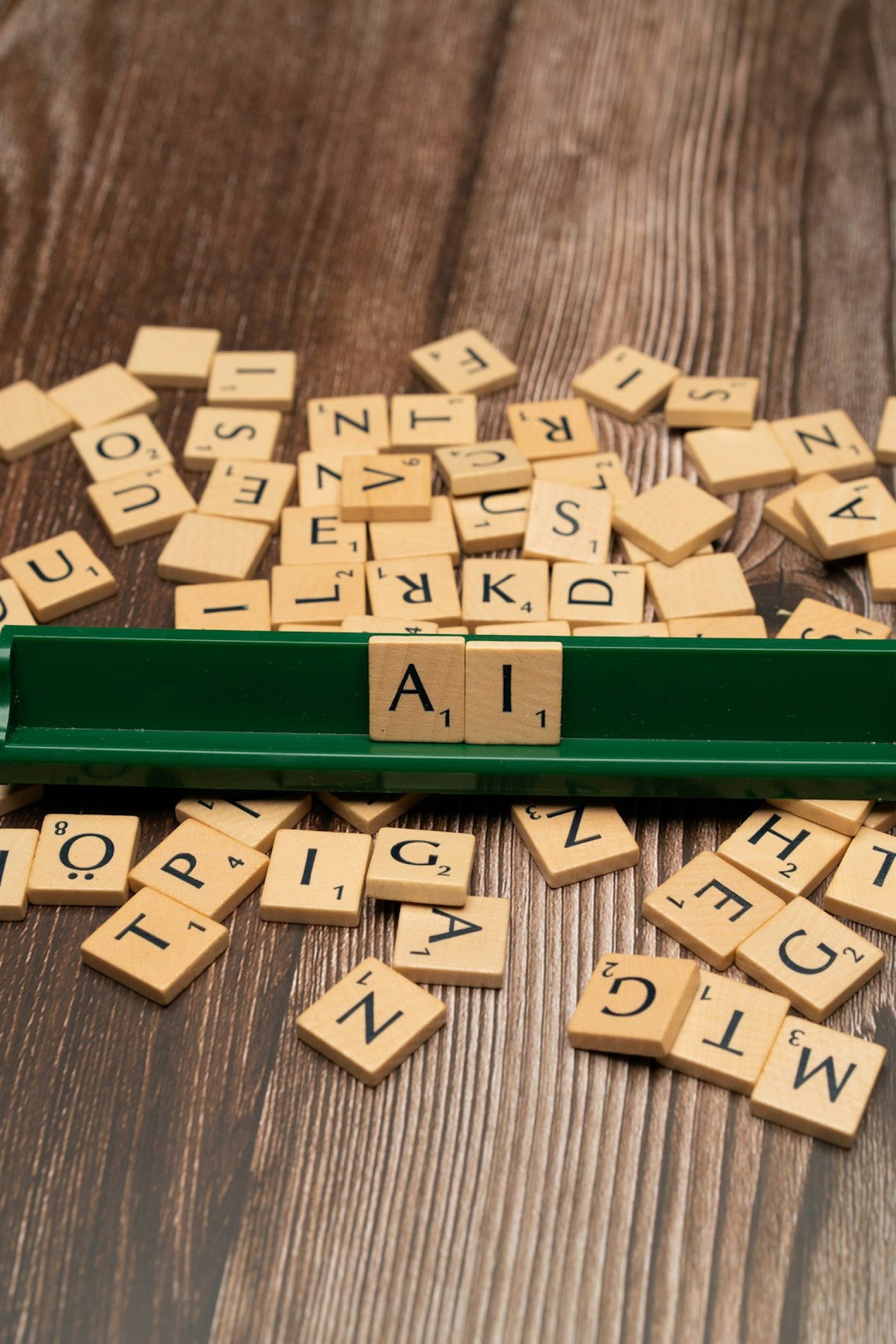
Photo by Eden Constantino on Unsplash
메타데이터
- post_id
- 6578b7cf2ccc
- slug
- from-instruction-to-identity-when-learning-stops-being-delivered-and-starts-becoming-lived-6578b7cf2ccc
- url
- https://medium.com/educreation/from-instruction-to-identity-when-learning-stops-being-delivered-and-starts-becoming-lived-6578b7cf2ccc
- canonical_url
- https://medium.com/educreation/from-instruction-to-identity-when-learning-stops-being-delivered-and-starts-becoming-lived-6578b7cf2ccc
- author_url
- https://medium.com/@rexwinkel
- status
- ok
- fetched_at
- 2026-06-11 05:11:55