Why Do I Judge Myself So Much At Night?
The exhaustion isn’t from today being bad. It’s from grading yourself every single night.
Why Do I Judge Myself So Much At Night?
The exhaustion isn’t from today being bad. It’s from grading yourself every single night.
So far this week: Monday: the night that wouldn’t end. Tuesday: the emptiness after the screen goes dark. Wednesday: the meetings the mind holds at 2am — and how to stop attending. Today: the question underneath all of it. Why does every day have to mean something? Who decided that?
Deep in the night. In bed.
Running through the day.
What did I actually accomplish? Did anything move forward? Was today worth it?
The verdict comes back: not enough.
And that verdict — that quiet, private, nightly verdict — is what sent you to the phone in the first place. Not boredom. Not habit. The need to escape the courtroom that opens every time the room goes quiet.
I want to ask something.
That question — was today meaningful? — who asked it?
Not your employer. Not your family. Not anyone who was watching.
You asked it. Quietly, automatically, every night, without ever deciding to. A scorecard that appears at bedtime, every bedtime, demanding to be filled in.
And when the score comes back low, the emptiness arrives. The phone comes out. The thumb moves. Hours pass.
When did every day become something that had to be earned?
You’re not awake because today was bad. You’re awake because you’re grading it. And the grading never stops.
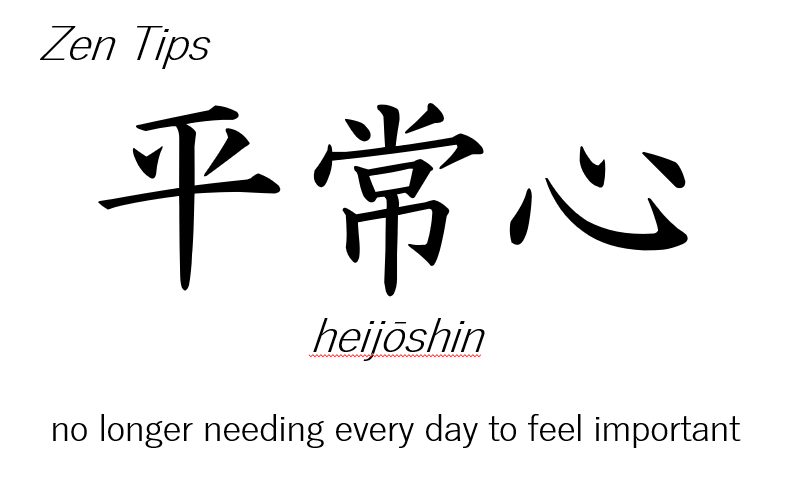
Zen has a phrase that cuts directly through this: heijōshin.
It’s often translated as “a calm, steady mind” — but that’s not quite it. The deeper meaning is closer to: a mind that has stopped trying to be special.
Heijōshin wa dō — the ordinary mind is the way. Not the improved mind. Not the productive mind. Not the mind that made today count. The ordinary one. The one that is simply here, at the end of a day that happened.
We have quietly turned every day into a performance review. Did I grow today? Was I productive? Am I ahead of where I was yesterday? Did I use my time well?
When the answer is yes, we feel relief. When the answer is no — or when we can’t tell — the emptiness moves in. And since the answer can’t always be yes, the emptiness keeps returning.
Zen says: put the scorecard down.
Today ended. Not: today was good. Not: today was meaningful. Just — today ended. The day ran its course. Night came, the way night always comes, regardless of what the day contained.
An ordinary night is not a failure. A quiet day is not a wasted one. A life built mostly from unremarkable evenings is still a life.
You don’t have to make every day count. Some days just pass. That’s allowed. That’s most of them, for most people.
Tonight, when the scorecard appears — and it will — try saying just this:
Today ended.
Not a grade. Not a verdict. Just a fact. The day is over. You were in it. It’s done.
An ordinary night doesn’t need to be fixed. It just needs to be allowed.
Heijōshin. The ordinary mind is the way. Not the exceptional one. Not the one that made today matter. Just — this one. Here. At the end of a day that was enough simply by having happened.
Tomorrow, the last of this week. The feeling at 2am that you are empty — and why that feeling is not who you are. It’s only passing through.
메타데이터
- post_id
- 6b0b9f3f474f
- slug
- why-do-i-judge-myself-so-much-at-night-6b0b9f3f474f
- url
- https://medium.com/@sorainner/why-do-i-judge-myself-so-much-at-night-6b0b9f3f474f
- canonical_url
- https://medium.com/@sorainner/why-do-i-judge-myself-so-much-at-night-6b0b9f3f474f
- author_url
- https://medium.com/@sorainner
- status
- ok
- fetched_at
- 2026-06-12 07:40:50