🇬🇧 Shoulder Osteoarthritis: Understanding Omarthrosis and Restoring More Comfortable Movement…
Omarthrosis, also known as shoulder osteoarthritis, is the progressive wear and degeneration of the cartilage within the shoulder joint…
🇬🇧 Shoulder Osteoarthritis: Understanding Omarthrosis and Restoring More Comfortable Movement Through Pilates
Omarthrosis, also known as shoulder osteoarthritis, is the progressive wear and degeneration of the cartilage within the shoulder joint. Like all forms of osteoarthritis, it leads to a reduction in joint gliding quality, stiffness, deep aching pain in some cases, and a gradual loss of mobility. In the STOTT PILATES® Injuries & Special Populations materials, osteoarthritis is described as a process involving degeneration, erosion, and deterioration of the entire joint, requiring gentle, progressive exercise that avoids excessive compression.
Studio Biopilates Paris
An Extremely Mobile and Demanding Joint
The shoulder is one of the most mobile joints in the human body. It allows the arm to move in nearly every direction in space. This remarkable freedom depends on a delicate balance between the humeral head, the glenoid fossa of the scapula, the joint capsule, the ligaments, the rotator cuff, and the muscles responsible for scapular control.
When osteoarthritis develops, this balance is disrupted. Movement becomes less fluid, sometimes painful, and the body naturally begins to compensate. A person may elevate the shoulder, tighten the neck, restrict breathing, or alter overall posture to avoid discomfort.
The Different Types of Omarthrosis
Two primary forms of shoulder osteoarthritis are commonly recognized: centered and eccentric omarthrosis.
In centered omarthrosis, the humeral head remains relatively well positioned within the glenoid cavity despite progressive cartilage wear. In eccentric omarthrosis, the humeral head no longer remains properly centered, often due to insufficiency or previous rupture of the rotator cuff.
This distinction is important because it influences rehabilitation strategies. A shoulder with osteoarthritis and a functional rotator cuff will not be approached in the same way as an arthritic shoulder that lacks adequate active stabilization.
Causes and Risk Factors
Omarthrosis may develop naturally with aging, but it can also result from previous trauma, shoulder dislocations, fractures, repetitive activities, excessive mechanical stress, or old rotator cuff injuries. Some individuals develop secondary osteoarthritis after years of postural compensation or muscular imbalance.
The problem is not simply cartilage degeneration. It is also the way the shoulder continues to move around that degeneration. Poor scapular control, thoracic stiffness, excessive tension in the upper trapezius, or weakness of the stabilizing muscles may all increase joint stress.
Common Symptoms
Shoulder osteoarthritis often presents as a deep ache within the shoulder joint, sometimes radiating into the arm. Stiffness is common, particularly in the morning or after periods of inactivity. Everyday tasks may become challenging, such as lifting the arm overhead, putting on a jacket, fastening a bra, carrying a bag, or reaching for an object on a high shelf.
Grinding sensations, loss of strength, and feelings of restriction may also occur. Pain may decrease with gentle movement but return after prolonged or excessive activity.
Medical Diagnosis
Diagnosis belongs to the medical professional. It is based on the clinical examination, patient history, assessment of mobility, pain, strength, and overall function. Imaging studies such as X-rays can reveal joint space narrowing, osteophytes, and bony changes. MRI or CT arthrograms may be prescribed when further evaluation of the rotator cuff or surrounding tissues is required.
For a Pilates instructor, the role is never to diagnose or medically treat the condition. The instructor’s responsibility is to facilitate movement safely, in collaboration with the physician or physical therapist, while respecting pain levels, functional limitations, and contraindications.
The Pilates Approach: Moving Without Compression
With shoulder osteoarthritis, Pilates should prioritize quality over range. The objective is not to force movement or gain additional degrees of motion at all costs. Instead, the goal is to restore control, improve breathing mechanics, mobilize the thoracic spine, organize scapular movement, and gradually strengthen the stabilizing muscles.
All movement should remain within a pain-free range. Loads should be light, lever lengths reduced, and movement performed slowly and precisely. One essential guideline is simple: if pain increases during the session or persists for more than two hours afterward, the program was too demanding.

Biopilates By Caroline
Pilates Protocol by Equipment
Reformer
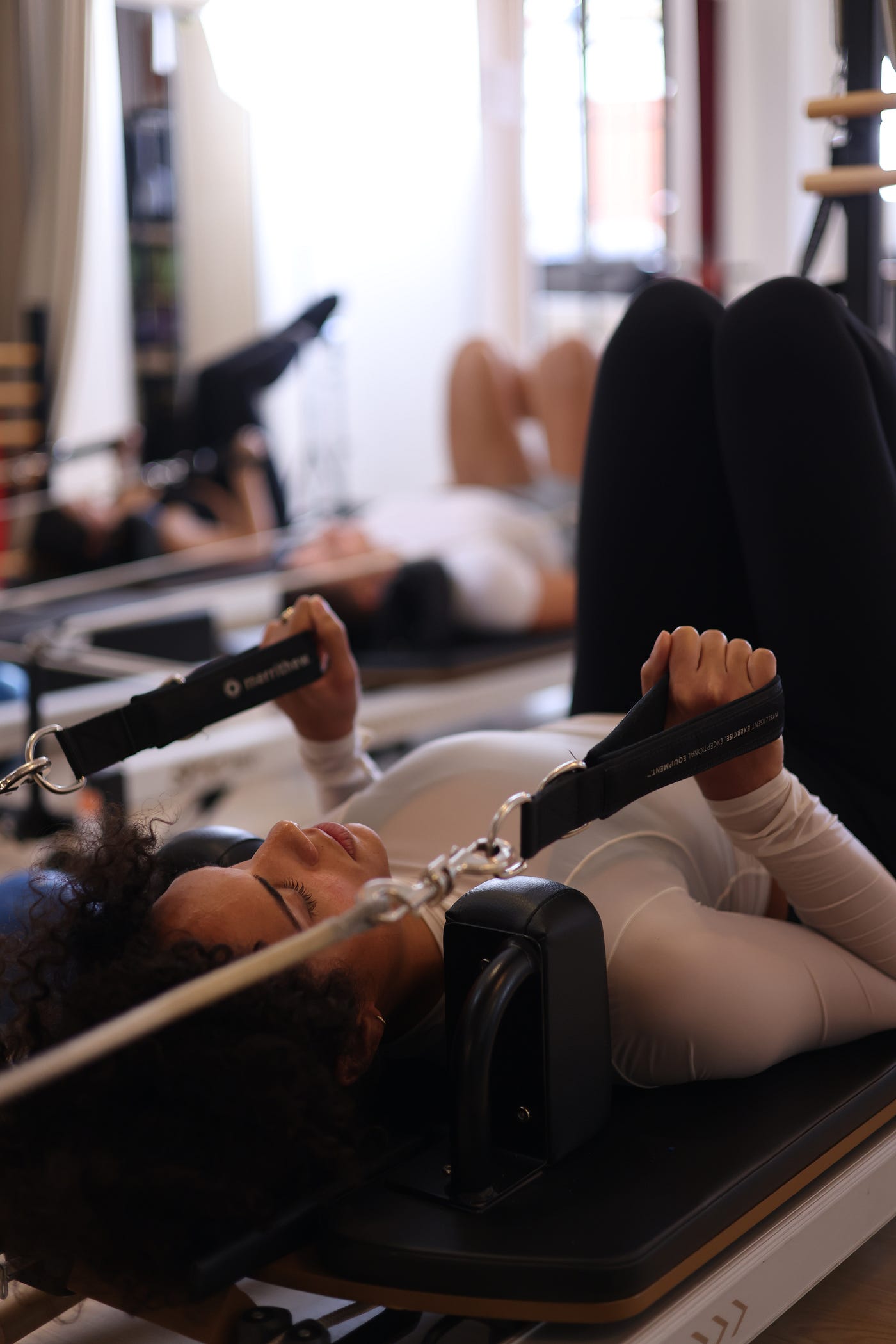
Arm work with straps performed in a supine position can be introduced using very light springs to restore controlled shoulder mobility. Movements should remain small and fluid, avoiding unnecessary elevation of the shoulder toward the ear while maintaining awareness of rib cage and scapular positioning.
Matwork
Arm circles performed in a supine position are particularly useful. This exercise helps the client understand the relationship between the arm, the scapula, and the rib cage without introducing excessive loading. The emphasis remains on maintaining a relaxed neck and stable ribs.
Cadillac
Arm spring work in sitting or supine positions is especially valuable because the springs assist the movement. Light biceps curls or gentle chest press variations can be introduced while focusing on symmetry, fluidity, and the absence of joint compression.
Stability Chair
On the Stability Chair, a very light press-down using the hands may be appropriate when weight-bearing is tolerated. The movement should originate from organized scapular stability rather than forceful pushing through the arms. Small ranges of motion are preferable initially.
Spine Corrector
The Spine Corrector can help gently open the thoracic cage. In supported positions, clients can focus on lateral thoracic breathing and small arm movements, reducing cervical tension while improving upper thoracic mobility.
Ladder Barrel
The Ladder Barrel provides an excellent environment for gentle thoracic opening. Large shoulder ranges are unnecessary. Instead, the objective is to restore thoracic mobility so the shoulder does not compensate for stiffness elsewhere in the body.
Arc Barrel
The Arc Barrel supports the spine and places the body in a comfortable position. Small arm arcs can be introduced with light, controlled movement while remaining entirely within a pain-free range. It is an excellent tool for combining breathing, thoracic mobility, and shoulder relaxation.
Spine Supporter
The Spine Supporter is useful when significant support is required. In a semi-reclined position, arm movements become less demanding. Breathing exercises, head placement awareness, neck relaxation, and gentle shoulder mobilization can be performed without excessive fatigue.
Conclusion
Omarthrosis is not simply a matter of joint wear. It represents a complex interaction between pain, mobility, posture, strength, and confidence in movement. When appropriately adapted, Pilates can help maintain function, reduce compensatory patterns, and support a more comfortable relationship with movement. The key is never to force, always to respect the medical diagnosis, and to build an individualized, progressive program that remains deeply attentive to the client’s sensations and capabilities.
메타데이터
- post_id
- 6bb52ac2d4f3
- slug
- shoulder-osteoarthritis-understanding-omarthrosis-and-restoring-more-comfortable-movement-6bb52ac2d4f3
- url
- https://medium.com/@carolinebergerdefemynie/shoulder-osteoarthritis-understanding-omarthrosis-and-restoring-more-comfortable-movement-6bb52ac2d4f3
- canonical_url
- https://medium.com/@carolinebergerdefemynie/shoulder-osteoarthritis-understanding-omarthrosis-and-restoring-more-comfortable-movement-6bb52ac2d4f3
- author_url
- https://medium.com/@carolinebergerdefemynie
- status
- ok
- fetched_at
- 2026-06-10 08:17:25