Why Customers Leave Without Complaining (The Trust Deficit 70% of Brands Ignore)
Photo by Sanni Abiodun Joshua
Why Customers Leave Without Complaining (The Trust Deficit 70% of Brands Ignore)
Sanni Abiodun Joshua
Brand Strategist | Customer Trust and Retention Specialist)
The hidden reason behind declining retention, rising acquisition costs, and silent customer churn.
There’s a version of revenue loss that never shows up as a complaint.
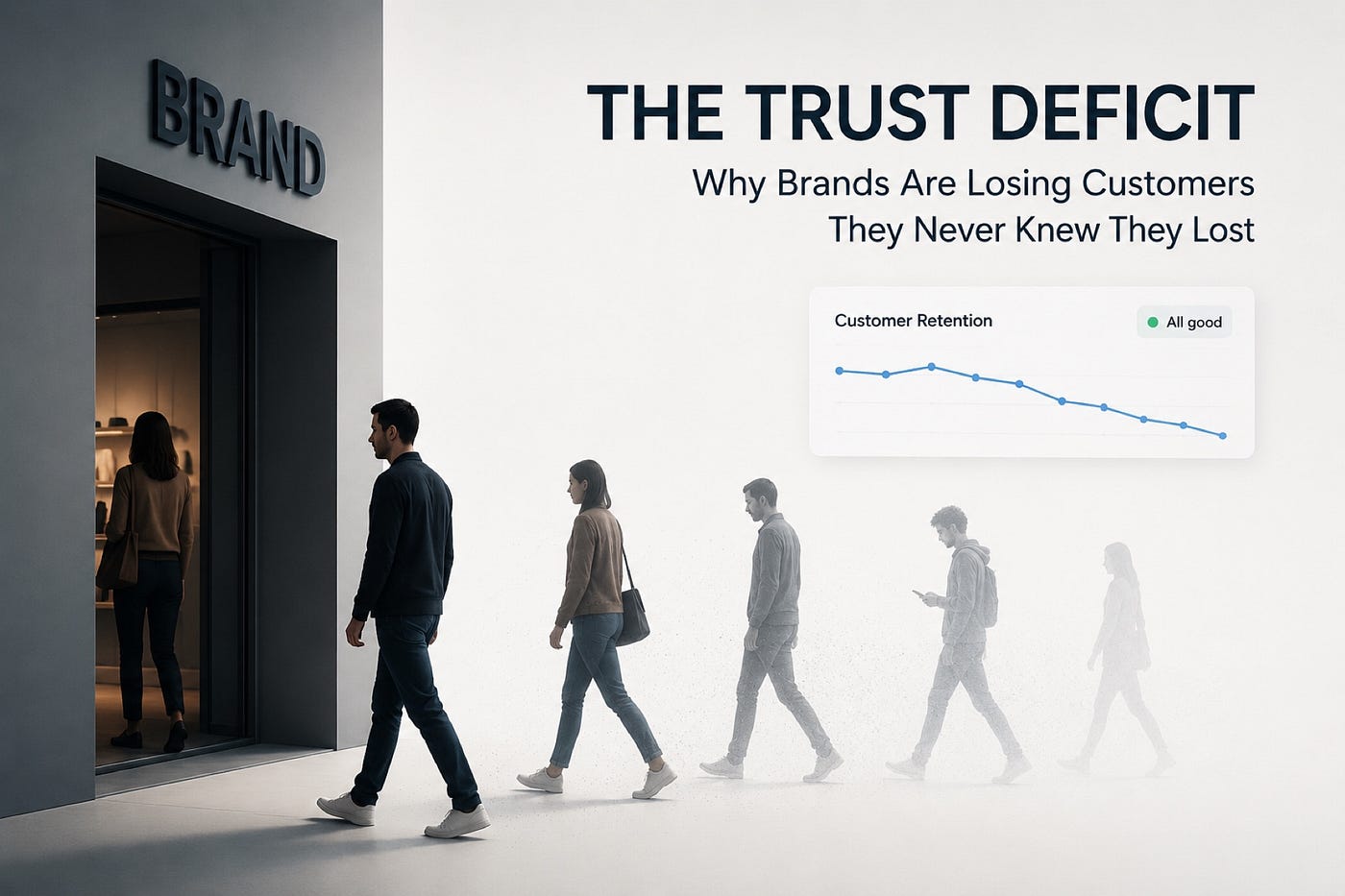
It doesn’t come with angry emails or public backlash. No one tags your brand, No one asks for a refund. On your dashboard, everything looks normal enough to ignore. Traffic is still coming in, Campaigns are still running, Sales haven’t collapsed, they’ve just softened.
But something has shifted. The customers who used to buy every month now buy every three, The ones who used to refer friends have gone quiet, Your emails still send, but fewer people open them.
Nothing dramatic enough to trigger alarm, Just enough to slowly drain momentum.
By the time someone notices, the damage is already done.
What Disappeared
What disappeared wasn’t attention, It wasn’t pricing competitiveness, It wasn’t product-market fit, It was trust. And trust doesn’t break loudly, It cracks early, then compounds silently.
Where The Real Answer. Came From
Over the years, I’ve sat with brand after brand that all said some version of the same thing: we don’t know why sales are dropping. The marketing hadn’t changed, The product hadn’t changed, Nobody could point to a single reason, So at some point I stopped trying to guess and went looking for the actual answer, I put out a survey and asked people directly, in plain terms: what makes you stick with a brand, and what makes you tell other people about it. The answer that came back most often, ahead of how attractive a brand looked or how often it posted, was trust.
That matched something I’d already suspected from being inside these businesses for years. Branding and visibility will get you a customer, But the hard truth is that they will not keep customers. Visibility is what makes someone notice you exist. Trust is what decides whether they come back, and whether they bring someone else with them, And if you fail to retain a customer you’ve already paid to acquire, you don’t just lose that one sale, you end up spending the same money and running the same strategy all over again to go find another customer to replace the one who left quietly, usually without ever knowing why the first one left in the first place.
What Trust Is Actually Made Of:
According to what came back in that research, trust itself isn’t one single thing. It builds from a few specific angles, and two came up again and again.
The first is quality, the actual standard of the product or service once it’s in someone’s hands, not how it was described before the sale.
The second is whether the brand met the expectations it set for itself, meaning whether it actually fulfilled the promises made in its own advertising. Quality and kept promises, Almost everything else people said about why they trusted or distrusted a brand traced back to one of those two things.
The Core Misunderstanding
Put in commercial terms, trust is the customer’s confidence that what you promise will consistently match what they experience, across time, across channels, and especially when something goes wrong. It is not how much people like you. It is how safe they feel choosing you again. That distinction is where most brands misread the problem. A brand can be highly visible and still be distrusted. It can be liked and still be avoided. It can even be growing and still be quietly leaking customers, because visibility amplifies perception, but it does not guarantee belief, and belief is what drives repeat purchase, referrals, and long-term retention. This is where the misdiagnosis begins. Revenue softens, and the instinct is to fix the funnel: more ads, more promotions, a sharper offer, a new campaign. But if the underlying issue is trust, none of those interventions touch the real problem. They mask it temporarily while increasing acquisition costs, because you don’t fix a credibility gap with more exposure. You fix it by closing the distance between what you say and what people experience.
When I cross-checked what I was hearing directly from consumers against the existing global research on this, the pattern held up everywhere I looked. Edelman’s 2019 Trust Barometer Special Report, “In Brands We Trust,” surveyed sixteen thousand people across eight countries and found that 81% of consumers say they must be able to trust a brand to do what is right before they will buy from it, ranking trust just behind quality as a purchase consideration. That figure has held up because it isn’t measuring preference, it’s measuring permission. If trust is missing, the transaction often doesn’t happen at all, and for a founder that translates directly into a softer conversion rate and a higher cost per acquisition, because you’re paying to reach people who haven’t yet decided it’s safe to choose you. The same Edelman research found that consumers who trust a brand are more than twice as likely to buy its new products first, more than twice as likely to stay loyal when a flashier competitor shows up, and roughly twice as likely to actively recommend it. Strip the percentages away and the meaning is simple: trust determines whether your existing customers do your marketing for you, or whether every sale has to be bought through ads because nobody is willing to vouch for you unprompted.
Salesforce’s State of the Connected Customer report, the fifth edition, fielded between December 2021 and February 2022 across more than seventeen thousand consumers and business buyers, found that 88 percent of customers say the experience a company provides is as important as its products or services. That same research found a majority of consumers believe most companies aren’t transparent about how they handle information and process, and that additional transparency directly increases trust. This is the “quality” half of what kept showing up in my own survey, just measured at scale: customers read your operational behavior, how clearly you explain pricing, what happens to their data, how a refund actually gets processed, as a trust signal whether you intended it to communicate anything or not.
Salsify’s 2022 Consumer Research report, surveying nearly five thousand shoppers across the US, UK, France, and Germany, found that 45 percent of consumers were willing to pay more for a product from a brand they trusted, and that close to half, 46 percent of US shoppers specifically, would not buy a product at all if they couldn’t find the detailed information they were looking for online. That is pricing power and lost revenue sitting side by side in the same dataset. It means trust protects margin directly, and the absence of basic transparency, a missing spec sheet, an unclear return policy, a vague description, costs sales before a customer ever reaches checkout.
Deloitte’s research on consumer trust adds the weight of what a single visible failure can do. In its study “Building Consumer Trust: Protecting Personal Data in the Consumer Product Industry,” Deloitte found that 59 percent of consumers said a single data breach would negatively change their likelihood of buying from that company again. A breach is the most dramatic version of a broken promise, but the underlying mechanism is identical to a missed delivery date or an ignored complaint: a single visible failure recalibrates, often permanently, how much benefit of the doubt a customer is willing to extend.
When you place these findings beside what consumers told me directly, the pattern is impossible to miss. Trust is not a soft metric sitting beside conversion, retention, and pricing power. It is the hidden variable behind all three. And yet most brands don’t measure it directly. They measure sales, traffic, and campaign performance, then assume trust is intact as long as those numbers are stable. That assumption is where the loss begins.
To see how this actually plays out inside a real, growing brand, three documented cases from the last five years make the mechanism visible. Each one traces back to one of the two angles that kept surfacing in my research: a broken promise, or a failure of quality and service in the moment it mattered most.
In July 2020, The Sunday Times published an investigation into garment factories in Leicester, England, supplying the fast-fashion retailer Boohoo, revealing workers paid as little as £3.50 an hour, well below the UK minimum wage, alongside reports of unsafe conditions during the pandemic. Boohoo’s public brand position had emphasized speed and value, but the investigation exposed a gap between that marketing promise and the reality of how the product was actually made. Within days, Boohoo’s share price fell by roughly 40 percent, wiping more than £1 billion off its market value, and major retail partners including Amazon, Next, and Asos suspended its products. The financial damage was sudden, but the trust damage was the trigger, not the other way around. Customers and partners weren’t reacting to a pricing change. They were reacting to discovering that what the brand said about itself wasn’t true.
In January 2021, Robinhood, the trading app that had built its entire brand identity around “democratizing finance,” abruptly restricted customers from buying shares of GameStop and other volatile stocks during a historic retail trading surge, while still allowing customers to sell. The decision triggered a class-action lawsuit within days, bipartisan criticism from members of Congress, and a formal House Financial Services Committee hearing on February 18, 2021, where Robinhood’s CEO publicly apologized and insisted the company did not act to protect hedge funds. Whether or not the restriction was technically justified by clearinghouse capital requirements, the brand damage came from the inconsistency: a company that had marketed itself as the ally of the small investor had, in the moment that mattered most, behaved in a way that looked exactly like the opposite. Robinhood’s own user base, the people who powered its growth through word of mouth, became its loudest public critics within forty-eight hours.
In December 2022, Southwest Airlines suffered an operational collapse during a winter storm that its crew-scheduling system couldn’t handle, leading to the cancellation of nearly 17,000 flights and stranding more than two million travelers over the holiday period. The failure itself was a logistics problem, but what turned it into a trust crisis was what happened next: customers facing hours-long hold times, unclear rebooking information, and slow refunds, with no visible person taking ownership of the chaos in real time. Southwest later disclosed the meltdown cost the company more than $1.1 billion in refunds, reimbursements, and lost revenue, and in December 2023 the US Department of Transportation fined the airline $140 million, the largest civil penalty of its kind in the agency’s history, citing the airline’s failure to adequately assist stranded passengers. This is the quality side of the equation, not the product itself, but the standard of service the moment something went wrong, and customers judged it just as harshly as they would have judged a faulty product.
Across these three cases, the same underlying mechanics repeat, and they map onto exactly what kept surfacing in my own research. First, there is a gap between what is promised and what is delivered, whether that promise is about ethics, mission, or basic reliability. Second, there is a weak or absent response in the moment something goes wrong, which tells the customer more about the brand than the original failure did. Third, there is a lack of transparency about process, the thing the customer can’t see but can absolutely feel the consequences of. And fourth, there is no visible human accountability, no one customers can point to who is clearly responsible for making it right. None of these failures require a scandal to do damage in a smaller business. They show up first as a quietly declining reorder rate, a referral that doesn’t happen, an email that goes unanswered and is simply abandoned rather than escalated, long before they show up as a number a founder can point to.
The Solution: Fixing The Trust Deficit
Fixing this is not about a campaign. It is about discipline, and it starts this month, not next quarter.
- Audit The Promises Vs Experience Gap: The first step is to audit the gap between what your brand promises publicly and what your customers consistently experience, not on your best day, but on an average one, across every touchpoint. If your marketing promises speed and your delivery is inconsistent, that gap is a trust issue before it’s ever a logistics issue.
- Build a Real Complaint Resolution System: The second step is to build a real response system for complaints, not a polite one. Customers are not testing your ability to apologize. They are testing whether you can resolve a problem in a way that makes them feel safe staying with you, which means a clear owner for every issue, a defined response time, and a resolution they can actually see happened. If complaints are low but repeat purchase is falling, you don’t have a satisfaction problem, you have an unreported trust problem.
- Make Trust Visible on Purpose: The third step is to make trust visible on purpose: clear pricing, clear policies, and real customer testimonials that reflect actual experience rather than polished narrative, because trust grows when customers can verify a claim without taking a leap of faith.
- Build Consistency Into Behavior : The fourth step is consistency, not in aesthetics, but in behavior. The way you communicate in marketing has to match the way you communicate in support, and the way you treat a first-time buyer has to match how you treat a returning one, because trust compounds through repetition and resets through inconsistency.
When This Work
When this is done well, the research, mine and everyone else’s, stops being abstract. Customers start advocating for you without being asked, because they feel safe attaching their own reputation to yours. That is the point where trust turns into distribution you didn’t pay for. A trusted brand is carried by its customers. A distrusted one has to keep introducing itself, at full cost, over and over again.
Final Standard That Defines Trust
If there is one standard worth holding your brand to from here, it is this: a customer should never feel uncertain about what will happen when they choose you, not about quality, not about delivery, not about how you’ll respond if something goes wrong. Because the moment uncertainty enters the relationship, trust starts to leave. And when trust leaves, customers rarely announce it. They just stop coming back.
Sources
Findings in this article are drawn from the my own consumer survey on brand loyalty and referral behavior, cross-referenced against the following studies:
Edelman, 2019 Edelman Trust Barometer Special Report: In Brands We Trust?*, 2019.
Salesforce, State of the Connected Customer, 5th Edition (survey fielded December 2021 — February 2022), 2022.
Salsify, Consumer Research 2022: Meet the Demands of Omnichannel Shoppers, 2022.
Deloitte, Building Consumer Trust: Protecting Personal Data in the Consumer Product Industry, 2015.
The Sunday Times / reporting compiled in subsequent coverage, Boohoo Leicester supply chain investigation, July 2020.
CNBC, Fast Company, NPR, and US House Financial Services Committee hearing record, Robinhood/GameStop trading restrictions, January — February 2021.
NPR, CBS News, CNN, and US Department of Transportation consent order, Southwest Airlines holiday operational failure, December 2022, with DOT settlement announced December 2023.
메타데이터
- post_id
- 6eb88007c73c
- slug
- why-customers-leave-without-complaining-the-trust-deficit-70-of-brands-ignore-6eb88007c73c
- url
- https://medium.com/@sanniabiodunjoshua/why-customers-leave-without-complaining-the-trust-deficit-70-of-brands-ignore-6eb88007c73c
- canonical_url
- https://medium.com/@sanniabiodunjoshua/why-customers-leave-without-complaining-the-trust-deficit-70-of-brands-ignore-6eb88007c73c
- author_url
- https://medium.com/@sanniabiodunjoshua
- status
- ok
- fetched_at
- 2026-07-07 01:49:13