SciDAP Supports Multi-omics Study Linking Vitamin D Deficiency to Allergies
Vitamin D (VD) is considered an essential factor, that tempers damaging and boosts healthy immune responses. Its deficiency has been linked…
SciDAP Supports Multi-omics Study Linking Vitamin D Deficiency to Allergies
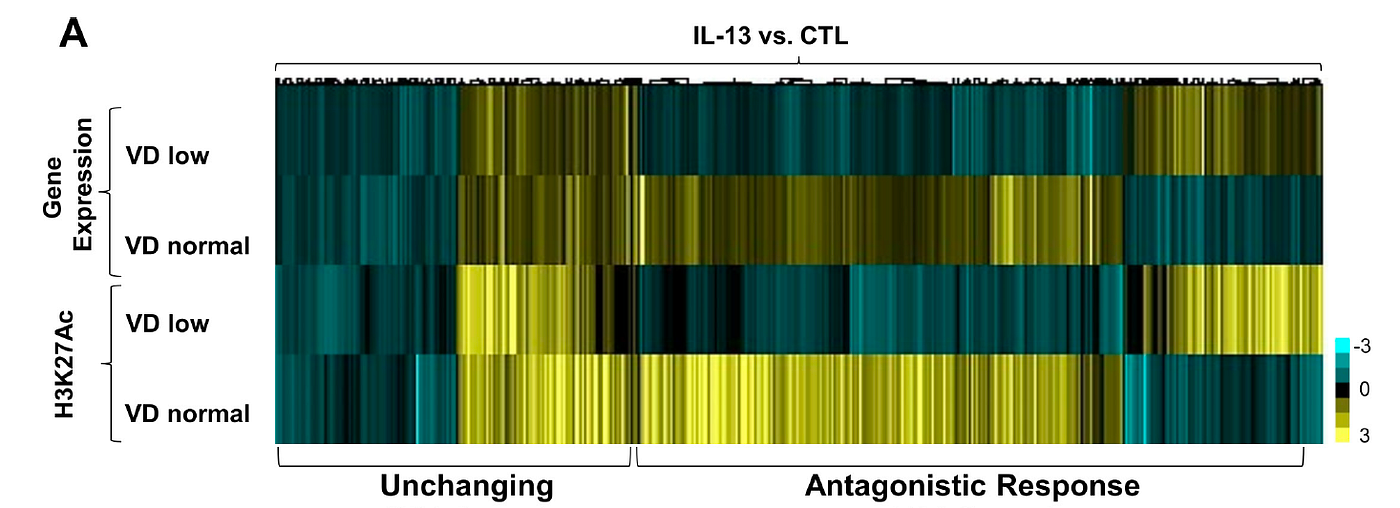
Vitamin D reverses effect of IL13 on epithelial cells
Vitamin D (VD) is considered an essential factor, that tempers damaging and boosts healthy immune responses. Its deficiency has been linked with the risk and severity of numerous inflammatory diseases, including allergies. Yet, its role and mechanism are not yet agreed on. A recent paper by Michael Brusilovsky, PhD, titled *Vitamin D receptor and STAT6 interactome governs oesophageal epithelial barrier responses to IL13 signalling* aimed to mechanistically dissect VD involvement in allergic inflammation at the molecular level. Because SciDAP was used for next-generation sequencing (NGS) data analysis, we inquired with Dr. Brusilovsky on how it supported findings in the paper.
Q: What were your research goals for this paper?
Michael Brusilovsky (MB): It’s a common idea to understand the contribution of the environment to a certain disease. In our case, we wanted to understand the contribution of vitamin D deficiency to the pathogenesis of allergic disease. Our model is a prototypical allergic disease called eosinophilic esophagitis (EoE). It’s a rare disease of the esophagus characterized by altered esophageal epithelial integrity, a critical contributor to allergic inflammation in patients with EoE. Our approach was to look at different aspects of epithelial cell biology and response to the environment and pro-inflammatory mediators.
Q: What was the most challenging part of the research?
MB: Interleukin (IL)-13 is a pro-inflammatory cytokine involved in epithelial barrier dysfunction in EoE and is a critical factor in asthma and skin allergy. We researched IL-13 signaling, which involved analyzing gene expression, transcription factors binding, and epigenetic marks using multiple bioinformatic approaches simultaneously. It was challenging to integrate all this data together.
Q: How did you leverage multiomics in your study?
MB: We assessed the genomic distribution and the function of the epithelial transcription factors — vitamin D receptor (VDR) and IL-13- regulated STAT6. We used integrated multiomics approaches to look at several factors such as gene expression by RNA sequencing (RNAseq), epigenetic modifications and VDR/STAT6 interactions with particular genes by chromatin immunoprecipitation DNA sequencing (ChIPseq).
Q: How did you analyze the ChIPseq and RNAseq data?
MB: The sequencing data from these multiomics approaches was analyzed using SciDAP bioinformatic software. SciDAP was handy because it let us analyze multiple data sets in one platform on our own. For a biologist like me, it lets you perform most, if not all of the tasks yourself. It is very user-friendly.
Q: What are the specific capabilities of SciDAP that helped you succeed?
MB: SciDAP integrates multiple analyses, so you don’t need to switch from one platform to another to analyze epigenomics, RNAseq, and ChIPseq data. It allowed us to successfully integrate the data and run various metagenomic analyses to show the implications of the VDR and STAT6 gene-specific interactions with the function of the IL-13 signaling in the esophageal epithelial cells. These capabilities and integrated pipelines were instrumental for us. Not just to complete the research, but to convey the main ideas.
Q: What was the output from SciDAP?
MB: For RNAseq analysis, we used different approaches to study the level of expression of certain genes such as DESeq2 differential expression and interpreted the results with gene set enrichment analysis (GSEA). Next was to look at the epigenetic marks, such as histone acetylation. For this we analyzed ChIPseq data to identify which genes were epigenetically modified and which transcriptional changes coincided with the epigenetic response. The data we generated with SciDAP was used in the paper, such as several panels in the figure 1 and supplemental figure 1.
Q: How did SciDAP impact your project?
MB: SciDAP let me do my research by reducing time spent on bioinformatic analysis. The tasks that SciDAP performed were not a single-person job. Without SciDAP, I would have needed a budget to hire five bioinformaticians. SciDAP was able to perform the job of 2 FTEs in a couple of weeks in what would have taken several months.
Q: What is the key finding from the study?
MB: The key finding of the paper is the identification of vitamin D as a natural IL-13 antagonist. It has the capacity to regulate the epithelial barrier in immune function. But it was the ability to look at a single transcription factor and gene resolution that were the main driving factors behind this research and the ability to make the conclusions.
The full citation is:
Brusilovsky M, Rochman M, Shoda T, Kotliar M, Caldwell JM, Mack LE, Besse JA, Chen X, Weirauch MT, Barski A, Rothenberg ME. Vitamin D receptor and STAT6 interactome governs oesophageal epithelial barrier responses to IL-13 signalling. Gut. 2022 Aug 1;gutjnl-2022–327276.
doi: 10.1136/gutjnl-2022–327276
https://gut.bmj.com/content/early/2022/10/28/gutjnl-2022-327276
To learn more about SciDAP, please visit www.scidap.com.
메타데이터
- post_id
- 72859819e0fa
- slug
- scidap-supports-multi-omics-study-linking-vitamin-d-deficiency-to-allergies-72859819e0fa
- url
- https://medium.com/@datirium/scidap-supports-multi-omics-study-linking-vitamin-d-deficiency-to-allergies-72859819e0fa
- canonical_url
- https://medium.com/@datirium/scidap-supports-multi-omics-study-linking-vitamin-d-deficiency-to-allergies-72859819e0fa
- author_url
- https://medium.com/@datirium
- status
- ok
- fetched_at
- 2026-07-26 10:57:40