The Beginner’s Guide to Consensus Docking: Why One Docking Program Isn’t Enough Anymore
When predicting how a potential drug binds to its target, should researchers trust just one computational tool? Increasingly, the answer is…
The Beginner’s Guide to Consensus Docking: Why One Docking Program Isn’t Enough Anymore
When predicting how a potential drug binds to its target, should researchers trust just one computational tool? Increasingly, the answer is no.
Imagine Asking Only One Expert…
Imagine you’re trying to decide whether a movie is worth watching. You ask one friend, and they tell you it’s fantastic. Another friend thinks it’s average, while a third insists it’s terrible. Whose opinion do you trust?
Most of us would feel more confident if several people independently reached the same conclusion.
Interestingly, modern drug discovery follows a similar philosophy.
For years, computational biologists have used molecular docking software to predict how small molecules bind to proteins. These predictions help researchers prioritize compounds before expensive laboratory experiments begin. However, scientists have learned that relying on a single docking algorithm can sometimes produce misleading results. Different software packages often disagree, even when analyzing the same protein and ligand.
This realization has led to the growing adoption of consensus docking — an approach that combines predictions from multiple docking programs to improve confidence and reduce errors.
What Is Molecular Docking?
Before diving into consensus docking, it’s helpful to understand molecular docking itself.
Molecular docking is a computational method used to predict how a small molecule, called a ligand, interacts with a target protein. The software explores different orientations, or poses, of the ligand within the protein’s binding site and estimates how favorable each interaction is.
The quality of each predicted pose is measured using a scoring function, which attempts to estimate binding affinity. Generally, stronger predicted interactions receive better scores.
Popular molecular docking programs include:
- AutoDock Vina
- AutoDock4
- Glide
- GOLD
- DOCK
- FlexX
Although these tools aim to solve the same problem, they do not solve it in exactly the same way.
Why Can Different Docking Programs Give Different Answers?
At first glance, it might seem that every docking program should produce identical results. After all, they’re analyzing the same protein and the same ligand.
In reality, each docking algorithm is built on different mathematical models and assumptions.
Some programs emphasize hydrogen bonding, while others handle hydrophobic interactions more effectively. Some treat molecular flexibility differently, and each uses its own scoring function to estimate binding affinity.
As a result, one program may predict an excellent binding pose while another ranks the same ligand much lower.
Imagine docking the same compound using three different programs:

Which prediction should you trust?
Unfortunately, there isn’t a simple answer.
The Problem with Relying on a Single Docking Algorithm
Every docking program has strengths and weaknesses.
Some perform exceptionally well for certain protein families but struggle with others. Some generate highly accurate ligand poses yet produce unreliable binding affinity estimates. Others may rank compounds effectively but miss biologically relevant interactions.
Because no single docking algorithm consistently outperforms all others, depending entirely on one program introduces uncertainty into the drug discovery process.
This uncertainty becomes especially important during virtual screening, where researchers evaluate thousands — or even millions — of molecules. Even a small number of false positives can waste considerable time and resources during experimental validation.
Enter Consensus Docking
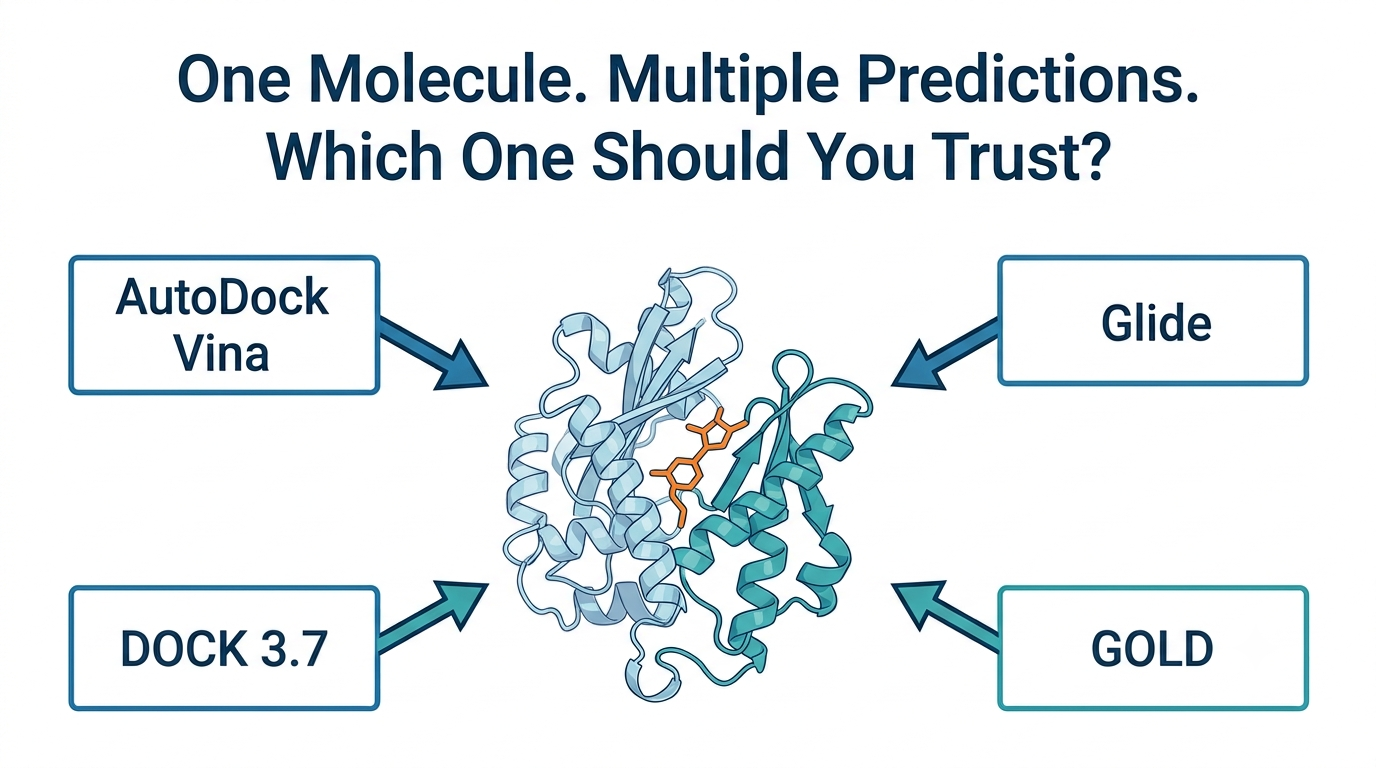
Consensus docking addresses this challenge by combining predictions from multiple docking programs rather than relying on only one.
Instead of asking:
“What does AutoDock Vina predict?”
Researchers ask:
“What do AutoDock Vina, Glide, GOLD, and other programs agree on?”
If several independent algorithms identify the same ligand pose or rank the same compounds highly, researchers can be much more confident that those predictions reflect genuine molecular interactions rather than software-specific bias.
The idea is simple: agreement among multiple independent methods often provides stronger evidence than a single prediction.
How Does Consensus Docking Work?
Although implementations vary, the general workflow follows these steps:
- Prepare the protein and ligand structures.
- Perform molecular docking using multiple docking programs.
- Collect the predicted poses and scores from each software package.
- Compare the results.
- Identify compounds or binding poses consistently supported by multiple algorithms.
- Prioritize these candidates for further experimental testing.
Rather than replacing traditional docking, consensus docking builds upon it by integrating multiple perspectives into a single decision-making process.
Different Ways to Combine Docking Results
Consensus docking isn’t limited to one technique. Researchers use several strategies depending on their objectives.
1. Rank-Based Consensus
Instead of comparing raw docking scores, compounds are ranked within each docking program.
A compound that consistently appears among the top-ranked candidates across multiple algorithms is considered more reliable than one that ranks highly in only a single program.
2. Score-Based Consensus
Different docking programs use different scoring scales, making direct comparisons difficult.
Researchers often normalize these scores before combining them into an overall consensus score.
3. Vote-Based Consensus
Here, each docking program effectively casts a vote.
If most algorithms identify a compound as a promising binder, confidence in that prediction increases.
4. Pose Consensus
Sometimes the exact numerical score matters less than the predicted binding orientation.
If several docking programs independently predict nearly identical ligand poses, the likelihood that the binding mode is biologically meaningful increases.
Is Consensus Docking Perfect?
Not quite.
Although consensus docking often improves prediction reliability, it also has limitations.
Running multiple docking programs requires more computational resources and time than using a single algorithm. Comparing results can also be challenging because each software package uses different scoring systems.
Most importantly, consensus docking cannot compensate for poor input data. Incorrect protein preparation, inaccurate ligand structures, or unrealistic docking parameters will affect all programs involved.
Like every computational method, consensus docking generates hypotheses — not definitive answers. Experimental validation remains essential.
Where Is Consensus Docking Used?
Consensus docking has become increasingly valuable in several areas of computational drug discovery, including:
- Virtual screening
- Drug repurposing
- Lead optimisation
- Structure-based drug design
- Protein–ligand interaction studies
- Early-stage pharmaceutical research
As computational methods continue to evolve, consensus approaches are becoming standard practice in many drug discovery workflows.

Final Thoughts
No docking algorithm is perfect.
Each software package brings unique strengths, assumptions, and limitations. By combining predictions from multiple tools, consensus docking helps researchers reduce uncertainty, improve confidence, and make better-informed decisions about which compounds deserve further investigation.
In many ways, consensus docking reflects a broader principle in science: important conclusions are rarely based on a single piece of evidence. Instead, confidence grows when multiple independent methods point toward the same answer.
As computational drug discovery becomes increasingly sophisticated, consensus docking is likely to play an even greater role in identifying the medicines of tomorrow.
메타데이터
- post_id
- 7ca4140deeaf
- slug
- the-beginners-guide-to-consensus-docking-why-one-docking-program-isn-t-enough-anymore-7ca4140deeaf
- url
- https://medium.com/@kirthimaheswaran/the-beginners-guide-to-consensus-docking-why-one-docking-program-isn-t-enough-anymore-7ca4140deeaf
- canonical_url
- https://medium.com/@kirthimaheswaran/the-beginners-guide-to-consensus-docking-why-one-docking-program-isn-t-enough-anymore-7ca4140deeaf
- author_url
- https://medium.com/@kirthimaheswaran
- status
- ok
- fetched_at
- 2026-07-15 17:14:21