Biochemists Spent 50 Years Failing to Solve This Problem.
In November 2020, a competition judge watched a computer predict protein structures with an accuracy that took his breath away. He said…
Biochemists Spent 50 Years Failing to Solve This Problem. An AI Did It in 18 Months. The Numbers Are Staggering.
In November 2020, a competition judge watched a computer predict protein structures with an accuracy that took his breath away. He said: “We have been stuck on this one problem for nearly 50 years. And we did not see this coming.” This is the full story.
My grandmother died of a disease we did not understand well enough to treat.
Most people’s grandmothers did.
We knew the disease existed. We knew the protein responsible. We had its genetic sequence. We had the amino acid chain that the sequence encoded.
What we did not have: the shape that chain folded into.
And without the shape, we could not design a drug that fit it. Without the shape, we were guessing. Without the shape, we were treating symptoms while the cause sat in front of us, invisible.
This is not a story about one disease. This is a story about every disease caused by a misfolded or misbehaving protein. Which is most of them. Alzheimer’s. Parkinson’s. Cancer. Cystic fibrosis. HIV.
For fifty years, we knew the sequence. We did not know the shape.
An AI fixed that. In eighteen months.
Why Shape Is Everything
Proteins are the machines of biology.
Your cells build them constantly. They carry oxygen, fight infections, catalyse reactions, build structures, send signals, repair damage. Every biological function you have ever performed — breathing, healing, thinking — required a protein.
A protein is a chain of amino acids. The human body uses 20 different amino acids. A typical protein is a few hundred to a few thousand of them strung together.
The sequence is the easy part. We can read it. We have been reading it since the 1970s. The Human Genome Project gave us the sequence of every protein the human body makes.
What we could not read was the shape.
Here is why shape matters.
A protein does not work as a flat chain. It folds. The chain twists, bends, coils on itself, guided by chemical attractions and repulsions between its amino acids. The final shape is a precise three-dimensional structure. And that structure is its function.
A key-and-lock metaphor is used constantly and it is almost right. The active site of a protein — the part where it binds to something, where a drug needs to attach — is a specific shape. A drug that fits that shape perfectly can block, activate, or redirect the protein. A drug that doesn’t fit does nothing. Or worse.
To design the right drug, you need the exact shape of the lock.
We could not predict the shape.
The Fifty-Year Failure
In 1972, biochemist Christian Anfinsen won the Nobel Prize in Chemistry.
His discovery: a protein’s three-dimensional shape is completely determined by its amino acid sequence. The sequence contains all the information needed to arrive at the final folded structure.
This was revolutionary. It meant, in principle, you could predict any protein’s shape if you knew its sequence.
In principle.
The actual prediction turned out to be one of the hardest problems in computational biology.
Cyrus Levinthal calculated the problem in 1969. A small protein with 100 amino acids has roughly 10³⁰⁰ possible configurations it could fold into. If you tested one configuration per nanosecond, going through all of them would take longer than the age of the universe.
The protein itself folds in milliseconds.
It does not try all configurations. It navigates to the right one through physics — through the energetics of molecular interactions that favour certain configurations over others. We understood this qualitatively. We could not compute it quantitatively for real proteins.
For fifty years, the best methods barely improved.
The CASP competition — Critical Assessment of Protein Structure Predictions — has been running since 1994. Every two years, research groups around the world compete to predict protein structures. A score of 100 means perfect prediction. A score above 60 means you have roughly the right fold.
For twenty-five years, the best scores clustered around 40 to 60. Grinding improvements. Conference papers. Incremental progress. The best human-designed algorithms, encoding decades of biochemical knowledge, plateaued.
Then November 2020 happened.
The Number Nobody Expected
CASP14. The fourteenth competition.
Group 427 submitted their results.
The judges computed the scores.
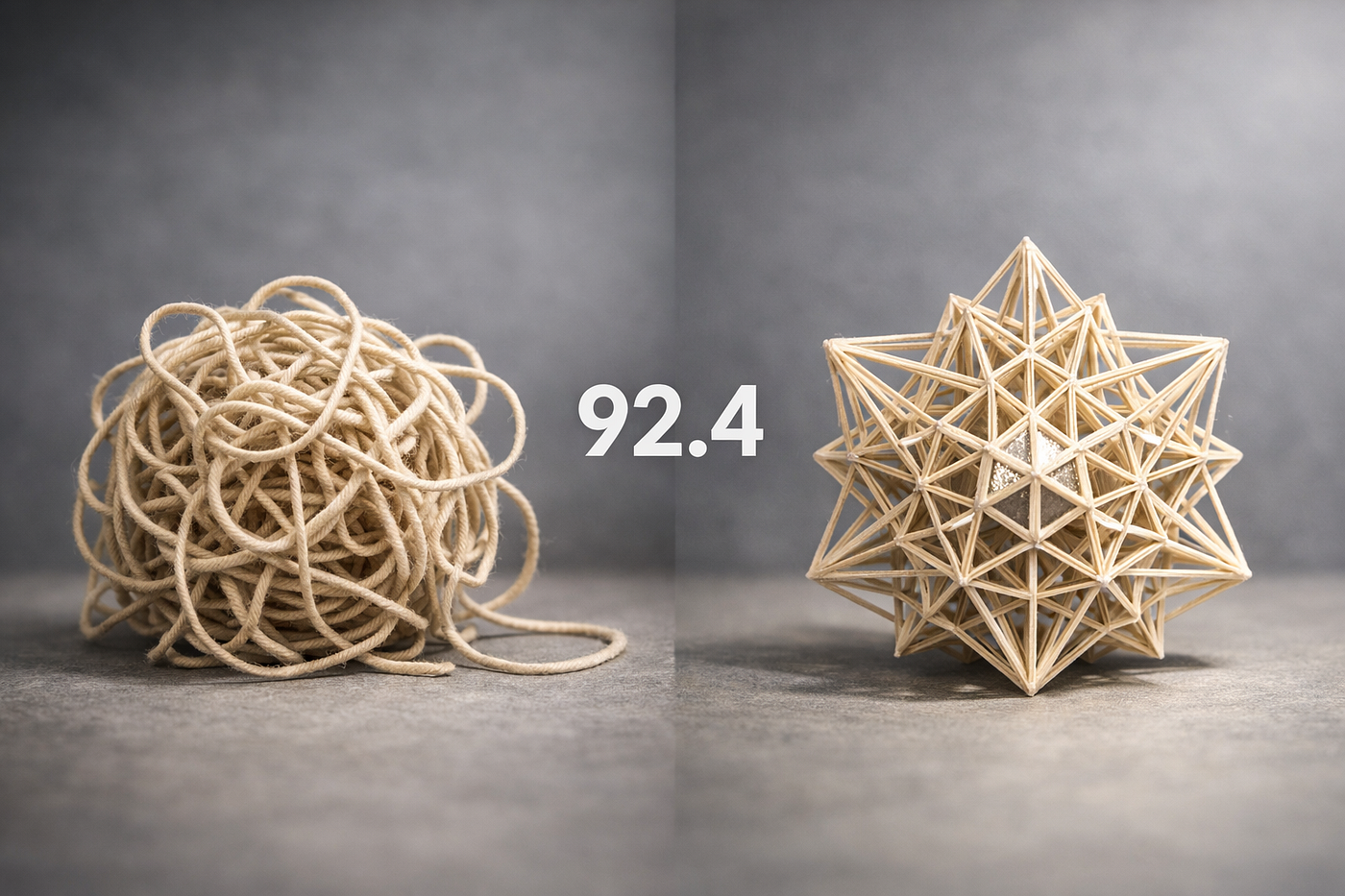
The median GDT score for Group 427: 92.4.
The previous best: around 60.
AlphaFold’s median score in CASP14 was 92.4 GDT, with an average error of 1.6 Ångströms calculated using the root-mean-square deviation from the correct atomic positions. This means AlphaFold predicted structures that were accurate to within the width of one atom.
One atom.
Fifty years of effort produced predictions accurate to roughly 4 to 6 Ångströms on average. In one year, AlphaFold structures had a median backbone accuracy of 0.96 Å RMSD whereas the next best performing method had a median backbone accuracy of 2.8 Å RMSD.
In the CASP14 assessors’ ranking by summed z scores, AlphaFold2 scored 244.0 compared to 90.8 by the next best group.
Not 20% better. Not twice as good. Nearly three times the score of every other method. A margin so large it redefined what the problem meant.
John Moult, who co-founded the CASP competition and had run it for 25 years, said it publicly: “We have been stuck on this one problem — how do proteins fold up — for nearly 50 years. And we did not see this coming.”
Group 427 was AlphaFold2. Built by Google DeepMind. Run by a 32-year-old researcher named John Jumper.
How It Actually Works. The Mathematics Underneath.
Most coverage of AlphaFold stops at “AI solved protein folding.” That is accurate and completely uninformative.
Here is what AlphaFold2 actually does.
Step 1: Multiple Sequence Alignment
A protein does not exist in isolation. Evolution has been running experiments on every protein for hundreds of millions of years. Different organisms have versions of the same protein — slightly different sequences, but the same basic function.
When two amino acids at different positions in a protein have co-evolved — when a change at position 34 is always accompanied by a change at position 89 — that is a signal. Those positions are spatially close in the folded structure. They interact. Evolutionary pressure preserved their relationship.
AlphaFold mines this co-evolutionary signal from thousands of related protein sequences simultaneously.
MSA: Multiple Sequence Alignment
  Human protein: MKTIIALSYIFCLVFA...
  Mouse protein: MKTIIALSYIFCLAFA...  (position 16: V→A)
  Rat protein:   MKTIIALSYIFCLAFA...
  Zebrafish:     MKTIIALSHIFCLVFA...  (position 8: Y→H)
  ...thousands more...
When positions X and Y always change together across species:
they are likely spatially adjacent in the folded structure.
This is a distance constraint derived from evolutionary evidence.Step 2: The Evoformer
AlphaFold2’s core module. A transformer architecture — the same technology behind GPT — adapted for protein structure.
The Evoformer processes two representations simultaneously:
A sequence representation: what each amino acid is, what its neighbours are, what the MSA says about evolutionary constraints.
A pair representation: what is the likely spatial relationship between every pair of amino acids.
These two representations update each other through 48 transformer blocks. Information flows from the sequence into the pair representation (co-evolutionary signal informs distance estimates). Information flows from the pair representation back into the sequence (predicted distances refine the per-amino-acid state).
For a protein of length L:Sequence representation: L × 256 tensor
One 256-dim vector per amino acid
Pair representation: L × L × 128 tensor
One 128-dim vector for every pair of amino acids
Encodes: predicted distance, predicted orientation
48 blocks of:
Row-wise attention (update each amino acid using other amino acids)
Column-wise attention (update each pair using other pairs in same row/column)
Outer product mean (integrate sequence into pair representation)
Triangle multiplicative update (enforce triangle inequality in distances)
The triangle inequality enforcement is critical.
If A is close to B, and B is close to C, then A cannot be far from C.
Standard transformers do not enforce this. Evoformer does.
This geometric constraint drives accuracy.Step 3: Structure Module
The Evoformer outputs a rich representation of distances and orientations. The structure module converts this into actual 3D coordinates.
It does this by representing each amino acid as a rigid body — a backbone frame with a specific position and orientation in 3D space. It iteratively updates these frames through 8 rounds of attention and invariant point attention — attention that is invariant to rotations and translations, so the predicted structure does not depend on arbitrary coordinate choices.
The result: actual XYZ coordinates for every atom in the protein.
This is not a lookup. Not a template matching. Not a database retrieval. The model is inferring the three-dimensional geometry from evolutionary signal and sequence information alone.
That geometry turns out to be accurate to the width of one atom.
What 200 Million Proteins Means
In July 2021, DeepMind did something extraordinary.
They ran AlphaFold2 on every protein with a known DNA sequence. Then they published the results for free.
Before AlphaFold2: approximately 100,000 protein structures with experimentally determined 3D coordinates. These took decades of painstaking crystallography, NMR spectroscopy, and cryo-electron microscopy. Some structures took individual research groups ten years.
After AlphaFold2’s database release: 200 million protein structures, achieving what would take hundreds of millions of years to solve experimentally. The freely available AlphaFold Protein Database has been used by over 3 million researchers in more than 190 countries, including over 1 million users in low- and middle-income countries.
A 2,000-fold increase in available protein structures. In eighteen months.
A researcher in Nairobi studying a neglected tropical disease now has access to the same structural information as a lab at Harvard. A graduate student in Bangladesh working on antibiotic resistance can fold the proteins of the bacteria they are studying without a crystallography facility.
The democratisation of this was not incidental. DeepMind made it free deliberately. The database is open access. The code is open source.
This is what AI looks like when it is not trying to sell you something.
AlphaFold3. When It Got Even Bigger.
In May 2024, DeepMind published AlphaFold3.
AlphaFold2 predicted protein structures. Alone. A single protein, folded.
AlphaFold3 predicts how proteins interact with everything else. Other proteins. DNA. RNA. Small molecules. Drug candidates.
This is the jump from understanding locks to understanding keys.
Drug discovery depends almost entirely on knowing how a molecule — a potential drug — binds to a protein. How strongly. Where. What shape it needs to be to fit the active site. Before AlphaFold3, this required expensive, time-consuming wet lab experiments for every candidate compound.
AlphaFold3 uses a diffusion model — the same underlying mathematics as Stable Diffusion and DALL-E — applied to molecular structure. It generates the most likely 3D configuration of any collection of biomolecules together.
In many cases, AI-based predictions like those provided by AlphaFold3 now surpass even the best physics-based models.
“With these new capabilities, we can design a molecule that will bind to a specific place on a protein, and we can predict how strongly it will bind,” Hassabis said. “It’s a critical step if you want to design drugs and compounds that will help with disease.”
The 2024 Nobel Prize in Chemistry went to Demis Hassabis and John Jumper. The Nobel committee does not give prizes for potential. They gave it for AlphaFold. For the 200 million structures. For what had already happened.
The prize committee called it: “cracking the code of life.”
The Diseases That Are Already Different
This is not a distant future story.
Researchers use AlphaFold3 to explore protein conformational changes linked to diseases like Alzheimer’s and cancer.
Alzheimer’s disease involves the misfolding of a protein called tau. For decades, we watched tau aggregate into tangles in the brains of patients and did not understand precisely how it happened or where to intervene. AlphaFold2 gave us tau’s structure. AlphaFold3 is helping researchers model how candidate drugs interact with it.
Antimicrobial resistance is killing approximately 1.27 million people per year. Bacteria evolve resistance by changing the proteins that our antibiotics target. Before AlphaFold, characterising each new resistant strain required months of structural biology work. Now it requires hours.
Neglected tropical diseases — the ones that kill millions in low-income countries and receive almost no pharmaceutical investment because there is no profit in treating the poor — now have their proteins folded and available to any researcher with an internet connection. The barriers to understanding them have dropped dramatically.
Over 30% of AlphaFold-related research is focused on better understanding disease, benefiting human welfare.
What Honestly Has Not Changed Yet
I want to be honest here. Because the excitement is real and the gap between excitement and clinical outcome is also real.
Knowing a protein’s structure is not the same as having a drug. Structure is the starting point of drug discovery. From structure to approved drug takes, on average, twelve to fifteen years and costs over a billion dollars. AlphaFold accelerates the early stages. It does not compress the clinical trial process.
AlphaFold3 still has limitations. It predicts static structures. Real proteins are dynamic — they flex, breathe, shift between conformational states. Some of these dynamics are critical for function and for drug binding. The prediction of intrinsically disordered regions — parts of proteins that do not fold into stable structures — remains a genuine weakness.
And the step from “we know the structure” to “we know how to design a drug that works in a human body” involves pharmacokinetics, toxicity, selectivity, off-target effects, and a hundred other considerations that structure prediction does not touch.
None of this diminishes what happened. It contextualises it.
AlphaFold solved the structure prediction problem. It did not solve drug discovery. It changed the first chapter of a story that still has many chapters left.
The Thing That Actually Matters
I want to come back to my grandmother.
She had a protein misbehaving in her body. We knew the protein. We had its sequence. We did not have its shape.
Without the shape, drug designers were working in the dark. They could screen thousands of compounds and hope something bound. They could learn from accidental discoveries. They could not rationally design.
AlphaFold2 turned on the lights.
Not just for her disease. For every disease caused by a misbehaving protein. Which is, in biology, most of them.
The fifty years of failure were not wasted. Every CASP competition built knowledge. Every failed method revealed constraints. The biology PhDs who spent careers on this problem — they understood what accuracy meant, what the distances meant, what the side-chain conformations meant. When AlphaFold2 appeared, there was a community of scientists who knew exactly what to do with 200 million structures. Who could validate it, extend it, apply it.
AI did not replace the biologists. It gave them the answer to the question they had been asking for fifty years.
What happens next is theirs to write.
The Uncomfortable Thought
Here is what I keep returning to.
Anfinsen won his Nobel Prize in 1972. For proving that sequence determines structure. For proving that, in principle, structure prediction should be possible.
Fifty years passed.
In those fifty years, hundreds of thousands of people died from diseases whose proteins we understood genetically but not structurally. We knew the problem was solvable. We could not solve it.
An AI trained on evolutionary data and gradient descent solved it in eighteen months.
The question that sits with me is this: what other fifty-year problems are we sitting next to right now, thinking they are unsolvable, when the answer is actually computable?
What other Anfinsens are we waiting for that an AlphaFold2 is already positioned to replace?
I do not know the answer to that.
But I notice that I can no longer look at a hard problem and assume that the pace of progress I have observed represents the pace of progress that is possible.
Something has changed. Not just in biology. In what we should expect from computation applied to hard problems.
My grandmother did not benefit from AlphaFold2.
Someone’s grandmother will.
Tell Me
AlphaFold3 is now modelling drug-protein interactions. The structures are free and available to 3 million researchers. The 2024 Nobel Prize has been awarded. This is not the future. It is happening.
Here is the question I am sitting with.
If you had to pick one disease — one condition whose underlying biology you believe is now reachable in a way it was not before — what would it be?
Not which disease needs curing most. Which one became computationally tractable the moment we could fold every protein in the human body?
Because the researchers reading this already have intuitions about that. And those intuitions, applied to the AlphaFold database, are probably the most valuable thing being computed right now.
What is yours?
References
AlphaFold: Five Years of Impact — Google DeepMind, March 2026
Highly Accurate Protein Structure Prediction with AlphaFold — Jumper et al., 2021 — Nature. The original AlphaFold2 paper.
CASP14: What Google DeepMind’s AlphaFold 2 Really Achieved — Oxford Protein Informatics Group, December 2020
Applying and Improving AlphaFold at CASP14 — Jumper et al., PMC, 2022
AlphaFold 3: An Unprecedented Opportunity for Fundamental Research and Drug Development — Fang et al., Precision Clinical Medicine, July 2025
AlphaFold3 in Drug Discovery: A Comprehensive Assessment — bioRxiv, April 2025
Has DeepMind’s AlphaFold Solved the Protein Folding Problem? — BioTechniques, 2022
The Accuracy of Protein Structures in Solution Determined by AlphaFold and NMR — Structure, 2022
Levinthal’s Paradox — Zwanzig et al., PNAS, 1996. The original calculation of why brute-force search fails.
Critical Assessment of Protein Structure Prediction (CASP) — The biennial competition that tracked fifty years of progress.
2024 Nobel Prize in Chemistry — Press Release — Royal Swedish Academy of Sciences
AI #Biology #AlphaFold #DeepMind #ProteinFolding #DrugDiscovery #MachineLearning #Science #Medicine #NeuralNetworks #DeepLearning #Nobel #Cancer #Alzheimers #LevelUpCoding
메타데이터
- post_id
- 815abbab8d30
- slug
- biochemists-spent-50-years-failing-to-solve-this-problem-815abbab8d30
- url
- https://medium.com/data-and-beyond/biochemists-spent-50-years-failing-to-solve-this-problem-815abbab8d30
- canonical_url
- https://medium.com/data-and-beyond/biochemists-spent-50-years-failing-to-solve-this-problem-815abbab8d30
- author_url
- https://medium.com/@swarnenduiitb2020
- status
- ok
- fetched_at
- 2026-06-09 15:37:30