Decoding Harmful Mutations: A Bioinformatics Journey Through nsSNP Analysis
What is nsSNPs ? why its important to study SNPs for cancer.
Decoding Harmful Mutations: A Bioinformatics Journey Through nsSNP Analysis
What is nsSNPs ? why its important to study SNPs for cancer.
Non-synonymous single nucleotide polymorphisms (nsSNPs) are genetic variations that alter amino acid sequences in proteins. These mutations can significantly affect protein structure, stability, and function, potentially leading to disease development.
With the advancement of computational biology, researchers can now identify and characterize harmful mutations using various bioinformatics tools before experimental validation. This blog presents a complete in silico workflow for nsSNP analysis and pathogenic mutation prediction.
DNA change → Amino acid change → Possible protein alteration
Unlike synonymous SNPs, which do not affect the amino acid sequence, nsSNPs directly modify protein composition and may alter protein structure, stability, or biological function.
nsSNPs are important because proteins perform almost every biological function in the body. Even a single amino acid substitution can lead to:
- altered protein folding
- reduced protein stability
- loss of enzymatic activity
- abnormal signaling pathways
- disrupted molecular interactions
- disease progression
Some nsSNPs are harmless, while others are highly pathogenic.
Types of SNPs
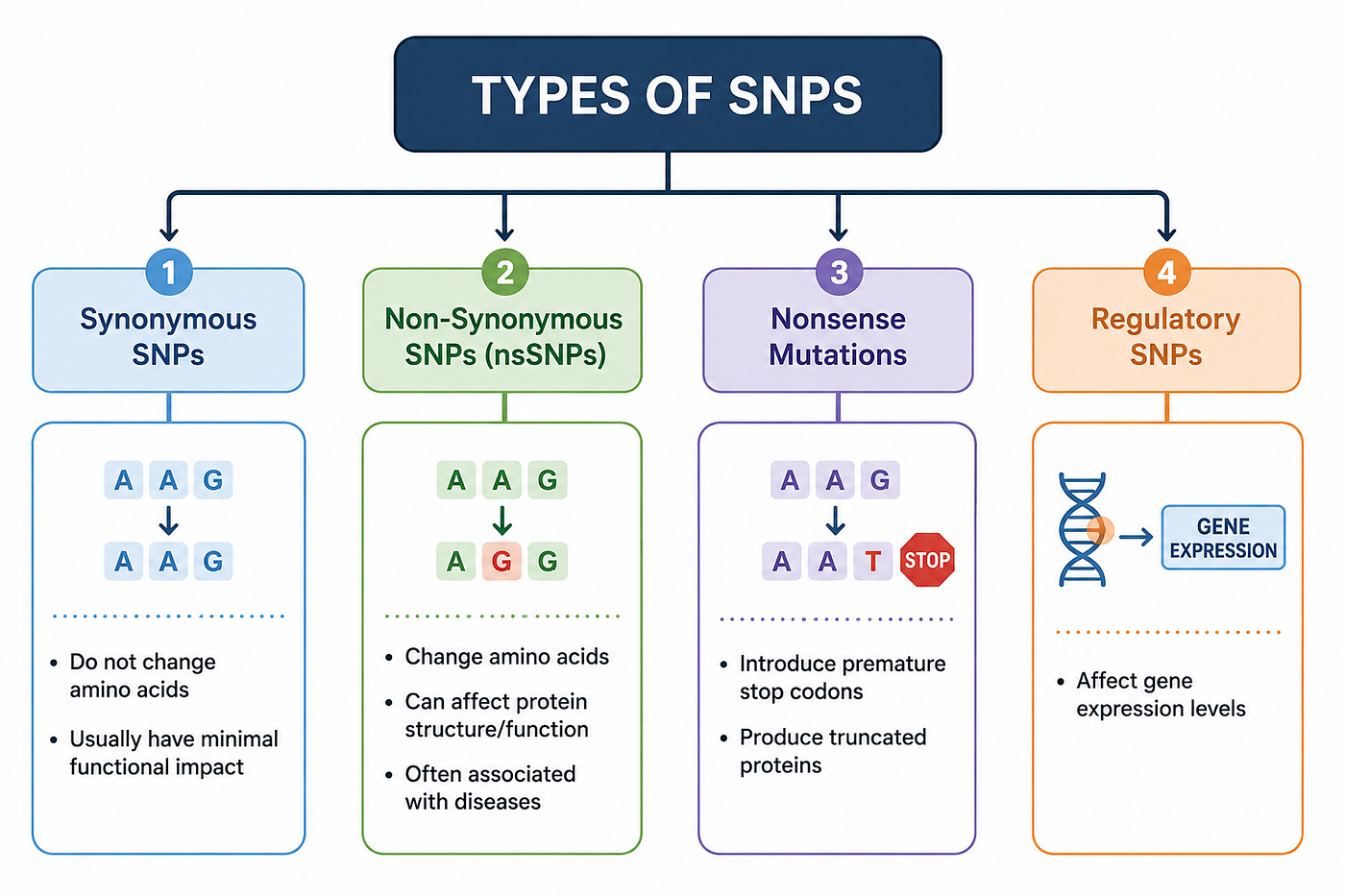
fig.1 Types of SNPs
Workflow for nsSNPs identification & Tools used for analysis
WORKFLOW FOR nsSNP IDENTIFICATION & ANALYSIS
Gene Selection ↓ Sequence Retrieval (NCBI / UniProt / Ensembl) ↓ Retrieve SNP Data (dbSNP) ↓ Filter Non-Synonymous SNPs (nsSNPs) ↓ Functional Impact Prediction • SIFT • PolyPhen-2 • PROVEAN ↓ Protein Stability Analysis • I-Mutant • MUpro ↓ Disease Association Prediction • PhD-SNP • SNPs&GO ↓ Pathogenicity Prediction • MutPred2 • REVEL • CADD • FATHMM • MutationTaster ↓ Evolutionary Conservation Analysis • ConSurf ↓ 3D Structure Modeling • SWISS-MODEL • AlphaFold ↓ Mutant Structure Generation • PyMOL • Swiss-PdbViewer • Chimera ↓ Structure Validation • Ramachandran Plot • PROCHECK • ERRAT ↓ Molecular Docking / Dynamics (Optional) • AutoDock • GROMACS ↓ Biological Interpretation & Conclusion

fig.2 complete workflow for nsSNP analysis

fig.3 nsSNP structure for V600E using HOPE
Importance of SNP Analysis in Cancer Research
Early Cancer Detection
SNP biomarkers can help identify individuals at higher cancer risk.
Personalized Medicine
Genetic profiling allows treatments tailored to a patient’s mutation profile.
Drug Development
Understanding mutation effects helps design targeted therapies.
Prognostic Biomarkers
Certain SNPs correlate with disease progression and patient survival.
Precision Oncology
Mutation analysis improves therapy selection and treatment outcomes.
r
메타데이터
- post_id
- 8b2af6cfc39b
- slug
- decoding-harmful-mutations-a-bioinformatics-journey-through-nssnp-analysis-8b2af6cfc39b
- url
- https://medium.com/@patanzebiulla/decoding-harmful-mutations-a-bioinformatics-journey-through-nssnp-analysis-8b2af6cfc39b
- canonical_url
- https://medium.com/@patanzebiulla/decoding-harmful-mutations-a-bioinformatics-journey-through-nssnp-analysis-8b2af6cfc39b
- author_url
- https://medium.com/@patanzebiulla
- status
- ok
- fetched_at
- 2026-06-09 15:37:30