AFTER GLUTEN
How Wheat Became a Load Test for 21st-Century Biology
AFTER GLUTEN
How Wheat Became a Load Test for 21st-Century Biology

It sits on the table, luminous and benign: a bowl of pasta, perhaps a cacio e pepe — a simple Roman dish of cheese and pepper — crafted from fine durum wheat. For millennia, this food was civilization’s signature: its caloric engine, its emblem of comfort and continuity. Yet today, for millions, the same dish provokes unease. The aroma that once meant home now whispers of bloat, fatigue, and an ineffable malaise — a vague, persistent discomfort difficult to name. We have become the confused eaters, caught between the joy of tradition and the rebellion of our own biology.
The debate that follows is deafening but directionless. On one side, skeptics dismiss gluten sensitivity as a bourgeois fantasy for the “worried well.” On the other, alarmists paint wheat as civilization’s original sin. Both camps miss the point. The problem is not the wheat. The problem is us. The ten-thousand-year-old food has met a one-hundred-year-old biology — and the results are quietly catastrophic.
To see this clearly, we must leave the empty theater of “gluten-free” and examine a specific protein fragment within wheat: gliadin. Contrary to its villainous reputation, gliadin is not a toxin. It is a signal — a molecular interrogator designed to “ask” the wall of our intestine a question. For decades, medicine saw that wall as a static barrier — brick and mortar, absorbing nutrients and keeping invaders out. It was wrong.
Dr. Alessio Fasano and others revealed a far subtler design. The gut lining is a dynamic membrane, guarded by a protein called zonulin, which controls the tight junctions — the physical seals between intestinal cells. These junctions are not cemented shut; they open and close like a customs gate. And gliadin, more than any other dietary molecule studied, can “pick the lock,” prompting zonulin to momentarily open those gates.
This mechanism is not a flaw — it is an evolutionary feature. In the Paleolithic and Neolithic worlds, this transient permeability — a temporary, controlled “leakiness” — may have served a defensive purpose: letting the immune system take small samples of the outside world, calibrating its responses, or flushing pathogens before colonization. In a robust host, the gate opened briefly, the immune patrol made its inspection, and the barrier sealed again. The system worked.
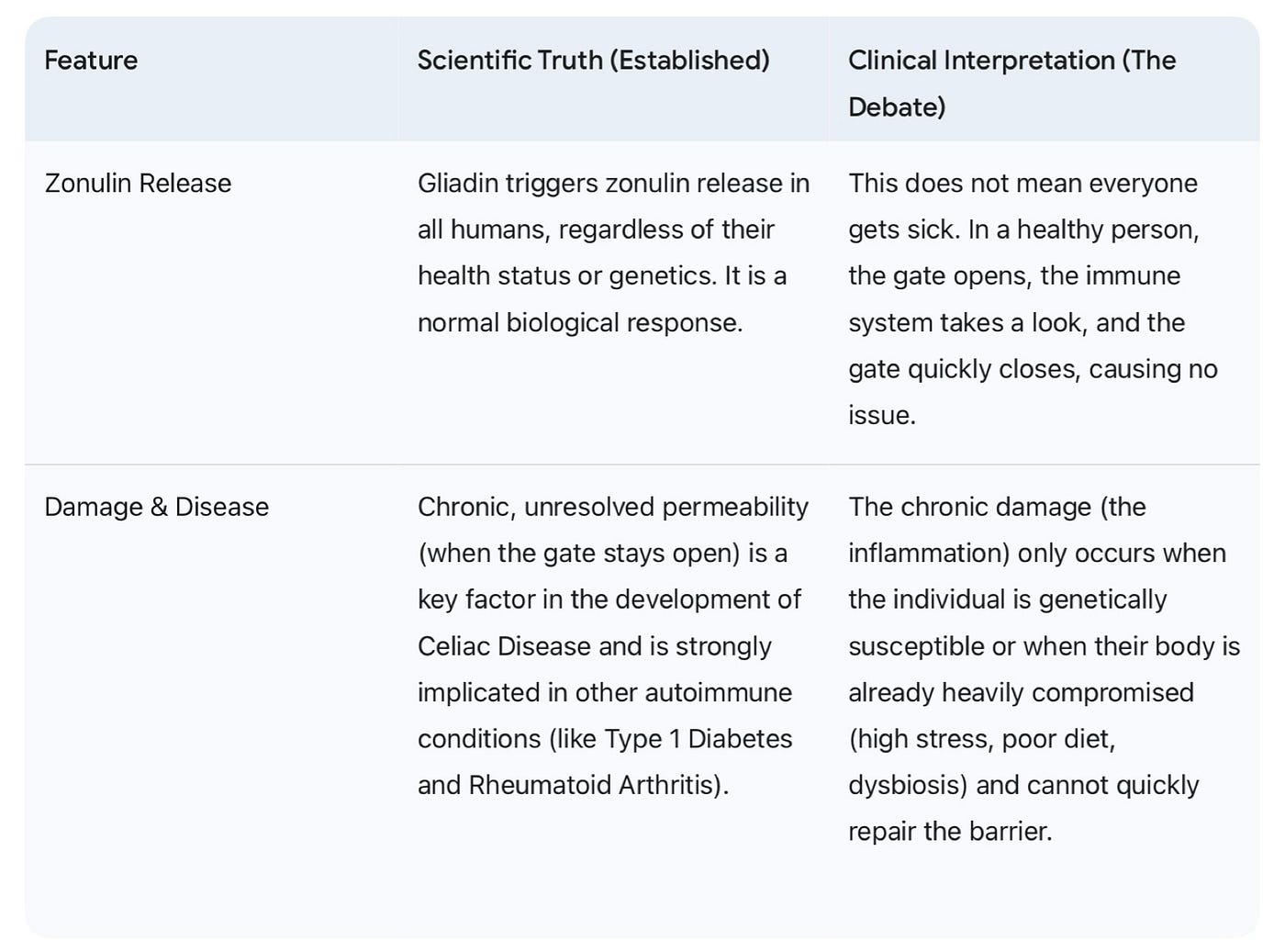
When the Gut’s Gate Stays Open: The Zonulin — Gliadin Axis Behind Modern Inflammation
But the 21st-century host is no longer robust. The modern intestine is a fatigued frontier, eroded by a multi-front assault. Chronic stress and the cortisol it brings weaken cellular seals. Antibiotics, ultra-processed diets, and sterile convenience have gutted our microbial diversity — the living ecosystem that maintains our inner frontier. A chemical soup of pesticides, plastics, and pollutants permeates our tissues, abrading what remains of our defenses.
Into this weakened landscape arrives modern wheat — its gluten composition selectively tuned by breeding for yield and texture, subtly shifting the gliadin-to-glutenin balance. The gliadin fragment does its ancient job: it knocks. But the door is already splintered. What should be a brief, harmless opening becomes a breach. Undigested food particles, microbial debris, and inflammatory molecules pour into circulation. The immune system, detecting invasion, wages a low-grade civil war. Left unchecked, this chronic inflammation becomes the staging ground for metabolic, neurological, and autoimmune disorders.

Gliadin (The Signal) requests access; Zonulin (The Regulator) complies; and the 21st-century gut becomes a permeable frontier.
The skeptics are right that wheat itself is not poison — yet they overlook the condition of the host. Their logic is akin to saying a match is harmless while ignoring the gasoline that coats the floor. What follows is not a digestive quirk but a systemic fire: neuro-inflammation masquerading as fatigue; joint pain mistaken for aging; eczema and allergies dismissed as “normal.” These are not isolated pathologies but the outward flickers of an interior blaze.
This distinction also clarifies the confusion around FODMAPs — the fermentable sugars in wheat. FODMAPs create localized fermentation, a plumbing issue that produces gas and bloating. Gliadin creates permeability — an immunologic issue that inflames the entire system. The first makes gas; the second makes inflammation. Confusing the two has kept the conversation superficial and the solutions cosmetic.
Step back, and a single pattern emerges. The modern disease spectrum — from brain fog to autoimmunity — looks less like a scatterplot of ailments and more like the predictable outcome of a compromised barrier in an inflammatory age. We are not allergic to wheat; we are over-reactive humans whose “off switch” has corroded. The sensitive few who feel this first are not hypochondriacs — they are sentinels, early-warning detectors of a civilization-wide condition.
The conclusion is not exile but reconstruction. The binary of “good” and “bad” food must yield to a harder concept: host resilience — the body’s innate capacity to absorb stress and recover. The solution lies not in avoidance but in architecture: rebuilding the barrier, restoring the gatekeeper’s discernment. That requires:
- Stress down-shift: Restore circadian rhythm and parasympathetic tone; regulating cortisol strengthens tight junctions.
- Microbiome rewilding: Reintroduce fibers, ferments, and soil-derived bacteria to reseed the gut’s lost ecology.
- Exposure pruning: Filter water, minimize pesticide residues, and reduce processed emulsifiers that erode the gut’s mucus and junctional proteins.
A resilient body can again hear gliadin’s question, answer it calmly, and close the gate. Until we rebuild that competence, the foods that once built civilizations will continue to expose our biological decline.
Wheat, then, is not our enemy. It is our mirror — a daily diagnostic test of the fragile equilibrium that defines 21st-century biology. When that bowl of cacio e pepe ceases to provoke inflammation, we will know that the species, not the food, has finally healed.
⸻
APPENDIX
Thirty Precision Actions After Gluten — A Framework for Biological Resilience
I. Restore the Inner Clockwork
-
Circadian Reintegration — fix bedtime rhythm ±30 min; light at dawn resets cortisol slope and gut motility.
-
Dark-Phase Consistency — avoid blue light exposure two hours before sleep; melatonin regulates intestinal permeability.
-
Shift Work Mitigation — legislate rotating shifts <3 weeks and offer post-night light therapy for essential workers.
⸻
II. Rebuild the Microbiome Ecosystem
-
Daily Fiber Diversity — minimum 30 g/day from ≥5 botanical sources; polyphenol-rich fibers increase butyrate yield.
-
Fermented Food Reintegration — one daily serving (kefir, tarhana, kimchi) boosts mucosal IgA within 4 weeks.
-
Soil-Based Bacterial Exposure — moderate outdoor contact (gardening, unsterile environments) restores lost commensal taxa.
-
Antibiotic Stewardship — enforce national registries; pair antibiotic courses with prebiotic adjuncts.
-
Postbiotic Inclusion — butyrate, acetate, and propionate supplementation improve epithelial energy metabolism.
⸻
III. Defuse the Chemical Assault
-
Pesticide Load Reduction — incentivize residue-free production; public database on contamination levels.
-
Emulsifier Regulation — restrict CMC, P80, and carrageenan in mass foods; require explicit labeling.
-
Plastic Contact Ban — remove BPA/BPS/PFAS in food packaging; thermal paper and bottled water top priorities.
-
Airborne Microplastic Surveillance — install indoor filtration standards in schools and hospitals.
⸻
IV. Recalibrate Stress and Neuroendocrine Axis
-
Breath Regulation Training — 5 — 6 breaths/min reduces vagal-sympathetic imbalance; measurable HRV ↑ 15%.
-
Structured Rest Intervals — promote 90-min ultradian recovery cycles in work legislation.
-
Psychobiotic Nutrition — use L. helveticus R0052 and B. longum R0175 strains proven to lower cortisol.
-
National Mind-Body Literacy — integrate stress-physiology education into public curricula.
⸻
V. Nutrient Repletion and Mucosal Repair
-
Vitamin D Optimization — maintain serum 25(OH)D 40 — 60 ng/mL; enhances tight-junction gene expression.
-
Zinc Sufficiency — 10 mg/day supports claudin synthesis and wound repair.
-
Omega-3 Fatty Acids — ≥1.5 g EPA+DHA daily downregulates NF-κB-mediated inflammation.
-
Vitamin A & Retinoid Intake — restores epithelial turnover in atrophic mucosa.
-
Collagen and Glycine Supplementation — improve intestinal barrier restitution post-injury.
⸻
VI. Food Systems and Agriculture Policy
-
Resilient Crop Breeding — prioritize ancient and low-gliadin cultivars (Einkorn, Emmer) within public research funding.
-
Soil Microbiome Restoration — regenerative agriculture increases plant-microbe symbiosis, improving human gut diversity.
-
National Fermentation Initiative — protect traditional starter cultures as microbial heritage assets.
-
Water Quality Mandates — install municipal activated carbon filtration to remove chlorination by-products damaging microbiota.
⸻
VII. Clinical and Surveillance Integration
-
Barrier Health Screening — include zonulin, LPS-binding protein, and hs-CRP tests in annual exams for receptable individuals.
-
Host-Resilience Index — establish a composite score integrating sleep, microbiome diversity, and inflammatory markers.
-
Personalized Reintroduction Protocols — after gut restoration, controlled gluten challenges under physician guidance to retrain tolerance.
-
Post-viral Recovery Clinics — monitor permeability in long COVID and ME/CFS patients; early intervention prevents chronic immune drift.
-
Data Infrastructure — build “Bariyer Sağlığı Ulusal Platformu” linking clinical labs, agriculture, and nutrition databases for predictive modeling.
⸻
Key Takeaway
Health in the 21st century is no longer the absence of disease, but the presence of barrier intelligence.
The task before consumers is discipline; before policy makers, transparency; before scientists, translation.
If these thirty steps become a cultural reflex rather than clinical advice, the ten-thousand-year-old food may yet serve another ten-thousand-year civilization.
⸻
Policy — Consumer Convergence Summary

⸻
Core Principle
Resilient health is no longer about avoidance — it is about system tuning.
The modern individual must learn to live with exposure yet remain unbreached.
The future policy maker must govern not only energy or defense, but also the nation’s “cellular borders”.
⸻
메타데이터
- post_id
- 8d2e81efbb3a
- slug
- after-gluten-8d2e81efbb3a
- url
- https://medium.com/food-strategy/after-gluten-8d2e81efbb3a
- canonical_url
- https://medium.com/food-strategy/after-gluten-8d2e81efbb3a
- author_url
- https://medium.com/@ilalan
- status
- ok
- fetched_at
- 2026-06-12 07:40:50