Code to Catalysis; Computational Enzyme Testing: Creating a Pipeline to Dock Ligands in the Enzyme…
Can you design a perfect car in one go? Of course not! That’s why the word prototype exists.
Code to Catalysis; Computational Enzyme Testing: Creating a Pipeline to Dock Ligands in the Enzyme Active Site
Can you design a perfect car in one go? Of course not! That’s why the word prototype exists.
Cars require multiple mockups to be tested before the final versions are ready. In modern car design, Computer Aided Design (CAD) and Computer Aided Engineering, which allow us to computationally simulate the car, reduce the amount of mockups required drastically. As a result, CAE developed to the point that it is trusted and used by many major car manufacturers from Toyota to Ford and Ferrari.

A Computer Aided Engineering simulation of the Aerodynamics of a car(right) and a physical clay model of a car being tested in a wind tunnel. Both give the same data, but the computational method is much cheaper- Credit Neutral Concept and DEWESoft
Enzyme engineering has started to adopt the use of AI predicting potential sequence changes to improve the enzyme. However, enzyme testing still needs the enzymes to be physically expressed and tested in the lab. Could we mimic the automotive industry and use computational processes to make enzyme testing faster?

Ginkgo Bioworks Automated Foundry. One of the Things that can be done at these foundries is mass testing of engineered enzymes to find improvements faster- Ginkgo BioWorks
Using Computational Enzyme Simulation and a custom AI Model to make Enzyme Engineering Cheaper, Faster and More Successful
There are the methods of enzyme engineering currently used:
- Rational Design: This method makes use of detailed knowledge of the enzyme’s structure and mechanism of function to make targeted mutations in regions thought to have an effect on the enzymes function.
- Directed Evolution: This method mimics natural evolution in a laboratory setting by generating random mutations in the enzyme gene, followed by the selection of promising mutants and then carrying out random mutations on them.
- Semi-rational Design: In this method, areas of the protein thought to influence the function of the protein are either randomly mutated or edited using knowledge from similar proteins.

A diagram comparing all three methods of protein engineering. As you can see, semi rational design, whilst not always being carried out the same way, is generally a mix of methods from both directed evolution and rational design — Pongsupasa et al.
Yet, every single one of these methods requires the enzymes to be physically expressed multiple times so favourable candidates can be picked, but this is expensive. For context, a small 51 amino acid protein has ~2.25*1⁰⁶⁶ possible amino acid configurations. Insulin, a 51 amino acid long protein can easily require over $1500 to make just 1 gram. Imagine expressing 1 gram of even just 100 different mutated variants. That’s $150,000!
Despite physical expression currently being an inevitability for you to keep isolating good strains as the enzyme is engineered, it’s the 21st century, the age of computers! Surely, there must be a better solution.
That is why I am creating a model to reliably predict how likely an engineered enzyme is to perform better than the base enzyme.
Now you may ask, how exactly do you plan to outdo experimental results in accuracy? And to that I say, I don’t aim to, *yet. The plan is simply to make it such that you don’t need to do nearly as many. To make it such that we can computationally test thousands of potential positive mutations, then be able to isolate, with reliable accuracy, a few promising candidates for expression. Consequently, we can test much larger enzyme landscapes, helping us find positive mutations that may have been hidden due to our limited testing capabilities.
To from a protein sequence to a working AI model, I will need to first find a way to obtain a folded protein structure from the sequence, then dock a ligand into that structure and, finally, simulate parts of the reaction. At each of these steps, I will be able to obtain data that I will then be able to use to train the AI model, such that it learns how to identify what datapoints highlight potential protein improvement.
Obtaining the data needed to train the model from Protein Folding and Molecular Docking Algorithms.
To assure the model is sufficiently accurate, the following data points will be needed:
Protein Folding with AlphaFold and ESMFold
The first data point is how the mutated protein folds. To get it, I chose to make use of AlphaFold 2 and ESMfold, both of which are currently among the most accurate protein structure prediction models. To summarise Alphafold’s function, which is the one I mainly made use of, it takes the sequence of a protein and basically searches a database of thousands of proteins for similar proteins, then uses what it learns from those similar proteins to see how the protein sequence you have given it may fold. This step is especially important as it gives me a structure I can then use to test the features of the edited enzyme, such as ability to bind well to a ligand. Thus, protein folding is a preparatory step to make the data collection steps possible.
These are the structures that were obtained from running Alphafold on the sequences of RNA polymerase and Adhesin, both are very close to the real structures of the protein.— A Silicone Valley Insider
Molecular Docking with AutodockVina
Now that we have a folded protein, the next data points required are coming from simulating how a ligand would dock into the mutated enzyme. For this, I chose to use Autodock Vina to do that docking as it shows good accuracy and is free and open source Autodock Vina gives me two general outputs, the docked ligand and energy values describing that docked ligand, such as total energy. Due to these energies, docking can already give us a good idea of potential improvement as a slightly better dock into the active site could mean some improvement. Though, this is not always the case as sometimes the best dock, in terms of energy, is not the best for the reaction. This is why I will need to simulate the actual reaction, so we can see if there is true improvement.

Images of ligands docked into enzymes using Autodock Vina- Scripps Research.
Programming A Pipeline to make it Easy to Obtain the Data for Multiple Enzymes
Upon choosing what algorithms would be used to obtain the necessary data, the next step was to create a pipeline that would allow me to easily plug in mutated enzyme sequences, alongside a ligand, and have the structure predicted then ligand docked.
So far, I have been able to program a simple python program that allows this to be achieved. The software not only does the above but also allows a myriad of other important factors, such as pH, to be controlled, which makes sure the enzymes are simulated in environments similar to the real world environments they will be used in. Below are some results I obtained testing this software.
The blue sections with a green outlines, obtained from Protein Databank, represent the ligands as they are docked in the real protein and the brown structures are the docking predictions.


Left, Protein PDB ID. Middle Protein PDB ID. Left Protein PDB ID.
As you can see from the above images, all of the ligands were successfully docked within the correct active sites. However, the predicted docking conformations, though close, are not quite right, which is a problem given that ability of the ligand to successfully dock properly is one of the datapoints the model will be relying on. Consequently, it signifies a need to further tweak not just my code, but also to attempts to also tweak AutoDock Vina’s code in attempt to achieve higher accuracy. It is also necessary to not that some of this inaccuracy is very likely due to the protein folding models themselves not having 100% accuracy as well, thus leading to compounding errors. Thus, they too need tweaking.
Computational Methods Can Still Be, and are, Trusted Despite Lacking 100% Accuracy
The previous results may have raised questions within you about the reliability, thus trustworthiness of these computational methods. In response to this, computational methods are already greatly used for analysing the reaction mechanism of enzymes, helping fill in gaps in knowledge on how enzymes works. They may not give us 100% accurate data, but they at least give us what we may not always be able to experimentally measure, or show us enough that we can concentrate efforts, thus save time and resources.
AutoDock Vina is already being used to predict where in the enzyme the active site may be as it by tries to predict which part of the enzymes bond most favorably to the ligand. The previous results show that it was reliably able to find the active site. That is one of the reasons it is trusted, and constantly improved by a large community of researchers. Furthermore, it must be noted that for enzymes, the lowest energy conformation may not always be the one used by the enzymes. At times, that instability is core to the enzymes reaction mechanism, which makes prediction more difficult as we cannot just search for the conformation which takes the least energy. Though, this simply means there is more tinkering to be done.
As for the inaccuracy in protein folding, I shall attempt to intergrate the more accurate Alphafold3 and ESMfold2 models.
What next?
Firstly, there are a lot more datapoints I am still working on getting for the final model. The first is a simulation of the reaction taking place. To achieve this, I will make use of QM/MM(Quantum Mechanics/ Molecular Mechanics) simulations. These simulations can be used to show us how a reaction will take place.
The only caveat lies in them being very computationally expensive to run, thus a full reaction cannot be run but rather smaller sections. Therefore, I will need to find a way to either optimise them, or run very short simulation, but still get enough data to allow my AI model to be able predict whether the mutated enzyme will be a better candidate. Alternatively, a molecular dynamics simulation, which shows how atoms interact over time, may be a suitable alternative. To find out, I will need to test out both.
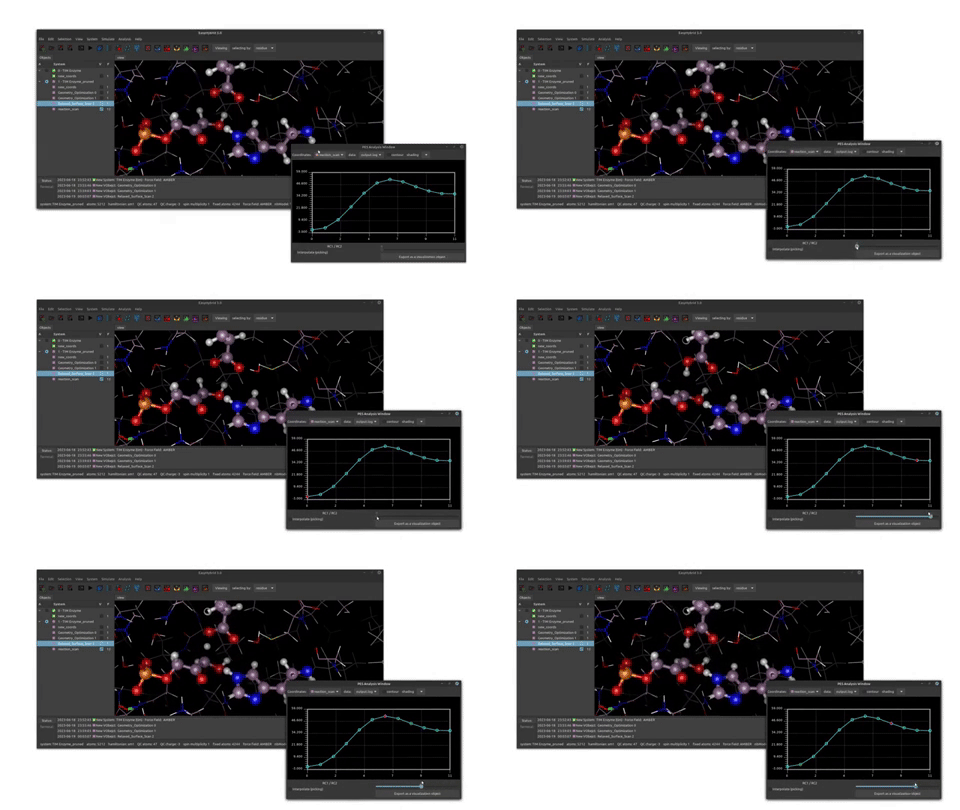
A QM/MM simulation highliting bond breaking and formation-Easy Hybrid

A molecular dynamics simulation of a protein within a membrane- S. Menzel
The next important thing is to increase the accuracy of the docking. It is paramount to assure that the docking of the original enzyme is as accurate as possible. This is such that when engineered enzymes are tested, if the docking appears worse, we know it is not a consequence of inaccuracy in the docking, but rather an issue with the engineered enzyme.
Finally, once all of this has been completed, the programming of the AI model that will be taking in all of this data and making the predictions can officially begin. At present, I am continuing to study and play with different model architectures, such that when all the data is prepare, I can attempt different architectures and then pick the best performing one for further optimisation and development. I am also developing a library of enzymes, and their successfully mutated and failed mutated counterparts, which shall be used to train the AI model, such that it can learn how to effectively use the data to predict enzyme performance.
Now, this may have you asking. Why AI? The simple answer, it can see what we can’t. When used in enzyme engineering, AI has consistently been able to find and recommend protein structure alterations that we had previously been unable to identify ourselves. It is able to do this because it can through orders of magnitude more data than we can, and do it in a matter of minutes to hours. It is this same ability that I am trying to carry over to protein performance prediction. Why should our use of AI end at making predictions for alterations that may improve those enzymes? Well, it doesn’t have to, and that’s why I chose to integrate it in the enzyme testing process as well.
My Take
My choice not just to embark on this project, but to get into the computational simulation of enzymes in the first place was born purely out of constraint.
As a student working on microplastic bio-remidiating metamaterial, I quickly learned that enzyme engineering would be an unavoidable need for my work. However, this being a mainly self funded project, I realised that it would be financially difficult to express 1 mutant batch of an enzyme, let alone tens or hundreds. So naturally, I looked for alternative means and landed upon all of the previously outlined computational enzyme analysis methods. Still, these didn’t actually show me how my engineered candidate was likely to perform against the original, which is what got me into pursuing computational analysis in the first place.
Thus, I decided to make a solution. To make an algorithm that would allow me be able to make sure that the few enzyme mutants I would be able to muster the resources to produce would have a high chance of functioning as needed. This solves a problem that doesn’t just affect me, but also affects multiple other researchers out there facing the constraints of a lack of resources.
And since you’ve made it this far…
Thank you for taking your time to read! To keep up to date, subscribe to my Medium and to my newsletter! It will allow you to explore some of the other bio, and quantum physics research projects I am working on, whilst giving you access to my mind as you see some of the articles, or quotes, or mindsets I find interesting and worth sharing. Even better, you will be notified when I publish the article covering how I add on QM/MM to the pipeline, and then make the AI model.
메타데이터
- post_id
- 90b44c0d91be
- slug
- code-to-catalysis-computational-enzyme-testing-creating-a-pipeline-to-dock-ligands-in-the-enzyme-90b44c0d91be
- url
- https://medium.com/@rafikihalisi/code-to-catalysis-computational-enzyme-testing-creating-a-pipeline-to-dock-ligands-in-the-enzyme-90b44c0d91be
- canonical_url
- https://medium.com/@rafikihalisi/code-to-catalysis-computational-enzyme-testing-creating-a-pipeline-to-dock-ligands-in-the-enzyme-90b44c0d91be
- author_url
- https://medium.com/@rafikihalisi
- status
- ok
- fetched_at
- 2026-06-09 15:37:30