Can You Really Run a Marathon on Three Runs a Week?
Short answer: Yes.
Can You Really Run a Marathon on Three Runs a Week?
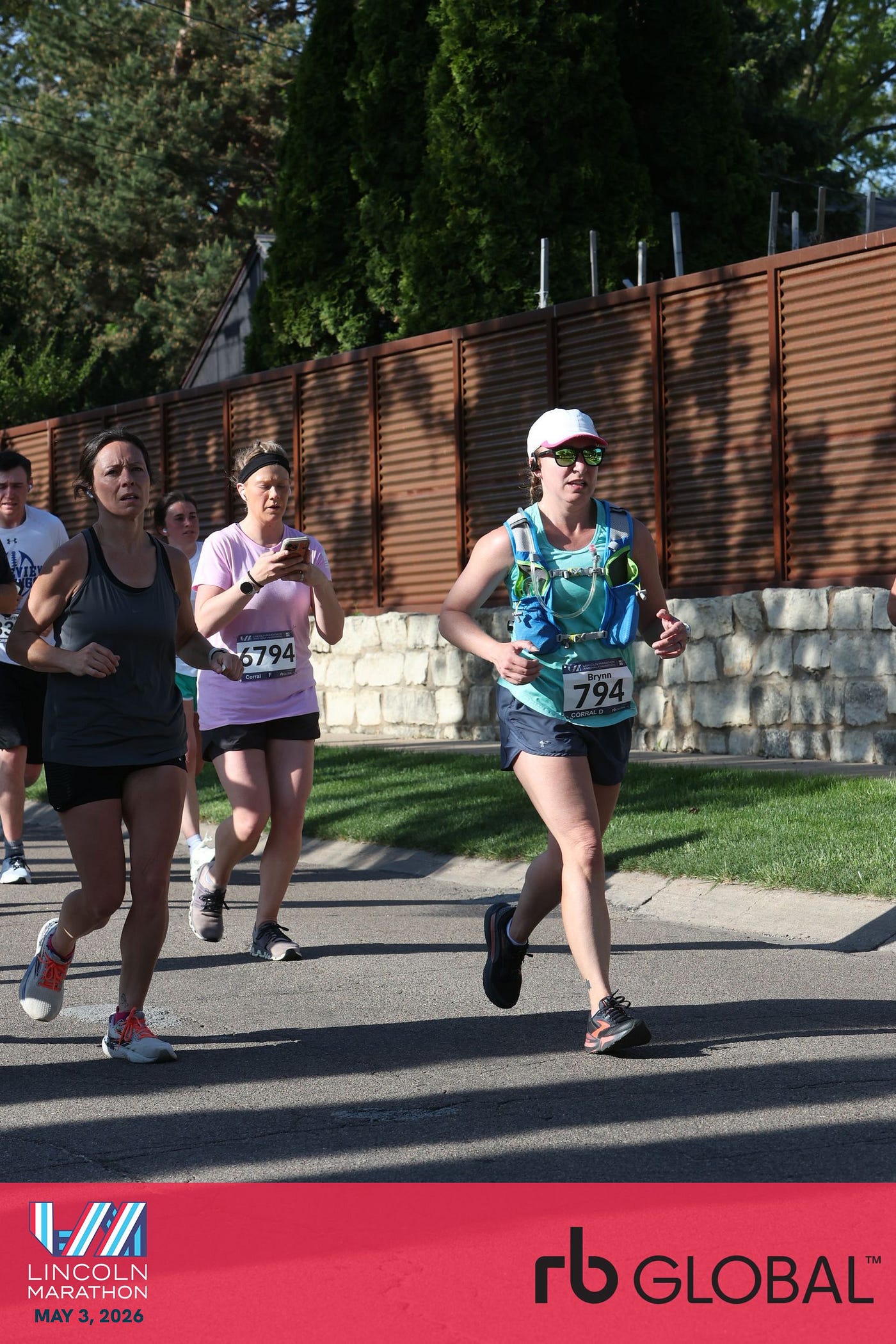
Race photo provided by the Lincoln Marathon. The first few miles of the Lincoln Marathon — so far so good!
Short answer: Yes.
But can you do it well? Also yes!
Here’s my experience with a three-day-a-week training plan.
Why three days a week?
Marathon training is notoriously challenging:
- The training block is typically at least 16 weeks long.
- It usually requires weekly mileage topping out at 60+ miles spread over five to six days per week, even for “easy” training plans (some go closer to 80–100+ miles per week!).
- It requires multiple hours dedicated to long runs every single weekend for months.
It’s a major commitment, especially if you have responsibilities like, oh, I don’t know, a job, a family, or any other commitments at all.
I ran my last marathon in 2001. For some reason, 2026 seemed like a good year to take another one on, but I absolutely did not want to run five or six days a week to train for it.
I’m 43 years old. Recovery times are longer than they used to be. Life is busier than ever with four teenagers and two pre-teens at home and a busy freelance career. Plus, I’ve found great joy in weightlifting, and running five or six days a week would require giving that up, at least for a season, because there’s only so much time in a week.
I stumbled upon the FIRST Marathon Method on a Reddit thread. It’s technically designed to get people across the finish line for their first marathon. It’s an 18–week plan that peaks at just 32 miles a week, which probably sounds insane, and maybe it is.
I’m no marathon beginner — I already have almost a dozen marathons and two ultras under my belt — but since it required only three days a week of running, I figured I’d give it a shot.
Worst-case scenario, I would suffer for several hours on the marathon course. Been there, done that, not a huge deal in the grand scheme of things.
Best-case scenario, I’d set a new PR (or at least get close) while also living my normal life.
Until I decided to do this race, I had been “training” for 10ks and half marathons throughout the past year on 10–15 miles spread over two days a week, total. Certainly not setting any PRs, but just staying in shape. My half times ranged from 2:10 to 2:15, and my training strategy was haphazard at best (more like, “Hmmm, how far should I run today?” than any sort of actual strategy). This training plan would give me structure without overwhelming my calendar.
The training plan
The training plan is made up of three types of runs done once each week: intervals, strength runs, and long runs. Every single run has a purpose and a pace. There are no “easy runs” in this training plan.
There are cross-training days, where you’re supposed to do 30–45 minutes of cross-training of some sort two to three days per week. I took the term “cross-training” a little to the extreme, mostly because I wanted to keep lifting weights and playing soccer. On Fridays, I counted lifting weights as my cross-training, which was probably stretching the definition a bit.
My weekly schedule looked like this:
- Monday: Lift in the morning (1 hour), soccer in the evening (1.5 hours, totaling 2.5 hours, which is a bit longer than the 30–45 minutes recommended)
- Tuesday: Interval run
- Wednesday: 30–45 minute bike ride, possibly a short lifting session if time/energy allows
- Thursday: Strength run
- Friday: Lift in the morning, eat food to prepare for Saturday :)
- Saturday: Long run
- Sunday: Off
I also walk a fair amount (usually 1–3 miles each day), but I didn’t really count that towards my training.
My training went well overall. I think I missed only one long run. I got pretty sick and didn’t want to push my body, but it was on a recovery week, so I didn’t feel too bad about it. I missed hitting my goal pace on one or two strength runs as well, but I still covered the distance and got as close as I could to the goal pace.
One thing I screwed up towards the beginning was that I was trying to cut some weight and eat in a caloric deficit to lose fat. Unfortunately, that made Saturdays very, very hard, and I gave up on that plan once my long runs reached two-plus hours. Pro tip: Marathon training and weight loss don’t mix!
The Results
I trained for a goal time of 4:30. If I hit it, that would be my third fastest marathon time ever (my fastest is 4:25, second fastest is 4:27, if you don’t count my treadmill marathon of 3:58, which I don’t!).
The wheels started falling off a little over halfway through the race. I reached the halfway point at 2:14:26, almost exactly on target, but just couldn’t keep up the pace.
I can’t really blame it on anything in particular. It was a little hotter than I’d like, but not awful. I drank enough water for sure. I probably didn’t take in enough calories (something I struggled with even on my long training runs).
I finished in 4:41, which was still my third-fastest marathon time EVER, and ended up at 25th out of 42 in my age group.
I’m still pretty pleased with the results. My last two marathons, I’ve missed my goal by 10 and 27 minutes, respectively (while using a much more demanding training plan), so missing this one by 11 minutes felt kind of on par for me. And with a completely experimental training strategy, and being five and eight years older, respectively, I felt like this was a huge win.
Takeaways
Would I do this training plan again? Absolutely. I didn’t feel like I was married to my training; I didn’t feel exhausted all the time, and I still got to play soccer and lift weights, two things I love that I would have probably needed to give up to do a traditional training plan. I also volunteered to coach two of my kids’ soccer teams over the spring, which I never would have had the energy (or time) for if I were doing a traditional marathon training plan.
Considering the fact that I’ve missed the mark every time when training for a specific pace goal in the marathon, I am not sure that it can be blamed on the training plan itself. I may need to adjust my training ambitions — for example, to hit a 4:30 marathon, I may need to adjust all my paces as though I’m training for a 4:15 marathon.
It did take a full two weeks to feel like I was recovered. I’m not sure if that’s age-related or if I’ve just forgotten how long recovery takes, since it’s been five years since my last marathon. But I don’t think that has to do with the training plan, either.
Should you do this plan?
If you have a decent running base and are short on time, but want to finish a marathon, I think this is an excellent plan.
It starts at about 18 miles per week, so it’s definitely not something you should just jump into with no training. But if you recently finished a half-marathon or are running 10–15 miles a week regularly, I think this plan could work for you.
What’s next
Next up for me is a 12-hour trail race, which I have also trained for by running only three days a week since my marathon. This may have been (probably was) a terrible idea; I’ll find out in about five days! My A goal is to finish 51 miles; B goal is to finish 42 miles. My C goal is to not die, I guess? I have no idea what to expect from myself, given the June heat and humidity, plus running on single-track trails. It’s gonna be great though!
And after that, possibly the Moab Trail Marathon, which has 5,000 feet of elevation gain over its 26.2 miles. I don’t anticipate adding more training days for that, either, though I may trade my bike rides for a stair stepper session at the gym.
Marathons are hard no matter what training plan you use or how in shape you are. Ultimately, your training should fit into your life and match your priorities.
Not everyone is cut out to, or wants to, run 60+ miles per week. This training plan provides a good balance of letting you finish a marathon while still living a somewhat normal life outside of running.
메타데이터
- post_id
- 91efc8f6b67c
- slug
- can-you-really-run-a-marathon-on-three-runs-a-week-91efc8f6b67c
- url
- https://medium.com/runners-life/can-you-really-run-a-marathon-on-three-runs-a-week-91efc8f6b67c
- canonical_url
- https://medium.com/runners-life/can-you-really-run-a-marathon-on-three-runs-a-week-91efc8f6b67c
- author_url
- https://medium.com/@brynn-mahnke
- status
- ok
- fetched_at
- 2026-06-27 07:40:21