CRISPR-Rewriting the Genetic Code
Some of the readers might have already perused my previous article on the CRISPR-Cas9 technology and its use for improving crops. Gene…
Demystifying Science
CRISPR-Rewriting the Genetic Code
Some of the readers might have already perused my previous article on the CRISPR-Cas9 technology and its use for improving crops. Gene cloning with the help of the technique of recombinant DNA technology has had several success stories and made an incredible impact in medicine, agriculture, and industry. In this article, I have made an attempt to demystify and simplify the technology of gene editing and its uses. This technology could modify the genetic code of any living being, fixing mutations, removing hereditary diseases, or even improving qualities such as intelligence or brawn. This is no longer science fiction; this is the reality of CRISPR, the revolutionary gene editor that is rewriting biology, medicine, and agriculture. Let’s dive in and see:
What Is CRISPR?
CRISPR is an acronym for Clustered Regularly Interspaced Short Palindromic Repeats. It is a built-in defense mechanism employed by bacteria to combat viruses. Scientists could use this tool, particularly a protein, an enzyme known as Cas9, to make precise incisions in DNA with the accuracy of a pair of scissors. The genes could be precisely edited using CRISPR-Cas9- inserting, removing, or altering a particular DNA sequence.
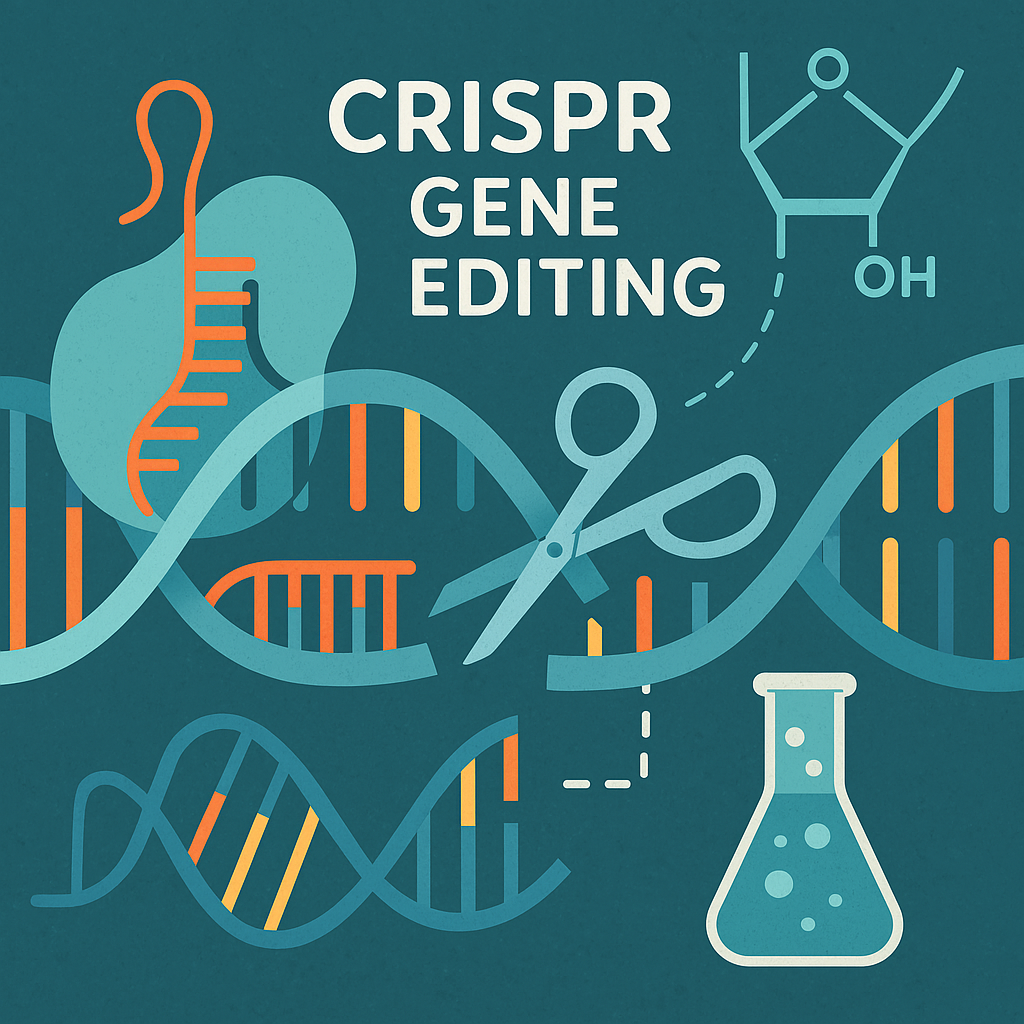
Image by Author using AI tool
How It Functions
Fundamentally, CRISPR technology consists of two major elements:
- Guide RNA (gRNA): A small artificially prepared RNA complementary to the target DNA sequence.
- Cas9 enzyme: This enzyme cleaves the DNA at the position indicated by the guide RNA. Essentially a genome editor, it functions as a scissors that cleaves DNA at a specific position under the instruction of RNA. After the DNA has been cut, the cell will attempt to mend it naturally. This process of fixing the DNA can be exploited to introduce genetic information, essentially rewriting the genetic code.
Applications
Already, CRISPR has proved to be a game-changer across various disciplines:
- Medicine: Sickle cell anemia, cystic fibrosis, and muscular dystrophy are potential targets for genetic diseases. The UK became the world’s first nation to approve, in 2023, a CRISPR-based treatment for curing sickle cell disease. The therapy targets the patient’s own cells for modification to produce fetal hemoglobin. There are some fascinating uses being researched to treat cancer, HIV, and reverse age-related illness.
- Agriculture: GMOs traditionally make use of DNA pieces from other living things, and that has long been the biggest point of contention with the production of GMOs. But there have been attempts to go around that by applying CRISPR to make the plants drought-resistant, grow faster, and resist pests without the incorporation of foreign DNA, making CRISPR-edited plants less controversial than traditional GMOs.
- Biodiversity and conservation: Researchers are investigating gene editing to bring back extinct animals such as the woolly mammoth, or to manage invasive populations (e.g., gene drives to lower disease-spreading mosquitoes).
The Ethical and Legal Implications
While CRISPR carries great potential, it also poses deep ethical issues:
- Designer Babies: A scientist from China announced in 2018 that he had edited human embryos to resist HIV. This caused global outrage, since the edits were not only unnecessary but also risky and permanent, fuelling fears of tampering with the natural process.
- Equity and Access: Will gene editing therapies become reserved for the affluent only, exacerbating health inequalities?
- Unintended Consequences: Long-term effects or off-target edits are not yet well understood. The community of scientists has demanded careful and regulated use, particularly for those altering the human germline (i.e., inheritable DNA).
Image by Maxwell Joe from Pixabay
The Future of CRISPR
Aside from CRISPR-Cas9, newer technologies such as base editors and prime editors make gene editing less invasive and more precise. Some of the promising leads include:
- One-shot solutions for genetic diseases
- Cancer-fighting T cells that are safer
- Gene-editing “vaccines” for viral infections
Over the next ten years, CRISPR may transition from the laboratory into the clinic, the farmhouse, and even conservation efforts, altering life itself. CRISPR may already be the most powerful biological tool that exists. It promises the capacity to heal diseases, redefine food production, and even push the limits of evolution. However, with such power, there would come tremendous responsibility. This has also raised a number of ethical, moral, legal, and social issues.
Interesting titbits
As per a study by the Science Citation Index till 2022, there were 12799 papers published on CRISPR technology.
The Nobel Prize in Chemistry for 2020 was awarded for this path-breaking discovery.
The above is an oversimplified version of this fascinating technology and is directed to a lay person.
If you found value in this article, please like and share the same and give your valuable comments.
메타데이터
- post_id
- 937737aae772
- slug
- crispr-rewriting-the-genetic-code-937737aae772
- url
- https://medium.com/technology-hits/crispr-rewriting-the-genetic-code-937737aae772
- canonical_url
- https://medium.com/technology-hits/crispr-rewriting-the-genetic-code-937737aae772
- author_url
- https://medium.com/@drtvan
- status
- ok
- fetched_at
- 2026-06-09 15:37:30