When FIFA Tried to Hide a Logo and Accidentally Made It Famous
Here’s a fun one from the World Cup: FIFA spent months and millions making sure no unofficial brand could sneak into a stadium. Then a…
When FIFA Tried to Hide a Logo and Accidentally Made It Famous
Here’s a fun one from the World Cup: FIFA spent months and millions making sure no unofficial brand could sneak into a stadium. Then a 170-year-old denim company proved that you don’t need a logo to be recognized, you just need a shape.
Let’s get into it.
The Rule Nobody Outside Marketing Knew Existed
FIFA has something called a “clean venue” policy, and it’s exactly as strict as it sounds. Every World Cup stadium has to be wiped of any branding that isn’t an official tournament sponsor. Not “toned down.” Wiped. FIFA renamed all 15 host venues across North America that had a corporate sponsor attached to them, and stadiums with naming-rights deals had their signage covered with tarps.
You would wonder, Why go this far?
Because official FIFA sponsors pay up to** $200 million for a four-year sponsorship cycle, with some tournament-specific deals running as high as $100 million.**
If you’re Coca-Cola or Visa writing that check, you don’t want a competing logo sneaking into the background of a TV broadcast. FIFA’s job is to make sure that doesn’t happen for anyone who didn’t pay to be there.
So venues across the U.S., Canada, and Mexico got new, deliberately boring names for the tournament.
Mercedes-Benz Stadium in Atlanta became “Atlanta Stadium.” Lumen Field became something equally generic as ‘Seattle Stadium.’ And Levi’s Stadium in Santa Clara, home of the San Francisco 49ers, became “San Francisco Bay Area Stadium.”
There was exactly one exception to the rule, and it’s a good one: Mercedes-Benz Stadium got to keep its actual Mercedes logo on the retractable roof, because removing it risked damaging the roof itself.
Everywhere else, FIFA’s enforcement was relentless. Inside the Levi’s Stadium press box, even condiment bottle logos got blacked out with tape so they wouldn’t appear on camera.
At Gillette Stadium in Foxborough, crews put blue tape over the logos on all **64,146 seats. Tape.** On 64,146 seats. That’s commitment.
Then Levi’s Logo Disappeared. Sort Of.
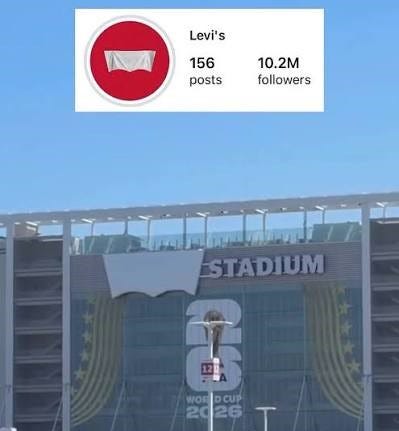
Here’s where it gets interesting. At Levi’s Stadium, massive white tarps covered the Levi’s logo both outside and inside the building. By the book, FIFA did exactly what it set out to do: erase the brand.
Except it didn’t, really.
The tarp followed the exact outline of the batwing, the curved double-stitch shape on the back pocket of Levi’s jeans, a design detail dating back to 1873 and turned into a logo in 1967.

So the word “Levi’s” was gone, but the shape of Levi’s was sitting right there in plain sight in a 49,000-seat stadium, on national television.
And people noticed instantly. Fans recognized the brand the moment they saw the covered sign, even with zero text on it. That’s the whole story in one sentence: FIFA removed a name and accidentally created the most-photographed logo of the opening week
Levi’s Didn’t Just Notice the Irony. It Levitated With It.
Most companies in this position would shrug and wait it out. Levi’s however leaned all the way in
After the first match at the venue, Qatar versus Switzerland. Levi’s posted on Instagram with the caption “Welcoming the world to the beautiful [redacted] stadium!” set to the trending “How will they know” TikTok audio. They didn’t stop there. The brand also changed its own Instagram profile picture to match the covered logo.
It’s a small move, but it’s a smart one.
Instead of fighting the joke, Levi’s became the joke, on its own terms, in its own voice, for free.
Videos and photos of the shrouded batwing logo at the stadium entrance and above the scoreboard went viral over the following days.

And the bit didn’t stay in Santa Clara. Levi’s took the covered-logo gag global, putting the same white-sheet treatment on storefronts in Paris, London, Brazil, Mexico, and Hong Kong. One stadium tarp turned into an international campaign and Levi’s didn’t have to write a single ad to make it happen
This wasn’t a textbook **ambush marketing campaign. It was an accidental ambush opportunity. FIFA’s sponsorship protections unintentionally handed **Levi’s a cultural moment, and decades of brand building allowed the company to turn that moment into earned media.
Why This Actually Worked (the Marketing Part)
Strip away the fun and there’s a genuinely useful lesson buried in here, especially if you think about brand recognition for a living.
Marketers call what happened a distinctive brand asset, a shape, color, or visual cue so embedded in people’s heads that it works without the name attached. Nike’s swoosh. The Golden Arches.
Levi’s batwing has been doing this job since 1967, and FIFA’s cover-up accidentally became a live demonstration of it.* Levi’s itself pointed to the moment as confirmation that the batwing can function as a standalone emblem, independent of any text.*
There’s also a classic case of the Streisand effect at play, the phenomenon where trying to hide something makes people pay more attention to it, not less. The covered batwing arguably became more noticeable once it was tarped over than it would have been if FIFA had simply left it alone. FIFA wasn’t trying to start a viral moment. It was just enforcing a sponsorship contract. The internet did the rest.
And then there’s the part every marketer/ PR agency secretly wants: Earned Media. Levi’s didn’t buy a single placement to get this attention. News outlets covered it because it was a genuinely odd, funny story. Fans shared it because it was relatable. None of that shows up on an invoice.
So Who Actually Won: Levi’s or FIFA’s Real Sponsors?
It’s tempting to call this a clean win for Levi’s, and on the social-media-buzz scoreboard, it kind of is. But it’s worth being honest about what FIFA’s actual sponsors were paying for in the first place, because it wasn’t “don’t get upstaged on Instagram for a weekend.”

Official sponsors bought something much bigger: guaranteed presence across broadcast graphics, official World Cup branding, hospitality programs, and global ad campaigns that ran for months before a single ball was kicked. That’s a different kind of value than a viral moment, slower, broader, and a lot less photogenic, but real all the same.
Levi’s, on the other hand, got something sponsors can’t buy at any price: a moment that felt spontaneous. People didn’t feel like they were looking at an ad. They felt like they were in on a joke. That distinction, paid visibility versus earned conversation is the whole story here, and it’s exactly why this is worth remembering past the World Cup news cycle.
The Takeaway
FIFA spent serious money and effort trying to make sure no unofficial brand got free attention inside its stadiums. And for one weekend in Santa Clara, the rule worked exactly as written. Levi’s name was completely gone and it still didn’t matter. The shape was enough.
That’s the kind of brand equity you can’t build with a clever stunt or a big media buy. You build it over decades, then a stadium tarp happens to remind everyone it was there the whole time.
메타데이터
- post_id
- 9b08c62552a9
- slug
- when-fifa-tried-to-hide-a-logo-and-accidentally-made-it-famous-9b08c62552a9
- url
- https://medium.com/@valasys/when-fifa-tried-to-hide-a-logo-and-accidentally-made-it-famous-9b08c62552a9
- canonical_url
- https://medium.com/@valasys/when-fifa-tried-to-hide-a-logo-and-accidentally-made-it-famous-9b08c62552a9
- author_url
- https://medium.com/@valasys
- status
- ok
- fetched_at
- 2026-07-27 23:51:09




