Your Website Traffic Dropped After Adding Consent Banners — Here’s Why That’s Not Entirely Bad News
And what you should do next to protect your data strategy
Your Website Traffic Dropped After Adding Consent Banners — Here’s Why That’s Not Entirely Bad News
And what you should do next to protect your data strategy
Photo by Myriam Jessier on Unsplash
If you’ve recently implemented consent management banners on your website — whether driven by GDPR, CCPA, or simply best practice — you’ve probably noticed in your Google Analytics dashboard: your user-traffic numbers decreased.
You’re not imagining things. And you’re definitely not alone.
Across industries, marketers and business owners are reporting traffic drops of 20–40% after activating cookie consent platforms with Google’s Consent Mode integration. It’s jarring. It feels like something broke. But before you panic, let’s talk about what’s actually happening — and why this shift may be the best thing to happen to your analytics.
Most of the Traffic You Lost Was Probably Spam or Bot Traffic
A significant portion of the user-traffic that disappeared was never comprised of real, engaged humans evaluating your product or service.
When consent banners are properly implemented, analytics tracking scripts only fire for users who actively opt in. That means the visits that vanish from your reports likely fall into a few categories:
- Bot traffic that never interacted with consent prompts
- Spam that bypassed engagement entirely
- Bounce visitors who left before the banner even rendered
- Users who genuinely declined tracking (a smaller percentage than most assume)
The result? After the initial drop, most sites see a meaningful increase in average engagement time. Your numbers are smaller, but they’re real. You’re finally looking at a clean picture of your actual audience — the people who matter for your business decisions.
This is a paradigm shift. For years, we’ve been making strategic decisions based on inflated data. Consent management forces a correction, and that correction is ultimately healthy.
GA4’s Blended Reporting Identity
Now, let’s talk about recovery from users who rejected your cookies — because Google anticipated this problem and built a solution directly into GA4.
If you navigate to Admin > Reporting Identity, you’ll find an option called “Blended.” This is an unknown feature in GA4, that your marketing team should be exploring.
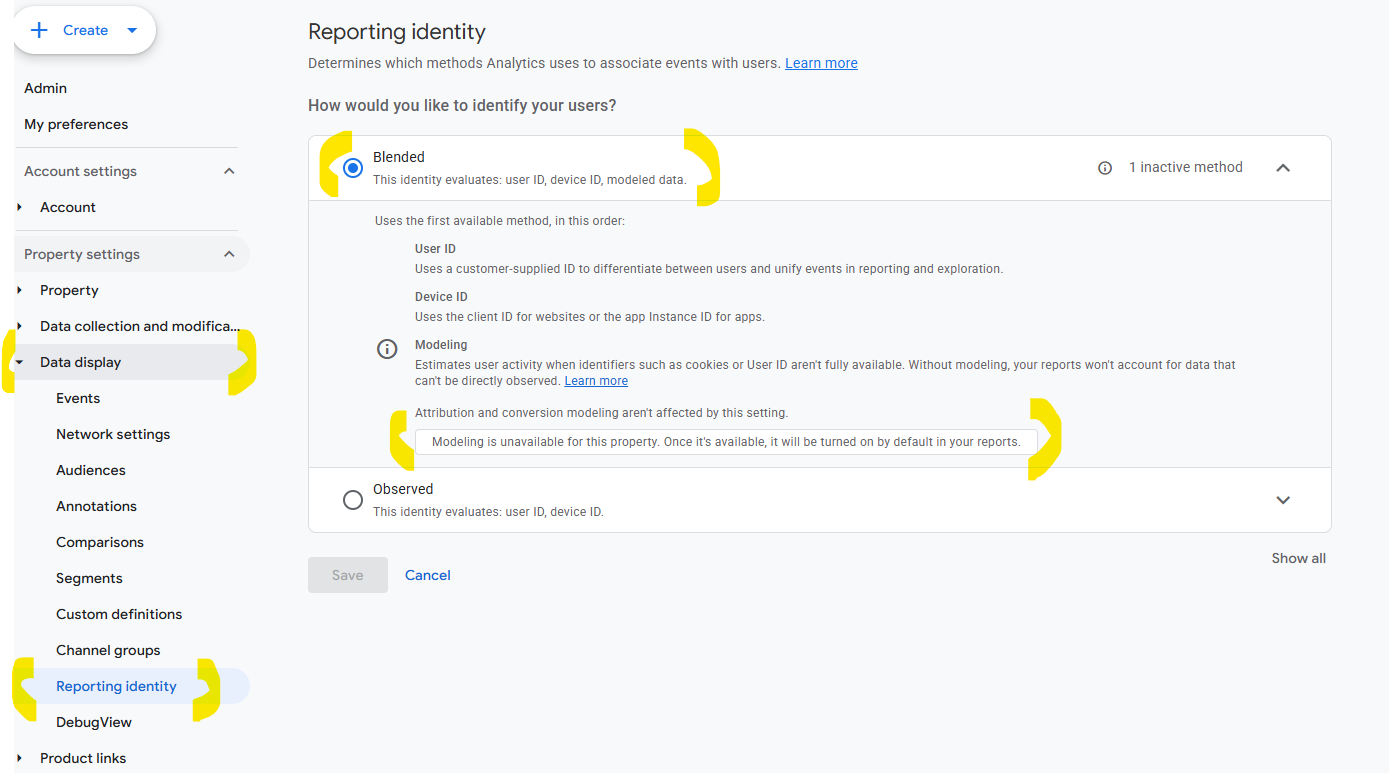
Screenshot of a GA4 property that is not yet eligible for Blended
What does Blended do?
When a user rejects cookies, GA4 traditionally loses visibility into that session entirely. Blended reporting identity changes this by leveraging Google’s AI-powered behavioral modeling to estimate what those unconsented sessions likely looked like — based on patterns from users who did consent.
In practical terms, it fills in the data gaps. Your reports become more complete without violating anyone’s privacy preferences. It’s not fabricating data; it’s using statistical modeling (similar to how census data works) to project a fuller picture.
The Prerequisites You Need to Meet
Here’s where it gets technical. Behavioral modeling in GA4 isn’t automatically available to everyone. Google requires certain thresholds before the AI can generate statistically reliable models:
- Google’s Advanced Consent Mode must be active on your banners: Basic Consent Mode simply blocks all data collection when a user declines. Advanced Consent Mode still sends cookieless pings to Google — anonymized signals that allow the modeling algorithm to work. If your consent platform only supports basic mode, you’ll need to upgrade your implementation.
- At least 1,000 rejected cookies per day for a minimum of 7 consecutive days: Google needs a sufficient volume of declined events to identify patterns worth modeling. If your site doesn’t generate this volume, the algorithm simply doesn’t have enough data points to work with reliably.
- At least 1,000 accepted cookies for a minimum of 7 of the past 28 days: The model also needs a robust control group — consented users whose full behavior is tracked — to serve as the baseline for its projections.
What If You Don’t Meet Those Thresholds?
Let’s be honest: those prerequisites exclude a lot of small-to-mid-sized businesses. If your site gets 500 visits per day, you’re likely not generating 1,000 cookie rejections daily.
This is exactly where first-party data becomes your most valuable asset — and where a CRM becomes the infrastructure you need.
Platforms like HubSpot or GoHighLevel allow you to:
- Track leads from qualified to closed deal without relying on third-party cookies
- Integrate directly with paid media platforms (Google Ads, Meta, LinkedIn) to feed offline conversion data back into your ad algorithms.
- Build attribution models based on actual revenue, not just clicks.
- Track MQLs, SQLs, and actual sales as conversion events — giving your ad platforms far richer optimization signals than a simple form submission ever could
When you feed offline conversion data back into platforms like Google Ads, you’re telling the algorithm: “This is what a real customer looks like. Find me more of them.” The performance lift from this approach consistently outperforms traditional pixel-based tracking.
The Bigger Picture: Why First-Party Data Is More Important Than Ever
I’ve been advocating for first-party data strategies for a long time, and the shift toward mandatory consent management is the clearest validation yet.
Consider the trajectory:
- 2018: GDPR goes into effect in the EU
- 2020: CCPA brings similar requirements to California
- 2021: Apple’s App Tracking Transparency decimates Meta’s ad targeting
- 2024–2025: Google phases out third-party cookies in Chrome (after multiple delays)
- 2025–2026: Consent enforcement tightens globally; more countries adopt strict frameworks
We are moving further away from third-party tracking — not in some hypothetical future, but right now, in measurable ways that directly impact your bottom line.
Businesses that build robust first-party data systems today aren’t just solving a compliance problem. They’re building a competitive advantage. While competitors scramble to figure out where their leads are coming from, you’ll have a clear, consent-compliant pipeline from ad click to closed revenue.
Your Action Plan
Here’s what I’d recommend, regardless of your traffic volume:
- Audit your consent implementation. Ensure you’re running Advanced Consent Mode, not just basic.
- Check your GA4 Reporting Identity settings. Switch to Blended if you haven’t already.
- Evaluate your eligibility for behavioral modeling. Check your daily consent/rejection volumes.
- Implement a CRM with offline conversion tracking. This is your insurance policy — and often your best-performing data source regardless.
- Stop mourning inflated traffic numbers. Start celebrating cleaner data and better decision-making.
Final Thought
Don’t view consent management as a setback — it’s a filter. It’s separating marketers who relied on bloated vanity metrics from those who build real measurement infrastructure.
The traffic drop you’re seeing isn’t a problem to fix. It’s a signal to improve.
I help agencies and companies build first-party data systems and consent-compliant tracking infrastructure. If you’d like to discuss your setup, connect with me on LinkedIn or visit my website.
메타데이터
- post_id
- adfc0c366f0e
- slug
- your-website-traffic-dropped-after-adding-consent-banners-heres-why-that-s-not-entirely-bad-news-adfc0c366f0e
- url
- https://medium.com/fullstack-ppc/your-website-traffic-dropped-after-adding-consent-banners-heres-why-that-s-not-entirely-bad-news-adfc0c366f0e
- canonical_url
- https://medium.com/fullstack-ppc/your-website-traffic-dropped-after-adding-consent-banners-heres-why-that-s-not-entirely-bad-news-adfc0c366f0e
- author_url
- https://medium.com/@matnelsonppc
- status
- ok
- fetched_at
- 2026-07-08 19:15:55