Is There Ever a Moment You Actually Want to See an Ad?
Most people describe advertising as something to endure, a tax on attention paid in exchange for free content. That reputation is not…
Is There Ever a Moment You Actually Want to See an Ad?

BRNDTS Technology in Action
Most people describe advertising as something to endure, a tax on attention paid in exchange for free content. That reputation is not entirely fair. An ad, at its most basic, is a piece of commercial information delivered to someone who has not asked for it directly, and depending on timing, that same piece of information can feel either like an intrusion or like a gift. Consider the difference between an ad that interrupts a recipe you are reading for the third time this month and an ad that shows up the moment you are actually shopping for a new oven. The message is structurally identical, a paid placement trying to earn a click, yet the emotional response could not be more different. That gap between annoyance and usefulness is the real subject of this article, and it points toward a question the industry has spent two decades avoiding: is there a moment when a person genuinely wants to see an ad, and if so, what separates that moment from all the others where advertising simply gets in the way?
When Advertising Actually Helps
There are specific moments in daily life when a person is not just tolerant of commercial messaging but actively looking for it. Someone searching for a specific appliance, a blender that can crush ice or a printer that supports a particular paper size, is not offended by a sponsored listing that answers the question directly. The same is true for someone who needs a plumber at nine on a Sunday night and wants to know, quickly, who is available and nearby. In both cases the person has already decided to spend money, and the only open question is where. An ad that resolves that question is not noise, it is infrastructure.
The same logic extends to price comparison. A shopper who already knows she wants a specific pair of running shoes still benefits from seeing which retailer has them in stock at the best price this week, and a well placed ad can save real time and real money in that exact moment. Event discovery works similarly. A person wondering what is playing at the local theater or which concerts are coming to town is, in effect, asking the market a question, and an ad that answers with relevant listings is doing useful work rather than interrupting anything. What connects all of these examples is intent. The viewer has already stepped into a buying or comparing mindset, and the ad simply meets them there.
Where the Frustration Comes From, and How the Industry Got Here
That contrast becomes sharper once you notice how differently advertising performs outside of these intent driven moments. Reading a recipe, studying a history topic, or catching up on a news story are all activities built around learning or routine, not purchasing decisions, and inserting a sales pitch into that flow breaks the rhythm of what the person came to do. The same applies to habits people have already settled, the brand of milk or soap someone buys without thinking, where a competing ad has almost nothing to offer beyond distraction. General research, when someone wants a plain fact rather than a persuasive angle, is perhaps the clearest case of all: the ad adds friction precisely because nothing was being sold in the first place.
Understanding why this frustration became so widespread requires looking at how digital advertising actually scaled. The early internet monetized attention through volume, banners, pop ups, and pre roll video that interrupted whatever the user was doing regardless of what that activity happened to be. Placement was sold by inventory, a slot on a page or a few seconds before a video, not by relevance to the moment the viewer was in. That model worked reasonably well when competition for attention was low, but as more brands entered the same channels, the volume of interruption grew faster than the sophistication of targeting. The result was an ecosystem trained to interrupt first and ask about relevance later, if at all.
What This Costs Viewers and What It Costs Brands
That mismatch between placement and moment produces consequences on both sides of the transaction, and they compound each other. For viewers, the cost is cumulative fatigue. Each irrelevant ad trains the brain a little further to filter out anything that looks like a sales message, a phenomenon marketers call banner blindness but which really describes a broader defensive reflex against being interrupted at the wrong time. Once that reflex sets in, even genuinely useful ads get ignored along with the noise, because the viewer has learned that scanning past all of it is safer than evaluating each one individually.
For brands, this shows up as a direct financial problem rather than an abstract one. Generic, broadly targeted messaging produces low engagement and weak conversion, and every impression that fails to convert still carries a cost. Marketers respond by buying more inventory to compensate, which raises acquisition costs without addressing the underlying issue, since the strategy is treating a relevance problem as a volume problem. Over time this creates a spiral: broad targeting produces poor results, poor results are answered with more spend, and more spend produces more of the same interruptive advertising that caused the fatigue in the first place. Breaking that cycle requires a different starting point, one that treats the viewer’s context as the primary design constraint rather than an afterthought.
Designing Around the Moment, Not the Second
That reframing, treating context as the starting point rather than an afterthought, changes what advertisers should actually be optimizing for. For years the dominant metric in advertising has been exposure time, how many seconds an ad held someone’s attention, on the assumption that longer exposure meant deeper impact. But exposure time measures presence, not welcome. A fifteen second pre roll that a viewer skips the instant the skip button appears has technically achieved its exposure, yet it has taught the viewer nothing except to distrust the next ad in the queue. What matters far more than duration is whether the ad arrived at a moment when the viewer had a reason to care.
Designing for relevance rather than exposure means building systems that can distinguish between someone who is actively comparing purchase options and someone who is simply trying to finish watching a show. It means recognizing that the same viewer can be a perfect audience for an ad in one context and an entirely wrong audience for the same ad thirty minutes later in a different context. This requires more than better targeting algorithms, it requires rethinking where and how an ad physically appears within the experience itself, so that its presence feels native to the moment rather than layered on top of it.
How BRNDTS Approaches the Problem
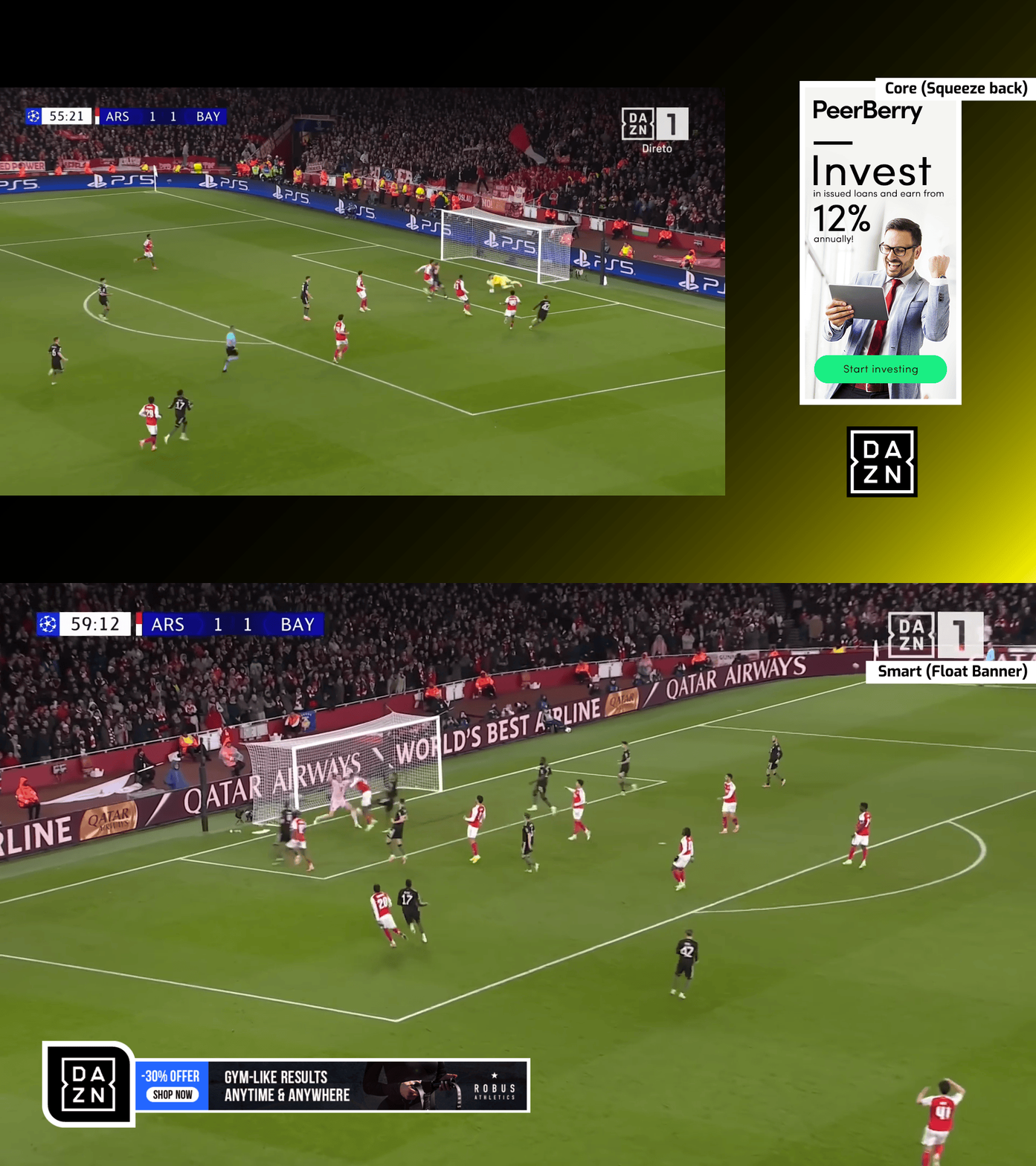
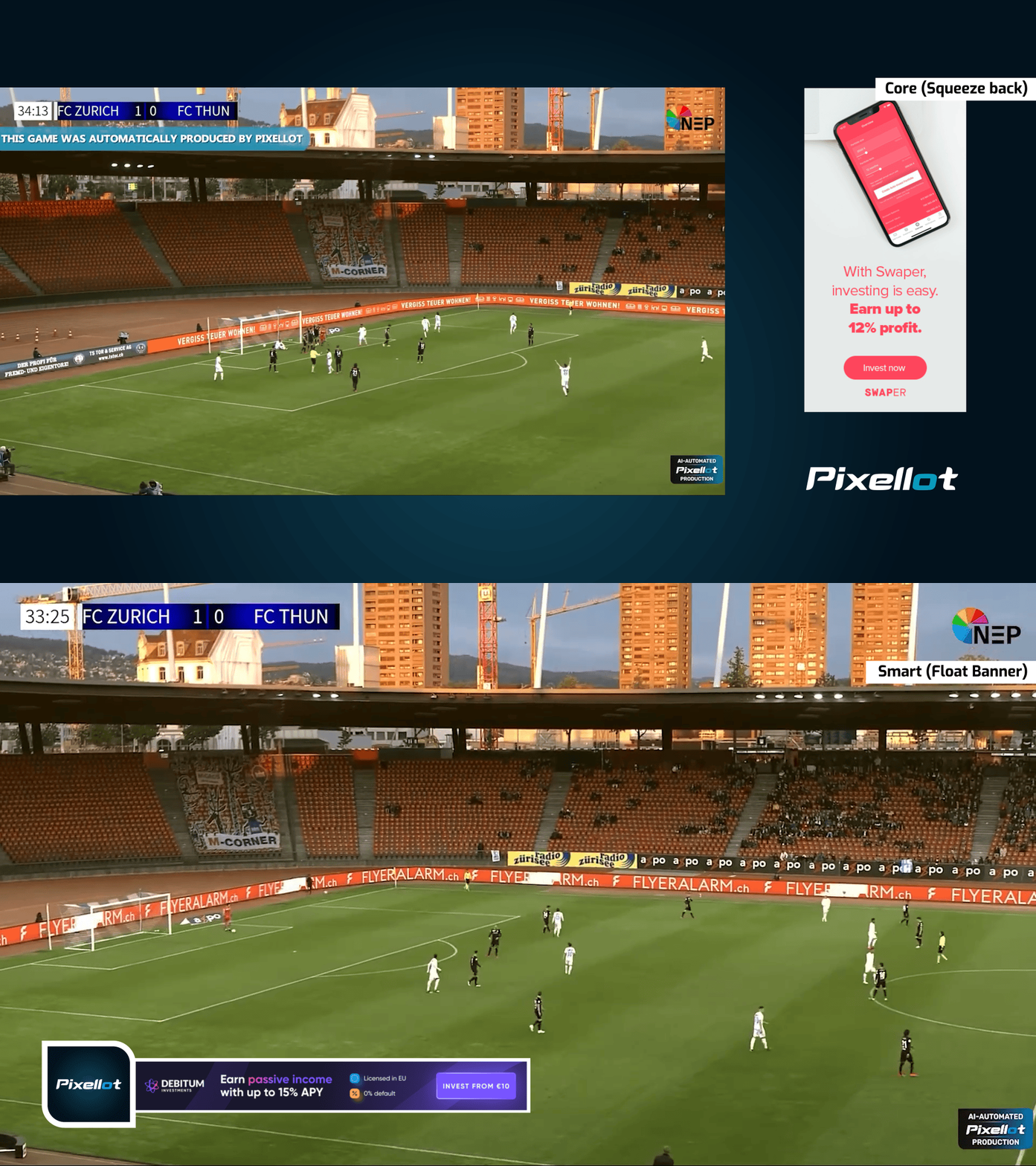
That shift, from optimizing exposure to optimizing context, is exactly the gap BRNDTS was built to close. Rather than inserting ads before or during a video and interrupting the viewer’s attention at a fixed interval, BRNDTS uses computer vision and AI to identify unused visual space within the content itself, without breaking the flow of what the viewer came to watch. This approach does not depend on guessing whether the viewer is in a buying mindset at that particular second, since it removes the disruption that makes irrelevant timing so costly in the first place. The ad exists within the scene rather than against it, which changes its relationship to attention entirely.
This also reframes the privacy conversation that targeted advertising usually forces. Traditional targeting achieves relevance by tracking behavior across sessions and devices, trading effectiveness for data collection that many consumers reasonably resent. Native, scene based placement achieves relevance differently, through where and how an ad appears rather than through what is known about the individual viewer, offering a path toward useful advertising that does not require the same depth of personal surveillance to work.
Closing Remarks
The original question was never really about advertising in general, it was about timing and fit. There genuinely are moments when people want to see an ad, when they are actively searching, comparing, or deciding, and there are just as many moments when the same message serves no one. Generic, poorly timed advertising produces the outcomes the industry has learned to expect, weak engagement, disappointing conversion, and rising costs that punish everyone involved. Relevant advertising, delivered at the right moment and in the right form, produces the opposite, but only if the industry is willing to solve for context and privacy together rather than treating one as the price of the other. That is the harder problem, and it is also the more interesting one.
메타데이터
- post_id
- b070232a8bf2
- slug
- is-there-ever-a-moment-you-actually-want-to-see-an-ad-b070232a8bf2
- url
- https://medium.com/@BRNDTS/is-there-ever-a-moment-you-actually-want-to-see-an-ad-b070232a8bf2
- canonical_url
- https://medium.com/@BRNDTS/is-there-ever-a-moment-you-actually-want-to-see-an-ad-b070232a8bf2
- author_url
- https://medium.com/@BRNDTS
- status
- ok
- fetched_at
- 2026-08-28 03:48:36