RFM #1: Three Questions About Your Customers You Need to Answer
The average customer is a fiction. Discover 3 key RFM questions to stop burning your marketing budget and find who really drives your sales.
RFM #1: Three Questions About Your Customers You Need to Answer
You can read the original article in Czech here.
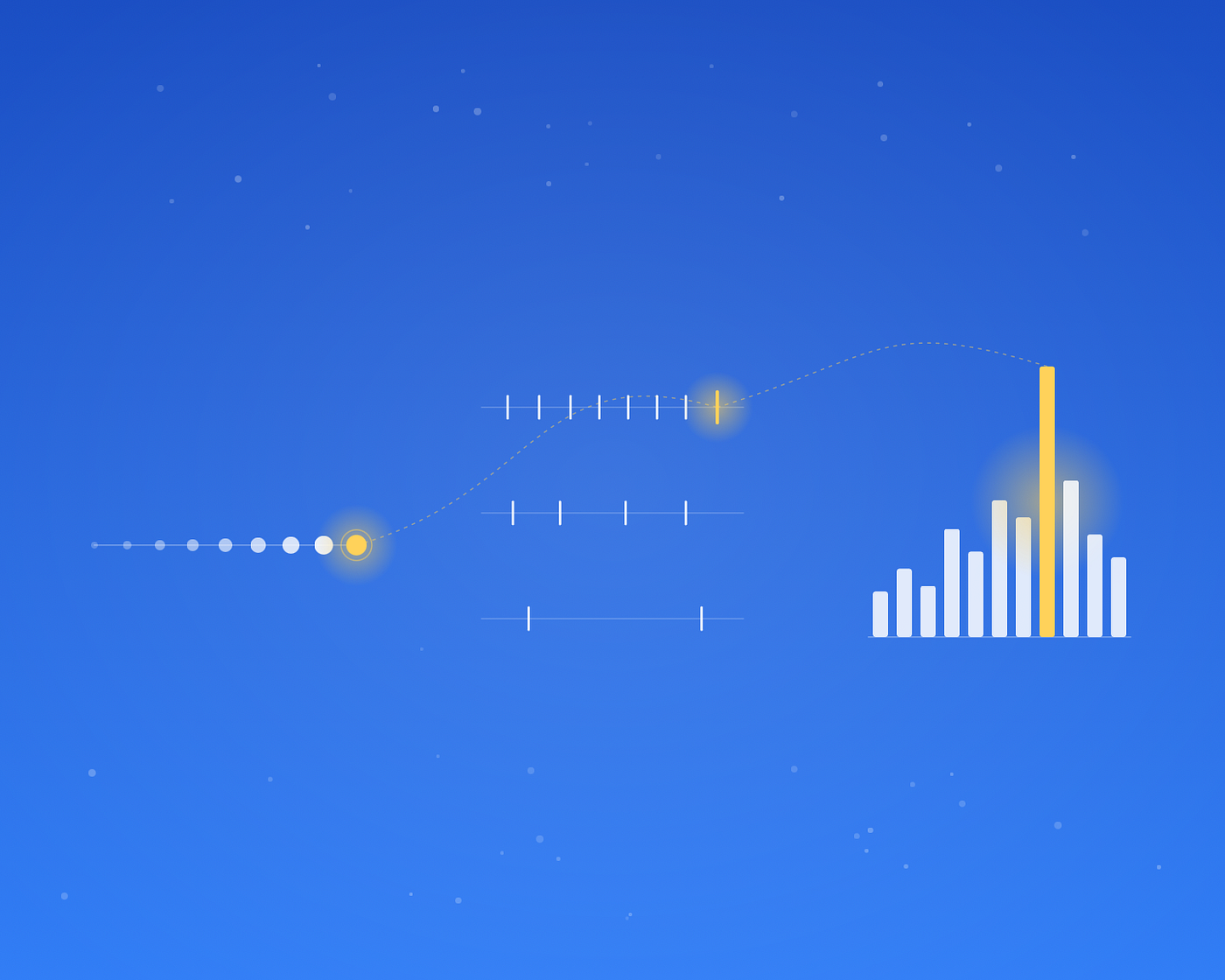
Abstract RFM.
Most e-commerce stores know their customers merely as a single number. Average order value. Total number of customers. Conversion rate. All of these are averages, and the average customer does not exist.
This is the first article in our short series on RFM. RFM is a straightforward way to look at your customers as distinct groups rather than one blended mass. But before we dive into the method itself, our series begins with three questions. They are simple questions, yet most e-commerce businesses have never actually calculated the answers. By the end of this article, you will know what these questions are, why looking through the lens of averages hides certain customers, and what changes once you can answer them.
The Averaged Customer is a Fiction
When you look at a single average, you are mixing two completely different people into one number.
One bought from you once two years ago and never returned. The other buys from you every six weeks and has been doing so for three years. Your average order value (AOV) treats them as the exact same customer. Your customer acquisition cost (CAC) is evaluated against a “lifetime” value that the first customer never had, and the second surpassed a long time ago.
Aggregated data doesn’t necessarily produce a wrong number. It just answers a question you didn’t ask. It tells you what happened on average. But it doesn’t tell you who is actually driving your business. Almost every important decision — where to invest your marketing budget, which customers to try to win back, how much a new customer is worth — depends on the difference between these two people. And an average completely erases this difference.
Question One: When Did Each Customer Last Make a Purchase?
Recency is by far the strongest signal of whether a person is still your customer.
A customer who bought last month does not hold the same value for your business as one who bought a year and a half ago, even if they both spent the same amount. The first represents a relationship. The second is merely a memory. If you treat them identically in your email strategies and remarketing, you are burning your budget on people who left a long time ago, while the ones who are still “hot” are only receiving a generic newsletter.
The shift in decision-making here is simple. You stop dedicating the same effort to everyone and start directing it where there is still value to be gained.
Question Two: How Often Do They Return?
Frequency tells you whether you have a real business or just a series of unrelated transactions.
If most customers buy once and disappear, your acquisition campaigns are inherently subsidizing a business built on one-off sales. That is perfectly fine, but it is a different business than what your CAC math probably assumes. However, if a meaningful group of people shops with you repeatedly, that is exactly where your real margin lies. And protecting it is worth far more than chasing the next first-time buyer.
You won’t see this in the totals. You will only see it when you calculate purchases per individual customer and look at their distribution.
Question Three: What Is Their Actual Value?
Monetary value is not revenue. It is the amount a customer is worth to you after deducting the costs of serving them.
A customer who places large orders and never returns anything is not the same as a customer with the same revenue who sends half the goods back. The revenue metric treats them as equals. Margin does not. When you rank your customers based on what they actually bring in, the final order almost never matches your expectations. And there are usually fewer people at the very top than you think.
This is where you decide where your attention will go. The majority of real value is usually carried by just a small group of customers. If you don’t know who they are, you can’t prioritize them, and you will continue treating your best customers exactly like your worst ones.
The Point Is to Ask at the Customer Level, Not in Totals
None of these three questions is new. Recency, frequency, monetary value. The reason they change anything is the level at which you ask them.
When you ask in aggregate, you just get three more averages and learn nothing actionable. When you ask at the level of a specific customer, it allows you to categorize each of them into a certain group. And with groups, you can start making meaningful decisions. This shift — from one blended number to a handful of practical segments — is the entire essence of RFM analysis. The rest of this series will be about how to do it right.
What the Series Will Cover and What You Should Do Now
The upcoming articles will dive straight into the method itself: how to build these groups from data you already have, which segments matter, what to do with one-time buyers, and how to stop your best customers from quietly slipping through your fingers.
But you don’t need any of that just yet. A useful first step is much smaller.
Pull a list of your customers into three columns:
- The date of their last order
- Their total number of orders
- Their total spend minus returns
Don’t model anything. Just sort that list in three different ways and see how vast the gap is between the top and the bottom. That gap is the exact business your averages have been hiding from you. And the rest of the series will be about how to work with it.
메타데이터
- post_id
- b25da95e51a0
- slug
- rfm-1-three-questions-about-your-customers-you-need-to-answer-b25da95e51a0
- url
- https://medium.com/@peter.plesko/rfm-1-three-questions-about-your-customers-you-need-to-answer-b25da95e51a0
- canonical_url
- https://medium.com/@peter.plesko/rfm-1-three-questions-about-your-customers-you-need-to-answer-b25da95e51a0
- author_url
- https://medium.com/@peter.plesko
- status
- ok
- fetched_at
- 2026-06-09 15:37:30



