The 2026 Disruption Playbook: Architecting Common Knowledge
As I am reading Steven Pinker’s new book, ‘When Everyone Knows That Everyone Knows…’, I realized that Pinker hasn’t just written a…
The 2026 Disruption Playbook: Architecting Common Knowledge
As I am reading Steven Pinker’s new book, ‘When Everyone Knows That Everyone Knows…’, I realized that Pinker hasn’t just written a masterpiece on cognitive science; he has inadvertently provided the definitive scientific articulation of how Disruption works.
Having spent 25 years at TBWA practicing our core methodology of Convention, Disruption, and Vision, I have seen our philosophy move markets. However, Pinker’s work on ‘Common Knowledge’ has cast our methodology in a startlingly fresh light. It has given me a rigorous new vocabulary to explain why what we do is not just a “creative” exercise — it is the most efficient way to architect social reality in an increasingly fragmented world.
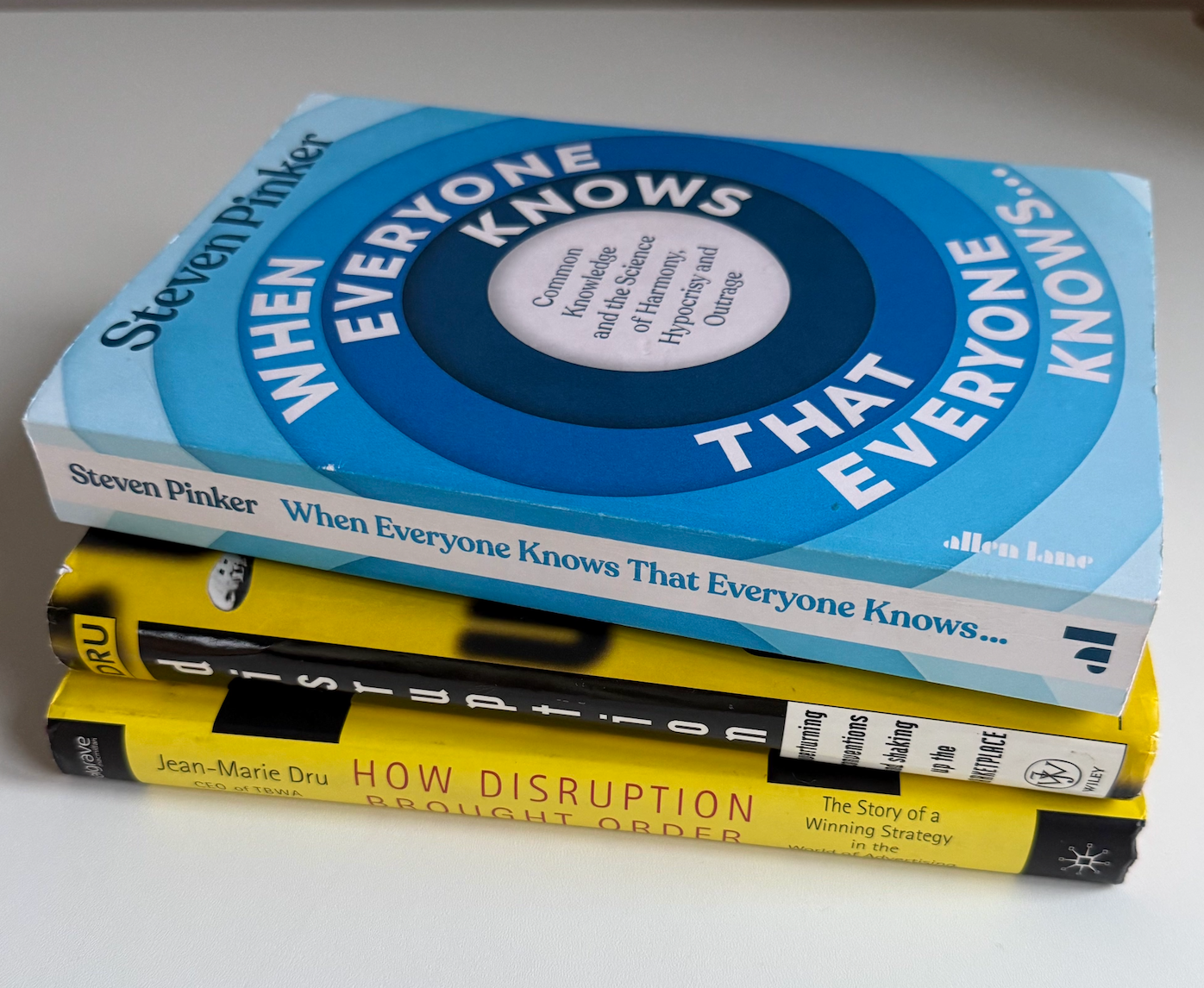
The book hinges on a distinction that may seem subtle at first but is actually transformative for how we understand influence and brand power.
‘Mutual Knowledge’ occurs when everyone knows a certain fact — for example, the private realization that “this category is boring”.
‘Common Knowledge’ is a higher state of awareness where everyone knows that ‘everyone else’ knows that fact, and they know that everyone else knows they know it, ad infinitum.
Pinker uses the ‘Emperor’s New Clothes’ to illustrate this social phenomenon. The crowd all saw the king was naked — that was Mutual Knowledge — but they stayed silent and compliant because they didn’t know if everyone else shared that reality. It took a child to shout the truth out loud to create ‘Common Knowledge’. In that single second, the social reality shifted, the collective hesitation vanished, and the regime of the naked emperor collapsed.
Applying this to our work, a ‘Convention’ is simply a “zombie social reality” maintained by a lack of Common Knowledge. People follow the convention not because they believe in it, but because they lack the signal to know that everyone else is ready to leave it behind.
I’ve started thinking about our three-step process through Pinker’s recursive lens to build a new playbook for 2026.
1. The Convention as ‘Pluralistic Ignorance’
Pinker explores the concept of pluralistic ignorance — a state where individuals misinterpret the public conformity of others as a sign of private conviction. In our world, this is the category convention. We have always looked for these stagnant rules, but I now see them as quiet lies.
The convention survives only because no brand has made the private dissatisfaction of the consumer public. For years, for instance, everyone privately felt that banking was cold, opaque, and predatory; yet, because every bank acted that way, everyone assumed that was simply the unalterable way of the world. At TBWA, our task is no longer just looking for a boring trend. We are looking for the lie that everyone is tired of believing but too afraid to challenge until they know others are with them.
2. The Disruption as the ‘Child in the Crowd’
Pinker argues that ‘Common Knowledge’ is generated by moments so salient and synchronized that they are impossible to ignore. In our methodology, this is the moment of Disruption. In a 2026 landscape where the ‘Public Square’ has been shattered into a billion algorithmic bubbles, a true Disruption must act as the ‘child in the crowd.’ While everyone else is trapped in a state of pluralistic ignorance — privately doubting the category convention but publicly complying — the Disruption shouts the truth in a way that makes it impossible for anyone to pretend they didn’t hear it. This doesn’t just reach” an audience; it creates the ‘recursive loop’ necessary for social change: “I know the brand is different, and I know you know it, so I know you know I know.”
3. The Vision as the New ‘Focal Point’
Pinker uses the game theory concept of a ‘Focal Point’, the obvious solution people gravitate toward when they need to coordinate their behavior without direct communication. They choose it because they know it is the most prominent solution that everyone else is likely to choose too.
By disrupting a category, we turn a brand into the new focal point. We aren’t just persuading one person at a time; we are coordinating the entire market around a new social fact. This is why Disruption is infinitely more efficient than traditional persuasion. We are changing the consensus, not just the individual mind.
How to think about efficiency, reach and Disruption today:
The industry’s obsession with Reach is a relic of an era that didn’t understand the difference between Mutual Knowledge and Common Knowledge.
Traditional media buying treats Reach as a simple sum of individual eyeballs. If you reach 1 million people through targeted algorithmic ads, you have created Mutual Knowledge: 1 million people know the message. But in the algorithmic bubble of 2026, none of those 1 million people know if anyone else saw the ad. They are isolated.
Without that recursive loop — the I know that you know — there is no social pressure to change behavior. Isolated Reach is just noise; people ignore it because they don’t see a crowd moving with them.
True Social Efficiency happens when we stop trying to persuade individuals and start coordinating the collective. This requires a shift in our tactical approach:
-
Don’t just share information; synchronize it. Effectiveness in 2026 isn’t about how many people saw the ad; it’s about how many people saw it while knowing that everyone else saw it too. Synchronization turns a message into a social fact.
-
Look for the ‘Blank Sign’. Pinker notes that autocrats fear blank signs because everyone knows exactly what they would say. Our Disruptions should be that visceral. The most efficient communication says the quiet part out loud, turning private dissent into a public movement.
-
Attack the ‘Quiet Lies.’ We must find the conventions that people privately hate but publicly tolerate. That is where the explosive, transformative power of Disruption lives. When you expose a Quiet Lie, you don’t just ‘reach’ an audience — you liberate them to act on what they already knew, but were too afraid to say alone.
In 2026, our role at TBWA is more vital than ever. We aren’t just making ads; we are the architects of common knowledge. Technical efficiency is just reach — a commodity. Social efficiency is Common Knowledge. It is far cheaper to move a crowd once through coordination than to try and convince a million individuals separately. We are the ones who shout that the emperor has no clothes, so that the rest of the world can finally start to see what’s next.
This is the framework I am now practicing exclusively through Disruption Consultancy. After decades of applying Jean-Marie Dru’s foundational principles, I have evolved my practice to help brands bridge the gap between “commodity reach” and “social reality.”
Whether we are identifying the “Quiet Lies” of a stagnant category or architecting the “Focal Points” of a new industry, Disruption consultancy is dedicated to one thing: The Science of Social Efficiency. We don’t just help brands speak; we help them synchronize.
(AI Disclosure: Created from an original idea; co-written, edited, and fine-tuned by the author in partnership with Gemini.)
메타데이터
- post_id
- b3e4ec142c2e
- slug
- the-2026-disruption-playbook-architecting-common-knowledge-b3e4ec142c2e
- url
- https://medium.com/@toygun.yilmazer/the-2026-disruption-playbook-architecting-common-knowledge-b3e4ec142c2e
- canonical_url
- https://medium.com/@toygun.yilmazer/the-2026-disruption-playbook-architecting-common-knowledge-b3e4ec142c2e
- author_url
- https://medium.com/@toygun.yilmazer
- status
- ok
- fetched_at
- 2026-07-14 14:19:39