FDIC’s Q2 Quarterly Banking Profile
Approximately 55 days after the end of each quarter, the FDIC publishes their Quarterly Banking Profile.
FDIC’s Q2 Quarterly Banking Profile
Approximately 55 days after the end of each quarter, the FDIC publishes their Quarterly Banking Profile.
Overall things look stable, and banks are performing well. Net income has a 25% YoY growth, largely relate to tax breaks.
There are two causes for concern in the long run though:
- Problem assets. In Q1 there was a 4x increase in problem assets, reversing a downward trend. It looks like that trend did not continue into Q2 and the size of problem assets is going sideways for now. “Continued to decline” from the FDIC’s report is perhaps misleading as the turnaround startedjust now from Q1, and problem assets remain greater than last year going all the way back to 2015 levels.
“The “Problem Bank List“ Continued to Decline: The FDIC’s Problem Bank List shows a decline from 92 to 82 banks during the quarter, the lowest number since the fourth quarter of 2007. Total assets of problem banks declined from $56.4 billion in the first quarter to $54.4 billion. Other notable bank activity during the quarter included merger transactions that absorbed 64 institutions, two new charters were opened, and no banks failed.”
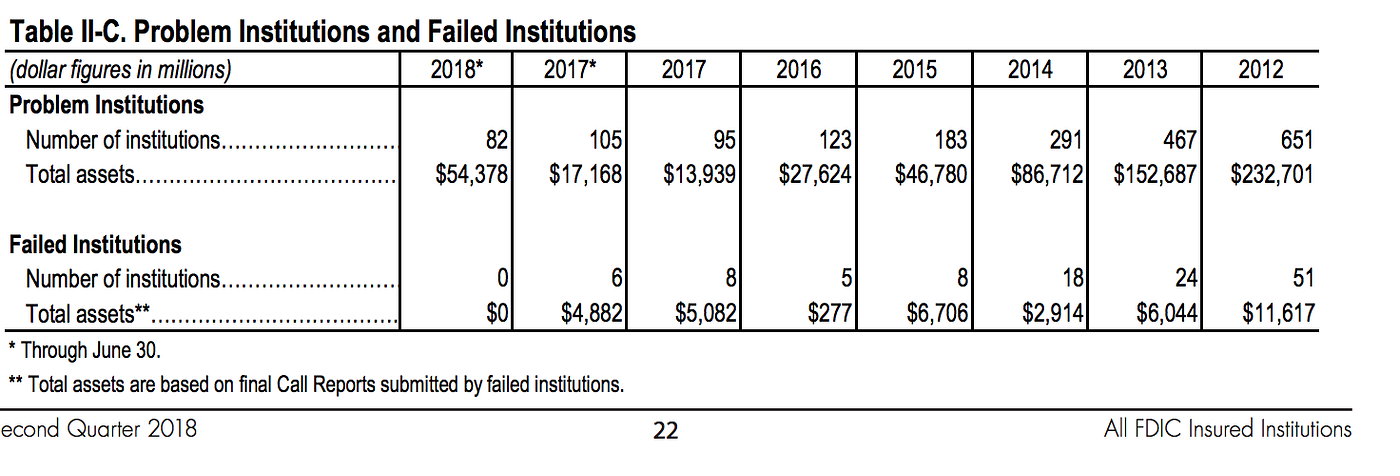
Problem Assets Since 2012
- Loan loss reserves are failing to increase.

Loan Loss Provisions Declining
The outgoing FDIC Chairmain said that it is now while banks are seeing record profits, that they should be increasing provisions to prepare for the “inevitable downturn”.
The fed funds target rate sits at 1.75%-2.00%. Two years ago it was 0.25–0.50%. One year ago 1.00–1.25%. In people terms, the prime rate from right now going back one year per step looks like: 5%,4.25%, 3.5%, 3.25%. It’s expected to hit 6% towards the end of 2019. Loan interest comes out to a 50% greater cost right now. The rise in rates should see banks increasing provisions since higher interest on variable loans has serious impact. Since the majority of loans are commercial loans, strong business performance likely sees banks forecasting good performance.
At the same time, the banking industry is undergoing a major fundamental change to loan loss provisioning through the adoption of CECL. It will start being enforced at the end of 2019 for large banks and at the end of 2020 for smaller banks and banks with exceptions. Most analysts think CECL will require 25–50% loan loss provisions than currently accepted practices.
The press release is here.
And the full report is here.
메타데이터
- post_id
- c58e2da44279
- slug
- fdics-q2-quarterly-banking-profile-c58e2da44279
- url
- https://medium.com/@amateuranalysis/fdics-q2-quarterly-banking-profile-c58e2da44279
- canonical_url
- https://medium.com/@amateuranalysis/fdics-q2-quarterly-banking-profile-c58e2da44279
- author_url
- https://medium.com/@amateuranalysis
- status
- ok
- fetched_at
- 2026-07-30 00:25:58



