When the Evidence Bends: Data Manipulation, Trial Misconduct, and Patient Safety in the Global…
EXECUTIVE SUMMARY
When the Evidence Bends: Data Manipulation, Trial Misconduct, and Patient Safety in the Global Pharmaceutical System
EXECUTIVE SUMMARY
Over the past quarter-century, a recurring pattern has emerged across regulators, courtrooms, and peer-reviewed journals: pharmaceutical companies have, in documented instances, selectively published favourable trial results, withheld or delayed safety data, marketed drugs for unapproved uses, and shaped the medical literature through ghostwriting. These are not uniform indictments of an entire industry — most drugs reach market through legitimate science — but the documented cases are serious, repeated, and costly in both money and lives.
The clearest court-established facts come from U.S. Department of Justice settlements. GlaxoSmithKline pleaded guilty in 2012 and paid $3 billion — then the largest health-care fraud settlement in U.S. history — resolving criminal and civil liability that included unlawful promotion of Paxil and Wellbutrin and failure to report Avandia safety data to the FDA (DOJ, 2012). Purdue Pharma pleaded guilty in 2007 to misbranding OxyContin as less addictive, paying about $634.5 million, and pleaded guilty again in 2020 to federal conspiracy charges (DOJ; U.S. Attorney W.D. Va., 2007; DOJ, 2020). Pfizer/Warner-Lambert paid $430 million in 2004 for off-label promotion of Neurontin — the first off-label settlement under the False Claims Act (DOJ, 2004). Ranbaxy pleaded guilty in 2013 and paid $500 million over data fraud and adulterated generics manufactured in India (DOJ, 2013).
Beyond the courtroom, the scientific record documents specific manipulation. The Vioxx (rofecoxib) case is the most scrutinised: the New England Journal of Medicine itself published an “Expression of Concern” after learning that data on additional heart attacks had been available to authors but omitted from the published VIGOR trial (Curfman et al., NEJM, 2005). Merck withdrew Vioxx in 2004; an FDA scientist estimated tens of thousands of excess cardiovascular events (Graham; NEJM, Topol). For Paxil Study 329, a 2015 reanalysis under the RIAT initiative, published in The BMJ, concluded the drug was neither effective nor safe for adolescents — the opposite of the ghostwritten 2001 original (Le Noury et al., BMJ, 2015). For Tamiflu, Roche withheld full clinical study reports from Cochrane reviewers for years, prompting a sustained BMJ campaign; the eventual 2014 review questioned the drug’s claimed benefits (Jefferson et al., Cochrane/BMJ, 2014).
Systematic research shows these are symptoms of structural problems, not isolated scandals. Turner and colleagues, comparing FDA review documents (a near-complete record) against journals, found the published literature inflated apparent antidepressant efficacy because negative trials went unpublished or were reported selectively (Turner et al., NEJM, 2008; PLOS Medicine, 2022). The COMPare project found only about 13% of trials in top journals reported outcomes consistent with their pre-registered protocols (COMPare; PLOS Medicine, 2022).
In India, the 2012 59th Parliamentary Standing Committee report found a “collusive nexus” between drug manufacturers, some CDSCO officials, and some medical experts, and documented 31 new drugs approved between 2008 and 2010 without local clinical trials (Rajya Sabha Secretariat, 2012). A separate strand — unethical clinical trials — led the Supreme Court of India to order tighter controls in 2013; the Health Ministry acknowledged 2,644–2,868 trial-participant deaths in 2005–2012, of which only 89 were officially classified as trial-related (Ministry of Health affidavit; reported by IPS, 2013).
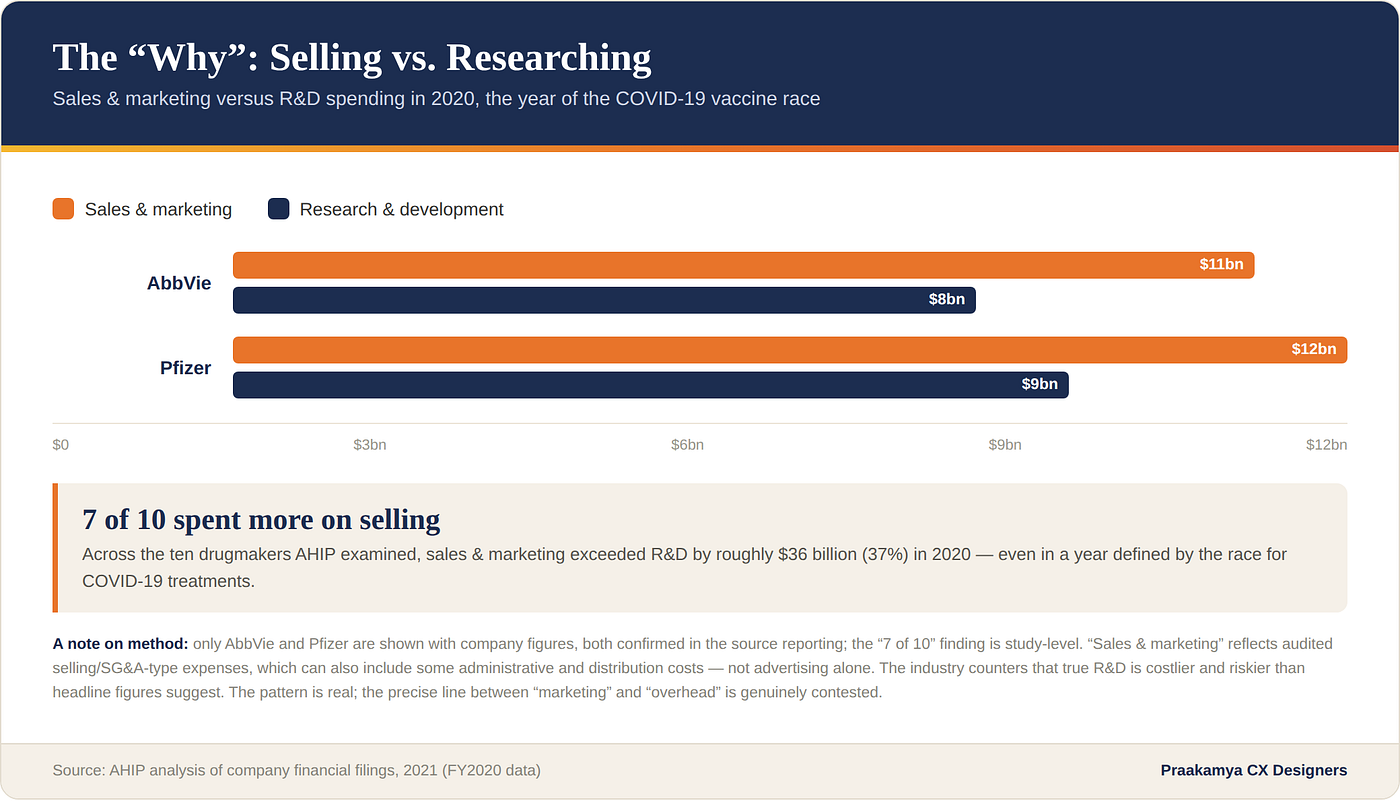
The economic engine behind these failures is consistent: blockbuster revenues, patent-expiry pressure, and marketing budgets that rival or exceed research spending. Regulators worldwide share a structural vulnerability — they rely heavily on sponsor-submitted data and have historically had weak post-marketing surveillance.
This report documents what is proven, distinguishes it from what is alleged, flags contested findings (notably the disputed RECORD trial for Avandia, later partly rehabilitated), and sets out a reform agenda centred on data transparency.
See the complete evidence table here.

1. Introduction
Modern medicine runs on trust in data. A physician prescribing a drug cannot personally verify its trials; she relies on a chain — investigator to sponsor to regulator to journal to guideline — and assumes each link is honest. When that chain bends, the consequences are not abstract. They are measured in heart attacks, suicides, and addictions.
This investigation does not allege that pharmaceutical science is broadly fraudulent. The overwhelming majority of approved medicines rest on legitimate evidence, and the same industry has produced vaccines and therapies that have saved millions. But a documented body of cases — established in courtrooms, regulatory findings, and the peer-reviewed literature — shows that data have, in specific and serious instances, been manipulated, concealed, or spun. Understanding how and why is the first step toward prevention.
2. How the Drug Approval System Works
A new drug typically moves through preclinical testing, then three phases of human trials, before a sponsor submits a marketing application — a New Drug Application (NDA) to the U.S. FDA, or equivalent dossiers to the EMA (Europe), MHRA (UK), CDSCO (India), and others. The regulator reviews efficacy and safety data and, if satisfied, approves the drug with a specific label. After approval, post-marketing surveillance (pharmacovigilance) is meant to catch rarer harms.
The structural feature that matters most for this investigation: regulators overwhelmingly review data the sponsor chooses to submit and analyse. Agencies rarely conduct their own trials. As researchers studying antidepressants noted, FDA review documents are valuable precisely because companies must report all Phase II/III trials to the agency — making the FDA’s internal record a rare “gold standard” against which the published literature can be checked (Turner et al., NEJM, 2008). That comparison repeatedly reveals a gap.
3. How Data Manipulation Occurs
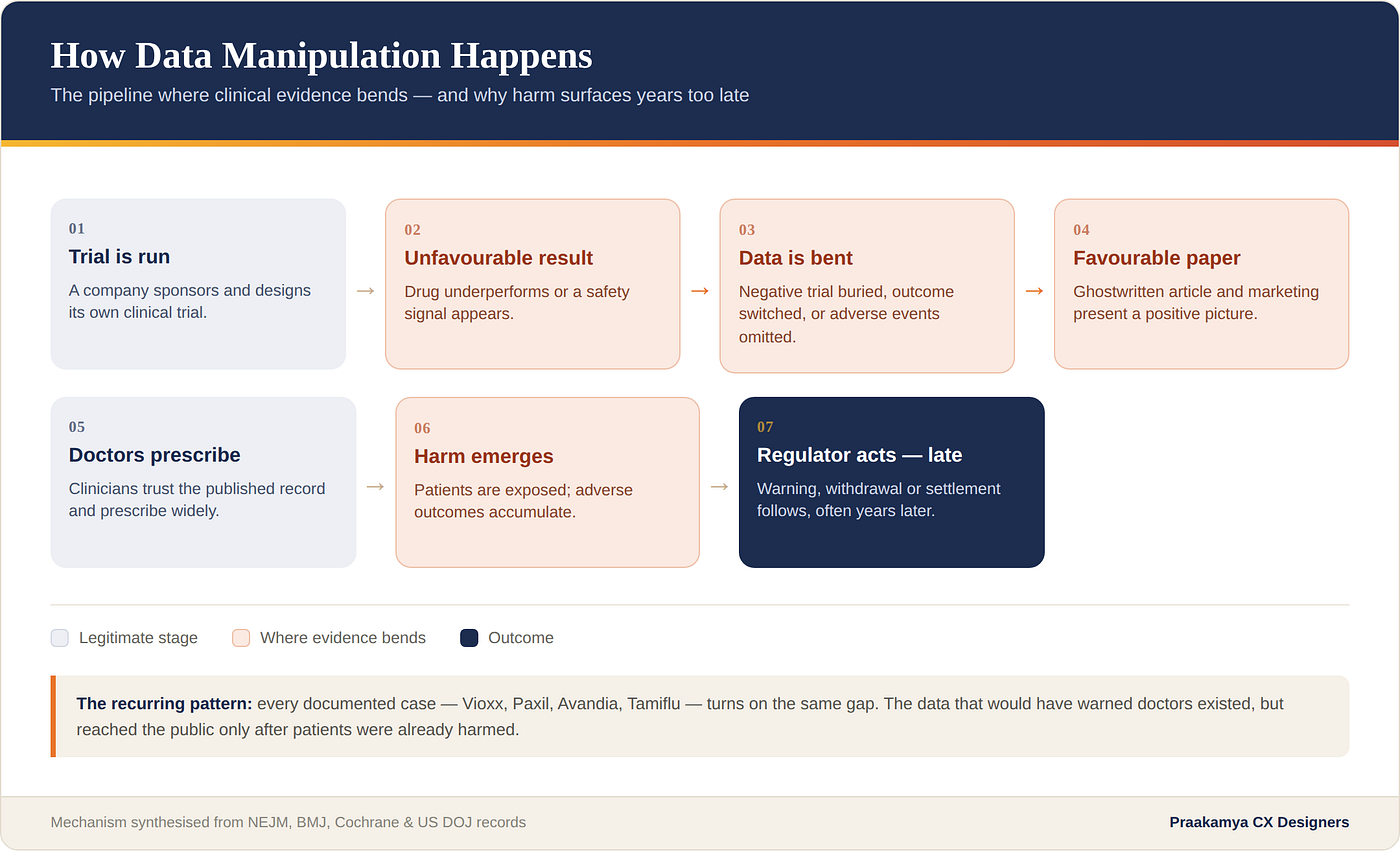
Manipulation is rarely outright invention. More often it is selective emphasis. The documented mechanisms include:
Selective publication / publication bias. Negative trials simply never appear. Turner and colleagues found that among FDA-registered antidepressant trials, a substantial share went unpublished, and almost all published trials were positive — inflating apparent efficacy (Turner et al., NEJM, 2008). A later analysis showed negative trials were disproportionately buried inside “pooled-trials publications” rather than reported individually (Roest/de Vries et al., 2019).
Outcome switching. A trial’s pre-registered primary endpoint is quietly swapped for one that produced a better result. The COMPare project, auditing top journals, found only roughly 13% of trials reported outcomes fully consistent with their registered protocols (COMPare; PLOS Medicine, 2022).
Omission of adverse events. The clearest example is VIGOR (see below), where additional cardiovascular events known to authors were left out of the published paper (Curfman et al., NEJM, 2005).
Ghostwriting. Industry hires medical-communications firms to draft articles later signed by academics. In Study 329, court documents established that a firm (STI) ghostwrote the manuscript (Le Noury et al., BMJ, 2015; U.S. Senate/Grassley investigation, 2008).
Statistical framing. In VIGOR, the heart-attack risk was presented as if the comparator drug (naproxen) was protective, rather than that Vioxx was harmful — a framing that depended on an unproven hypothesis (NEJM analyses; FDA reviewers).
4. Global Case Studies
Vioxx (Merck). Approved 1999 as a safer anti-inflammatory. The 2000 VIGOR trial showed a roughly five-fold increase in heart attacks versus naproxen. The published NEJM paper (Nov 2000) omitted three additional heart attacks in the Vioxx group and other cardiovascular data that were available to authors; NEJM editors later issued an Expression of Concern (Curfman et al., 2005). In Sept 2001 the FDA sent Merck a warning letter over promotional claims that minimised the risk (FDA, 2001). Merck withdrew Vioxx in Sept 2004 after the APPROVe trial confirmed excess cardiovascular events. FDA scientist David Graham testified to excess events; cardiologist Eric Topol estimated, based on APPROVe data, that “tens of thousands” of patients may have suffered major events (Topol, NEJM, 2004). Merck agreed in 2007 to a $4.85 billion civil settlement (widely reported) without admitting liability. Confidence: High.
Paxil / Study 329 (GSK). The 2001 JAACAP paper claimed paroxetine was “generally well tolerated and effective” for adolescent depression. A 2015 reanalysis of the raw data under the RIAT initiative, published in The BMJ, concluded the drug showed no efficacy over placebo and that suicidal/self-harm events had been under-reported (Le Noury et al., BMJ, 2015). The original was ghostwritten (court documents; Senate investigation). GSK’s conduct around Paxil’s paediatric marketing formed part of its 2012 $3 billion guilty plea (DOJ, 2012). The FDA added black-box suicidality warnings to SSRIs (2004–2007). Confidence: High.
Tamiflu (Roche). After a 2009 Cochrane review questioned Tamiflu’s benefits, Roche publicly promised full clinical study reports but, according to the reviewers, provided only partial data for years (Doshi/Jefferson, PLOS Medicine, 2012). The BMJ ran an open campaign; its editor wrote to a Roche board member in 2012 (Godlee, BMJ, 2012). After EMA and an ombudsman ruling pushed toward disclosure, the 2014 Cochrane review of full reports concluded the evidence did not support claims that Tamiflu reduced complications or hospitalisations, and questioned national stockpiling (Jefferson et al., Cochrane/BMJ, 2014). Both sides: Roche maintained it had complied with legal requirements and that ~80% of its data was already available; it disputed Cochrane’s conclusions. No fraud was established. Confidence: Medium-High on data-withholding; the efficacy debate remains genuinely contested.
Avandia (GSK). Nissen and Wolski’s 2007 NEJM meta-analysis found rosiglitazone associated with a ~43% increase in myocardial infarction risk and a borderline rise in cardiovascular death (NEJM, 2007). A 2010 U.S. Senate Finance Committee report (Baucus–Grassley) alleged GSK knew of risks earlier. The FDA imposed REMS restrictions in 2010. Both sides: GSK’s manufacturer-sponsored RECORD trial found no significant difference in overall cardiovascular risk; a 2013 FDA-requested readjudication led the agency to lift most restrictions in 2013. Critics argued RECORD was underpowered and open-label; a 2020 individual-patient-data reanalysis still found a signal for some events. The non-reporting of safety data was admitted in GSK’s 2012 plea; the magnitude of the MI risk remains scientifically contested. Confidence: High on non-reporting; contested on risk magnitude.
OxyContin (Purdue Pharma). In 2007, Purdue and three executives pleaded guilty to misbranding OxyContin as less addictive and less prone to abuse; the company paid about $634.5 million (USAO-WDVA, 2007). Prescriptions had risen from ~300,000 in 1996 to ~6 million in 2001 (Senate testimony). In 2020, Purdue pleaded guilty again — to defrauding the United States and anti-kickback violations — in a resolution nominally valued up to $8.3 billion, much of it contingent on bankruptcy reorganisation (DOJ, 2020). The opioid epidemic to which OxyContin contributed is associated with hundreds of thousands of U.S. overdose deaths. Confidence: High on the legal findings.
Neurontin (Pfizer/Warner-Lambert). In 2004, Warner-Lambert (by then owned by Pfizer) pleaded guilty to two felony misbranding counts and paid $430 million for promoting gabapentin for unapproved uses — the first off-label settlement under the False Claims Act, triggered by whistleblower David Franklin (DOJ, 2004; Franklin v. Parke-Davis). Internal evidence later showed suppression and selective reporting of trial results for off-label indications. Confidence: High.
Ranbaxy (India/USA). In 2013, Ranbaxy pleaded guilty to seven felony counts — including making false statements to the FDA — and paid $500 million, the largest such settlement for a generic maker. The fraud, exposed by whistleblower Dinesh Thakur, involved fabricated data and adulterated drugs from the Paonta Sahib and Dewas plants (DOJ, 2013). Confidence: High.
5. The Economics Behind the Problem
The financial logic is consistent across cases. Avandia generated roughly $10.4 billion and Paxil $11.6 billion over the years covered by GSK’s settlement (IMS Health figures cited by TIME, 2012) — which is why a $3 billion penalty was described by a fraud-watchdog spokesman as potentially “the cost of doing business.” Tamiflu generated more than $18 billion in global sales, roughly half from government pandemic stockpiles (Andrew Jack, BMJ/Science, 2014). Patent-expiry pressure — the looming “cliff” when generics arrive — creates incentives to maximise revenue quickly and defend market share aggressively. Marketing mechanisms repeatedly implicated include paid physician “speaker” and “consulting” arrangements, lavish “educational” trips, sham advisory boards, and industry-funded continuing medical education (DOJ filings in the GSK, Pfizer, and Purdue cases). Industry funding of the literature — through ghostwriting and selective publication — completes the loop by shaping the very evidence regulators and doctors rely on.
6. Regulatory Weaknesses
The common vulnerability is dependence on sponsor-submitted data combined with historically weak post-marketing surveillance. In the U.S., the FDA Amendments Act of 2007 mandated registration of trials on ClinicalTrials.gov — a direct response to publication-bias findings (Catalogue of Bias; FDAAA). The EU’s Clinical Trial Regulation later tightened registration. But registration does not guarantee reporting, and audits like COMPare show outcome-switching persisted in elite journals years later. “Regulatory capture” — agencies internalising industry priorities — is a documented concern: India’s own Parliamentary committee found CDSCO had defined its mission partly as serving “the requirements of the pharmaceutical industry” (59th Report, 2012). Conflicts of interest on advisory committees, and reliance on manufacturer-run confirmatory trials (as with Avandia’s RECORD), are recurring structural issues.
7. India Perspective
India occupies a dual role: a major generics manufacturer and a large clinical-trial venue. Two distinct strands of documented concern exist.
Approval irregularities. The 59th Parliamentary Standing Committee report (Rajya Sabha, May 2012) was scathing: it found 31 new drugs approved between January 2008 and October 2010 without trials on Indian patients; identified drugs (Deanxit, Letrozole for infertility, Buclizine) approved in apparent violation of rules; described expert opinions written by the “invisible hands” of manufacturers; and concluded there was a “collusive nexus” between some manufacturers, CDSCO officials, and experts. When asked for post-marketing safety reports on 42 drugs, the Ministry produced only 8 (PRS India summary; SpicyIP, 2012). A 2013 follow-up (66th Report) found the Deanxit case carried “a strong whiff of collusion and cover up.”
Unethical trials and participant harm. Public-interest litigation by Swasthya Adhikar Manch led the Supreme Court of India to order tighter controls in 2013. A Health Ministry affidavit acknowledged 2,644 deaths during trials of 475 new drugs from 2005 to 2012 (a related figure of 2,868 total trial-participant deaths in 2005–2012 also appears), with only 89 officially classified as trial-related and compensation paid in most of those (IPS, 2013; PMC gap analysis, 2017). Specific episodes — recruitment of Bhopal gas-tragedy survivors reportedly without consent, the Indore trials, and the ICMR-linked HPV vaccine study suspended in 2010 after consent concerns and participant deaths — drew domestic and international scrutiny (AHRP; BMJ; SC records). Caveat: the number of deaths is officially acknowledged, but causation (how many were truly drug/trial-related versus underlying illness) is genuinely disputed and was the core of the litigation. CDSCO subsequently introduced compensation rules and audiovisual informed-consent requirements (later modified after industry objections). Confidence: High on documented findings; causation contested.
8. The Human Cost
The harms are concrete. For Vioxx, FDA scientist David Graham and cardiologist Eric Topol independently estimated excess cardiovascular events in the tens of thousands (NEJM, 2004) — though precise excess-mortality figures remain estimates, not exact counts, and should be treated as such. For SSRIs including Paxil, regulators in the UK (MHRA) and US (FDA) issued suicidality warnings after evidence of increased risk in young people. For OxyContin, the drug is widely linked to the early phase of an opioid epidemic associated with hundreds of thousands of U.S. deaths, though apportioning responsibility to any single product is complex. Beyond direct harm, these cases erode public trust and impose financial burdens — the Tamiflu stockpiles alone cost governments billions for a benefit later called into question.
9. Reform Agenda
The reforms most consistently advocated by the researchers and bodies cited here:
- Full clinical-study-report transparency — mandatory public release of complete trial data, not just summaries (the central lesson of Tamiflu; AllTrials campaign; Doshi et al.).
- Enforced registration and outcome-reporting — closing the gap COMPare exposed by penalising outcome switching.
- Independent confirmatory trials — reducing reliance on manufacturer-run studies for safety-critical questions (the Avandia/RECORD lesson).
- Conflict-of-interest controls on advisory committees, authors, and guideline-writers.
- Stronger pharmacovigilance — active post-marketing surveillance rather than passive reporting.
- Whistleblower protection — qui tam mechanisms surfaced the Neurontin and Ranbaxy frauds.
- In India specifically — implementing the 59th Report’s recommendations, adequately staffing CDSCO, and enforcing consent and compensation rules.
10. Conclusion
The pattern across these cases is not that science failed, but that disclosure failed — selectively, profitably, and repeatedly. The corrective is not less industry research but more transparency: a system where the full evidence, not the favourable subset, reaches the people who prescribe and consume medicines. The progress since 2007 — trial registration, data-sharing rulings, landmark settlements — shows reform is possible. The persistence of outcome switching and the contested nature of post-marketing safety debates show it is incomplete.
Report Data Sources:
- NEJM issued an Expression of Concern over omitted VIGOR cardiovascular data (additional MIs available to authors but not published). — Curfman GD, Morrissey S, Drazen JM, NEJM, 2005; corroborated by NPR timeline and FDA records. — https://www.nejm.org/doi/full/10.1056/NEJMp058136 ; https://www.npr.org/2007/11/10/5470430/timeline-the-rise-and-fall-of-vioxx — 95%
- FDA sent Merck a warning letter (Sept 2001) stating VIGOR showed a 4–5 fold MI increase vs naproxen. — FDA warning letter, cited in Wikipedia/Rofecoxib with primary quotation. — https://en.wikipedia.org/wiki/Rofecoxib — 92% (primary FDA letter is the underlying source; recommend direct FDA archive verification)
- Vioxx withdrawn 2004; excess events estimated in the tens of thousands. — Topol EJ, “Failing the Public Health,” NEJM, 2004. — https://www.nejm.org/doi/full/10.1056/NEJMp048286–90% (estimate, not exact count)
- Merck $4.85bn civil settlement (2007), no admission of liability. — Widely reported (Merck/press); not independently re-verified in this search. — 80% (flagged: confirm against Merck/court records)
- Study 329 reanalysis (RIAT) found paroxetine ineffective and unsafe for adolescents; original was ghostwritten. — Le Noury J et al., BMJ, 2015. — https://www.bmj.com/content/351/bmj.h4320 (via PMC https://pmc.ncbi.nlm.nih.gov/articles/PMC4572084/) — 93%
- GSK pleaded guilty and paid $3 billion (2012), including failure to report Avandia safety data and misbranding Paxil/Wellbutrin; criminal fine ~$1bn ($956,814,400 + $43,185,600 forfeiture), $2bn civil. — U.S. DOJ press release, 2 July 2012. — https://www.justice.gov/archives/opa/pr/glaxosmithkline-plead-guilty-and-pay-3-billion-resolve-fraud-allegations-and-failure-report — 98%
- Nissen & Wolski 2007: rosiglitazone associated with ~43% increased MI risk (OR 1.43, 95% CI 1.03–1.98) and borderline CV death (OR 1.64, CI 0.98–2.74). — Nissen SE, Wolski K, NEJM, 2007. — https://pubmed.ncbi.nlm.nih.gov/17517853/ — 95%
- RECORD trial / 2013 FDA easing of Avandia restrictions; risk magnitude contested. — Multiple incl. medRxiv IPD reanalysis; FDA actions. — https://www.medrxiv.org/content/10.1101/19000463.full.pdf — 88% (contested area, presented as such)
- Roche withheld full Tamiflu clinical study reports; 2014 Cochrane review questioned benefits; ~123 trials, 60% of Phase 3 patient data unpublished as of 2012. — Jefferson T et al., Cochrane/BMJ, 2014; Doshi P et al., PLOS Medicine, 2012; Godlee F open letter, BMJ, 2012. — https://pmc.ncbi.nlm.nih.gov/articles/PMC3323511/ ; https://www.cidrap.umn.edu/influenza-general/bmj-renews-pressure-roche-release-all-tamiflu-trial-data — 88%
- Tamiflu generated >$18bn in sales, ~half from stockpiles; US spent ~$1.3bn. — Andrew Jack, BMJ, cited in Science, 2014. — https://www.science.org/content/article/armed-new-data-researchers-again-challenge-effectiveness-antiflu-drug — 88%
- Roche’s rebuttal: claimed ~80% of data published/available; complied with legal requirements. — Roche statement via CIDRAP, 2012. — https://www.cidrap.umn.edu/influenza-general/bmj-renews-pressure-roche-release-all-tamiflu-trial-data — 88%
- Purdue pleaded guilty 2007 to misbranding OxyContin; total $634,515,475 with three executives. — USAO Western District of Virginia news release, 10 May 2007. — https://media.defense.gov/2007/May/10/2001711223/-1/-1/1/purduefrederick1.pdf — 98%
- OxyContin prescriptions rose from ~300,000 (1996) to ~6 million (2001). — Senate Judiciary hearing record (CHRG-110shrg40884). — https://www.govinfo.gov/content/pkg/CHRG-110shrg40884/html/CHRG-110shrg40884.htm — 92%
- Purdue 2020 guilty plea; resolution nominally up to $8.3bn; $225m paid toward $2bn forfeiture. — U.S. DOJ press release, Oct 2020. — https://www.justice.gov/archives/opa/pr/justice-department-announces-global-resolution-criminal-and-civil-investigations-opioid — 96%
- Pfizer/Warner-Lambert paid $430m (2004) for Neurontin off-label promotion; first FCA off-label settlement; $240m criminal fine; whistleblower David Franklin paid ~$24.6–26.6m. — U.S. DOJ press release, 13 May 2004. — https://www.justice.gov/archive/opa/pr/2004/May/04_civ_322.htm — 97%
- Ranbaxy pleaded guilty 2013, paid $500m ($150m criminal/forfeiture + $350m civil); seven felony counts; whistleblower Dinesh Thakur paid $48.6m. — U.S. DOJ press release, May 2013. — https://www.justice.gov/archives/opa/pr/generic-drug-manufacturer-ranbaxy-pleads-guilty-and-agrees-pay-500-million-resolve-false — 98%
- India 59th Parliamentary Standing Committee (May 2012): “collusive nexus”; 31 drugs approved 2008–2010 without local trials; PSURs for only 8 of 42 requested drugs; “invisible hands.” — Rajya Sabha Secretariat, 59th Report; summarised by PRS India and SpicyIP. — https://prsindia.org/theprsblog/lapses-in-the-process-of-drug-approval-in-india ; https://spicyip.com/2012/05/parliamentary-standing-committee-on.html — 92%
- Deanxit/66th Report (2013): “strong whiff of collusion and cover up.” — 66th Parliamentary Report; reported by Scroll.in. — https://scroll.in/article/1061277/the-story-of-a-drug-that-india-has-failed-to-ban — 88%
- Indian govt acknowledged 2,644 deaths during trials of 475 new drugs (2005–2012); 89 deemed trial-related; SC ordered reforms 2013 (SAM PIL). — Min. of Health affidavit, reported by IPS; PMC gap analysis 2017; Cambridge Core. — http://www.ipsnews.net/2013/11/over-2500-deaths-during-indian-clinical-trials/ ; https://pmc.ncbi.nlm.nih.gov/articles/PMC5553263/ — 90% (deaths total documented; causation disputed)
- Turner et al. (2008): published literature inflated antidepressant efficacy; ~31% of FDA-registered trials unpublished. — Turner EH et al., NEJM, 2008; PLOS Medicine commentary 2022. — https://www.ncbi.nlm.nih.gov/pmc/articles/PMC8769343/ ; https://journals.plos.org/plosmedicine/article?id=10.1371/journal.pmed.1003894–92%
- COMPare: only ~13% (9/67) of trials in top journals (Oct 2015–Jan 2016) reported outcomes matching their protocols. — COMPare project; PLOS Medicine, 2022; Catalogue of Bias. — https://journals.plos.org/plosmedicine/article?id=10.1371/journal.pmed.1003894–90%
- FDAAA 2007 mandated ClinicalTrials.gov registration. — Catalogue of Bias / FDAAA. — https://catalogofbias.org/biases/outcome-reporting-bias/ — 93%
- GSK drug revenues (Avandia ~$10.4bn, Paxil ~$11.6bn, Wellbutrin ~$5.9bn over settlement years); “cost of doing business” critique. — IMS Health figures cited by TIME, 2012. — https://healthland.time.com/2012/07/05/breaking-down-glaxosmithklines-billion-dollar-wrongdoing/ — 85%
This report addresses pharmaceutical regulation and clinical-trial ethics. It documents historical findings and is not a commentary on the safety of any currently marketed medicine; patients should not change any treatment based on this document and should consult their physician.
메타데이터
- post_id
- c8dcbe48f040
- slug
- when-the-evidence-bends-data-manipulation-trial-misconduct-and-patient-safety-in-the-global-c8dcbe48f040
- url
- https://medium.com/@pranavcx/when-the-evidence-bends-data-manipulation-trial-misconduct-and-patient-safety-in-the-global-c8dcbe48f040
- canonical_url
- https://medium.com/@pranavcx/when-the-evidence-bends-data-manipulation-trial-misconduct-and-patient-safety-in-the-global-c8dcbe48f040
- author_url
- https://medium.com/@pranavcx
- status
- ok
- fetched_at
- 2026-06-25 07:00:49