Chiba’s Four-Minute Miracle: Shin-Keisei Maglev or Absolute Madness?
How a “Sloth-Like” Railway Defied Physics to Build a Sub-Five-Minute Shogunate
VELOCITY AS GOVERNANCE
Chiba’s Four-Minute Miracle: Shin-Keisei Maglev or Absolute Madness?
How a “Sloth-Like” Railway Defied Physics to Build a Sub-Five-Minute Shogunate
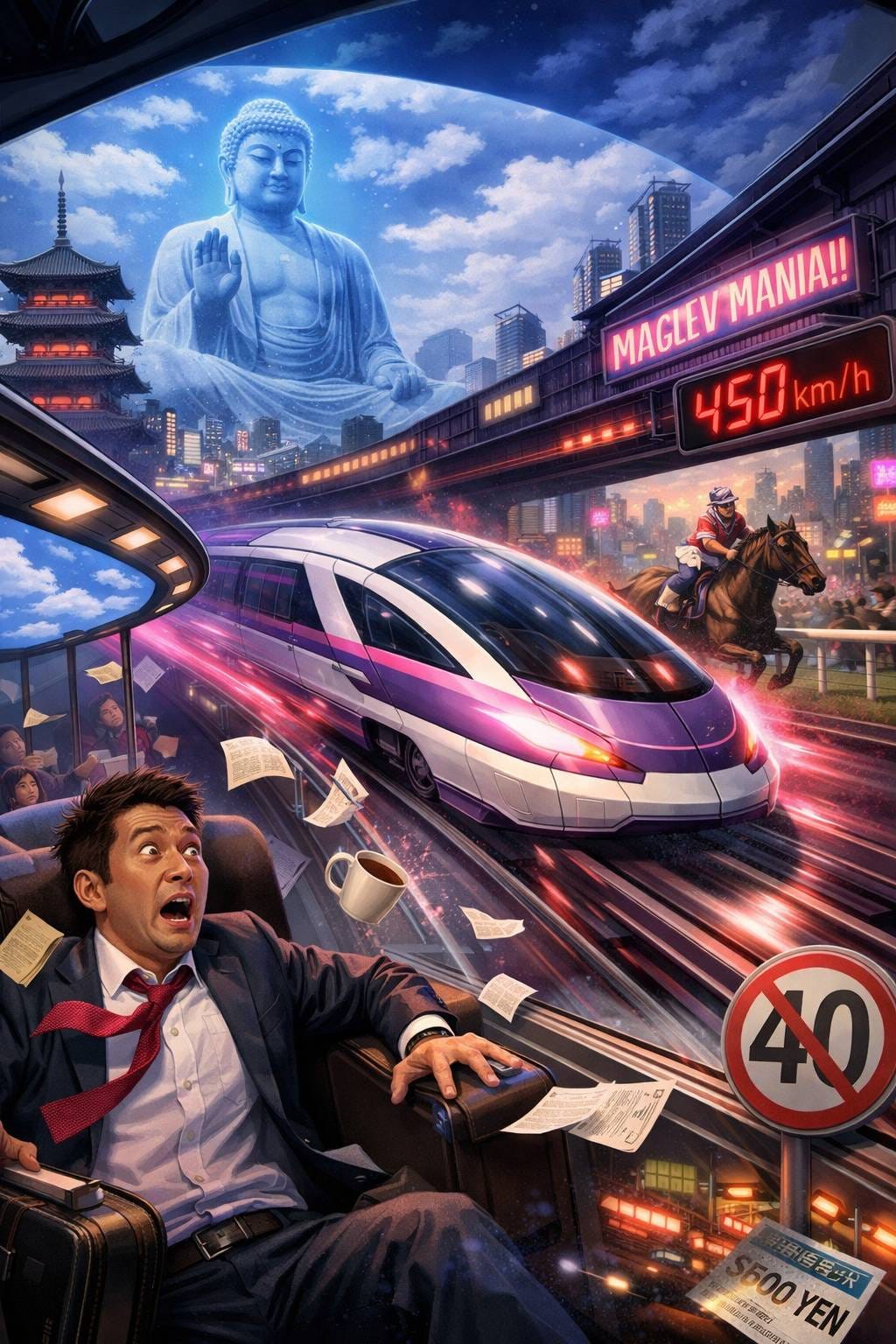
CHIBA AT 450 KM/H — Generated with Microsoft Copilot
Editor’s Note: This article was originally published in the Chiba Economic Review, moments before the author was reportedly flattened by a 450km/h departure.
In the spring of 2029, the Shin-Keisei Electric Railway performed an industrial feat so hubristic it bordered on the theological. They didn’t just disrupt a market; they insulted the laws of physics.
While transport analysts were busy laughing — “Nonsense,” they scoffed; “Wake up, sir,” they jeered — Shin-Keisei was quietly assembling a miracle. On December 22, 2029, the train screamed into existence, dragging the quiet suburban sprawl of Chiba into the future with four minutes and thirty-two seconds of pure, unadulterated velocity.
From Sedated Artery to Hyperdrive
For decades, the Shin-Keisei line was the “Sloth of the Tea Ceremony.” Slow, polite, and agonizingly deliberate. After a brief bureaucratic marriage to the Keisei Group, the line was spat back out as an independent entity with sudden, violent ambition: a 26.5 km (16.5 mi) Maglev corridor from Shin-Tsudanuma to Matsudo.
Construction timeline? One year. Probability of success, according to every toothy analyst on the circuit? Absolute zero.
And yet, the train launched.
Departure is less “commute” and more “jet engine in a living room.” Organs are violently pinned to the upholstery; the stomach performs a visceral Sumo dance. It blurs past Yabashira in two minutes. By the time a passenger attempts a quick toilet visit, the train has already arrived at Matsudo — leaving some forced to immediately return the same way, still mid-digestive panic.
Arrival clocks in at 4 minutes and 32 seconds. With a top speed of 450 km/h (~280 mph), the 40-minute commute didn’t just shrink — it underwent total molecular collapse.
Immersive Terror as Public Utility
Inside, massive holographic screens simulate the sky. Passengers feel like unlicensed pilots in a tech-noir fever dream. Floors hum with magnetic levitation; seats shudder with the ghosts of friction.
They call it the “Immersive Travel Experience.” For the salaryman who must be seated at a mahogany desk by 9:00 AM, it is four minutes of pure adrenaline. It is Disneyland for the suit-and-tie set.
The Shenzhen Pivot: Shopping as Strategy
How did a minor provincial player outmaneuver the titans of JR Central? CEO Yasuhiko Kurihara explained it with refreshingly naked cynicism: “While others do R&D, we do Shopping.”
By licensing modular Maglev components from the Shenzhen startup Lingxiang Mobility, Shin-Keisei bypassed a decade of engineering bureaucracy. They didn’t build a train — they purchased a high-velocity Lego set. At a cost of 120 billion yen (roughly the price of three mediocre Hollywood flops), they gained the power to launch the citizenry like surface-to-surface missiles.
Behavioral Economics and the Horse-Racing Demographic
Opening day saw 100,000 pilgrims. Many arrived from the Nakayama Racecourse — a local hub for professional losers of money. These are people who are experts at screaming in the face of high-velocity risk. They were the ideal early adopters for a Mach-0.4 tube.
The pricing strategy is a masterclass in predatory brilliance:
- The Plebeian Pass (500 yen / ~$3.75): Designed to incinerate the local bus industry through speed alone.
- The Tourist Premium (2,000 yen / ~$15): Includes the holographic sky, “Instagrammable” survival rights, and a G-force tax.
The tourists effectively subsidize the locals. Everyone smiles for the camera. The hashtags trend. The bank account swells.
The Rise of the Chiba Shogunate
The economic effects were immediate. The political effects were stranger.
Within six months, local governments began quietly adjusting their schedules to Maglev Time. Municipal offices opened later. Restaurants served lunch earlier. Meetings that once required an hour of travel became matters of seven minutes and mild nausea.
Distance ceased to function as geography. It became an administrative inconvenience.
The original Shin-Keisei tracks, now preserved as the “Retro-Heritage Walk,” attract thousands of visitors who pay to experience what historians call Sequential Travel: the ancient practice of occupying several different locations at different times. Schoolchildren stare at the rusted rails as if examining Roman aqueducts.
“People used to spend forty minutes going to Matsudo,” guides explain.
The children laugh.
Property values near stations tripled, but the larger transformation was psychological. Residents began referring to Tokyo as “the outer territories.” Office workers commuting from the capital found themselves classified, half-jokingly, as long-distance migrants.
At several izakaya, the old joke — “If Tokyo sinks, Chiba becomes the capital” — has ceased to function as a joke.
The Ministry of Land, Infrastructure, Transport and Tourism now studies what it calls the Short-Haul Density Model. Critics object that the system encourages dangerous accelerationism. Supporters counter that acceleration has always governed society; Shin-Keisei merely removed the hypocrisy.
For centuries, governments controlled territory. The twentieth century governed production. The twenty-first increasingly governs attention.
Chiba, unexpectedly and perhaps accidentally, discovered a fourth model: the government of velocity.
Under such a system, distance becomes taxation. Slowness becomes dissent. Timetables become law.
The timetable arrives every six minutes. The train is never late. The train has become the prefecture.
In the time required to read this article, the Shin-Keisei Maglev has traveled between Matsudo and Tsudanuma twice. If you are currently sitting in traffic somewhere in London or New York, you are not merely delayed.
You belong to a slower civilization.
Note: Originally written in Japanese. Translated into English with a well‑worn dictionary, limited AI assistance, and no theological supervision whatsoever.
메타데이터
- post_id
- cdde55da1eff
- slug
- chibas-four-minute-miracle-shin-keisei-maglev-or-absolute-madness-cdde55da1eff
- url
- https://medium.com/pitfall/chibas-four-minute-miracle-shin-keisei-maglev-or-absolute-madness-cdde55da1eff
- canonical_url
- https://medium.com/pitfall/chibas-four-minute-miracle-shin-keisei-maglev-or-absolute-madness-cdde55da1eff
- author_url
- https://medium.com/@majibai
- status
- ok
- fetched_at
- 2026-07-09 08:27:28