AI Is Rewriting the Code of Life.
A baby named KJ was born with a genetic typo.
AI Is Rewriting the Code of Life. Here Is Everything That Has Happened, Everything Being Attempted, and What Gets Unlocked If We Crack It.
A baby named KJ was born with a genetic typo.
One letter. Wrong. In a gene that tells his liver how to remove ammonia from his blood. Without the fix, ammonia builds up, crosses into the brain, and kills. Half the babies born with this condition do not survive infancy.
In February 2025, KJ received an infusion of billions of microscopic gene editors. Each one had been designed specifically for his mutation. Not for a class of patients. Not for a disease category. For his exact typo, in his exact genome.
The therapy was ready six months after his birth.
He went home in June 2025.
That story is not science fiction. It is not a research paper. It is a nine-month-old baby who went home. And it is the clearest possible signal that the combination of AI and gene editing has crossed a line we cannot uncross.
This piece covers everything. Where we started. What AI changed. What is happening right now in labs and clinical trials. The full timeline. And what gets unlocked — for real — if this technology reaches its potential.
First, understand the problem we are trying to solve
Your DNA is a 3-billion-letter instruction manual. It tells every cell in your body what to do, when to do it, and how.
Most of the time, it works perfectly. But sometimes there is a typo. A single wrong letter. A missing word. A duplicated sentence. And when that typo lands in the wrong place, it causes disease.
There are approximately 10,000 diseases caused by single-gene mutations. Sickle cell. Huntington’s. Cystic fibrosis. Muscular dystrophy. Most have no cure. Some have barely any treatment.
The total number of people living with a rare genetic disease: around 300 million worldwide. That is roughly the population of the United States.
The problem with treating them has never been “we do not know what is wrong.” We have known the exact genetic mutations behind most of these diseases for decades. The problem has been: we did not have the tools to fix them.
That is changing now. Faster than most people realize.
The timeline: from scissors to precision editors
1953 — The blueprint is discovered
Watson and Crick describe the double helix structure of DNA. We now know what the instruction manual looks like. We have no idea how to edit it.
1972 — The first gene therapy concept
Paul Berg creates the first recombinant DNA molecule — splicing genetic material from different organisms together. The idea of rewriting the code is born. No clinical application yet. No tool precise enough to do it safely.
1990 — First human gene therapy trial
A four-year-old girl named Ashanti DeSilva receives the first approved gene therapy trial for ADA-SCID, a severe immune deficiency. It is not a cure — the modified cells do not persist long enough — but a child with no immune system survives. The field has proof of concept.
1999 — A death that set the field back a decade
Jesse Gelsinger, 18, dies during a gene therapy trial. His immune system reacted catastrophically to the viral vector used to deliver the therapy. The field freezes. Clinical trials halt. Regulatory scrutiny becomes intense. A decade of caution follows.
2012 — The scissors that changed everything
Jennifer Doudna and Emmanuelle Charpentier publish the landmark paper describing CRISPR-Cas9 as a programmable gene-editing tool. Cas9 is a protein that acts as molecular scissors. Guide RNA is a GPS that directs those scissors to a precise location in the genome. Together, they can cut DNA at any specified location.
This is the moment the field restarts. CRISPR is cheap, fast, programmable, and works in virtually any organism. The Nobel Prize follows in 2020.
2016–2019 — The first clinical trials begin
CRISPR enters human trials. Early targets: cancer (editing T cells to attack tumors), sickle cell disease, beta-thalassemia. The results are promising. The side effects are manageable. But the tools are still blunt. CRISPR cuts DNA, but cutting creates its own problems — the cell’s repair machinery does not always fix the cut the way you intended.
2016 — Base editing arrives
David Liu at Harvard invents base editing. Instead of cutting the DNA double helix, base editors chemically convert one DNA letter directly into another. A to G. C to T. No double-strand break. No scissors. Just a precise chemical swap.
This matters enormously. The most dangerous thing about CRISPR 1.0 is what happens after the cut. Cutting DNA activates the cell’s damage response. The repair can be imprecise. You can get unintended insertions or deletions. Base editing avoids all of this. It is the difference between using a saw and using a pencil with an eraser.
2019 — Prime editing: the find-and-replace function
Liu’s lab invents prime editing. Where base editing can only swap one letter type for another, prime editing can insert new sequences, delete sequences, and make any of the 12 possible point mutations. It works like a word processor’s find-and-replace function for DNA.
The coverage of genetic diseases just expanded dramatically. Base editing can fix about 30% of known disease-causing mutations. Prime editing can theoretically fix around 90%.
2021 — AlphaFold 2 changes the entire field
DeepMind’s AlphaFold 2 solves the protein folding problem. Given a protein’s amino acid sequence, it predicts the 3D structure with near-experimental accuracy.
Why this matters for gene therapy: to edit a gene safely, you need to understand the protein it encodes. You need to know what a mutation actually does to the protein’s shape and function. You need to understand how your editing tool — itself a protein — will behave in the cell.
Before AlphaFold, protein structure determination took years and cost millions per protein. After AlphaFold, it takes hours and costs almost nothing. The entire protein universe — over 200 million proteins — is now mapped.
This is the inflection point where AI enters the story properly.
2023 — The first approved CRISPR therapy
On November 16, 2023, the UK approves Casgevy for sickle cell disease and beta-thalassemia. The FDA follows on December 8. This is the first-ever approved therapy using CRISPR gene editing.
Casgevy works by reactivating fetal hemoglobin — a form of hemoglobin that healthy adults stop producing after birth. In patients with sickle cell disease, adult hemoglobin is defective. Fetal hemoglobin works fine. The therapy edits patients’ own stem cells to turn the fetal hemoglobin gene back on, then returns those edited cells to the body.
Early results: patients with sickle cell disease who receive Casgevy have shown strong outcomes, with the treatment already approved in the US, UK, EU, Switzerland, Canada, Bahrain, Saudi Arabia, and the UAE.
This is a functional cure. Not a treatment. A cure.
2024 — AlphaFold 3 and the molecular instruction manual
AlphaFold 3 launches in May 2024. Where AlphaFold 2 predicted protein structures, AlphaFold 3 predicts the interactions between proteins, DNA, RNA, and small molecules simultaneously.
If AlphaFold 2 gave us the “parts list” for life, AlphaFold 3 is giving us the “instruction manual.”
For gene therapy, this is transformative in a specific way. You can now model what happens when your gene editor — your base editor or prime editor — lands on its target in the genome. You can predict whether it will work. You can predict whether it will accidentally interact with something it should not. You can simulate the entire interaction in software before touching a cell.
Drug design that used to take years of trial-and-error lab work can now be prototyped computationally. The first AlphaFold 3-designed drugs are expected to enter human clinical trials by the end of 2026.
February 2025 — The paradigm shifts
KJ Muldoon receives the first personalized CRISPR gene editing therapy ever administered to a human. Born with CPS1 deficiency — a rare metabolic disease where the liver cannot process ammonia — he would have needed a liver transplant or faced death.
The therapy was designed to fix the Q335X mutation KJ carried, using base editing, and was ready to administer within six months of his birth.
KJ received two doses using lipid nanoparticles to deliver the base editor to his liver cells. Around two months after the second infusion, he was discharged and went home.
The significance: this is not a therapy designed for a disease. It is a therapy designed for one human being’s unique mutation. The framework for doing this — rapidly, safely, at a cost that does not require billions of dollars — now exists.
What AI is doing right now across four layers
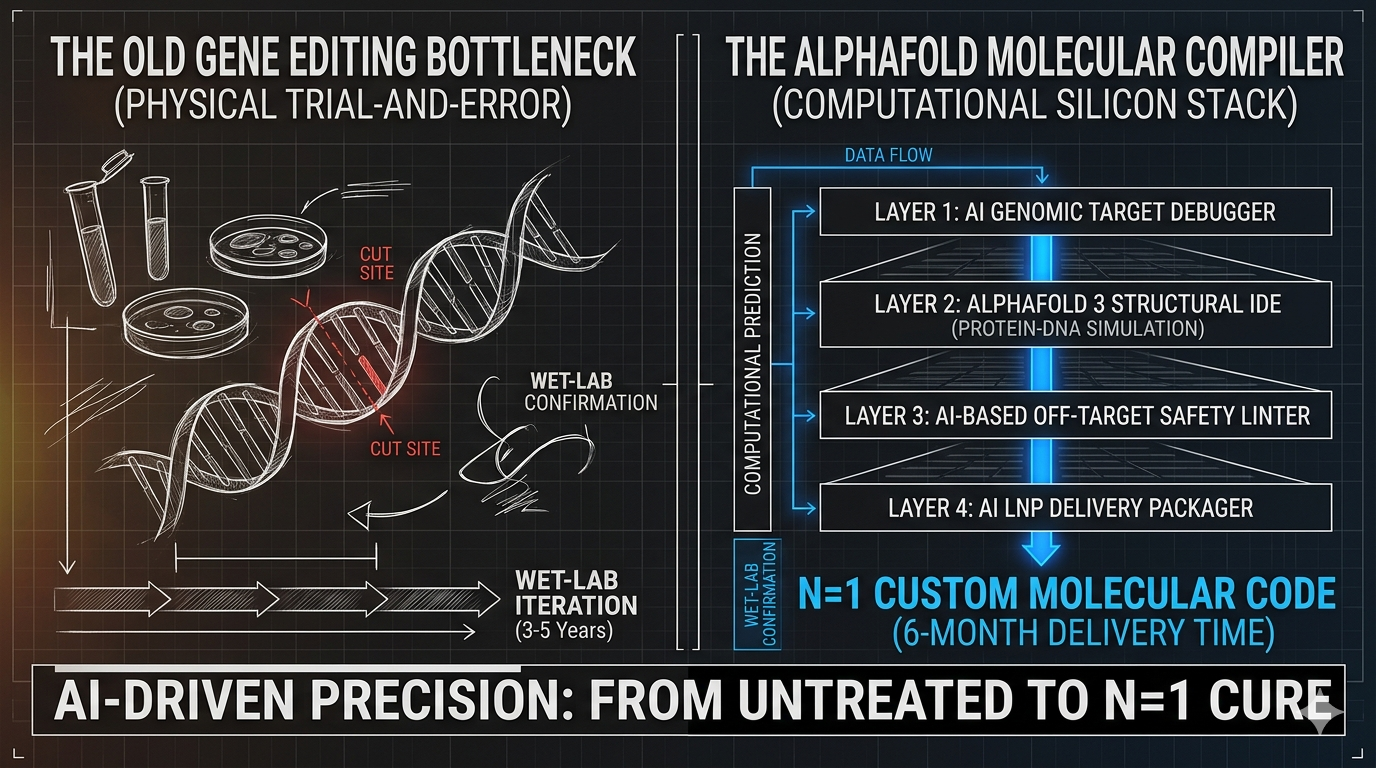
Here is what most coverage gets wrong: they talk about AI in gene therapy as if it is one thing. It is not. AI is operating at four distinct layers simultaneously, and each one changes a different part of the problem.
Layer 1: Finding the target
Before you edit a gene, you need to know where to edit it. This sounds simple. It is not.
The human genome has 3 billion base pairs. Finding the exact location of a specific mutation, understanding which genes are involved, predicting what a given edit will do — this requires analyzing enormous amounts of data.
AI models trained on genomic databases can now: identify the mutations responsible for a patient’s symptoms in hours instead of weeks, predict the functional impact of a given mutation on protein behavior, and rank potential editing targets by predicted efficacy and safety.
AI, including machine learning and deep learning models, is now accelerating the optimization of gene editors for diverse targets, guiding the engineering of existing tools, and supporting the discovery of novel genome-editing enzymes.
Layer 2: Designing the editor
Once you know what to fix, you need to design the molecular machine that will fix it.
A base editor has multiple components: the Cas protein that navigates to the right location, the deaminase enzyme that performs the chemical conversion, the guide RNA that specifies the target, and linkers connecting them all. Tweaking any one of these changes the editor’s efficiency, accuracy, and off-target behavior.
Before AI, optimizing an editor was an iterative wet-lab process. Design a variant. Test it in cells. Measure the results. Repeat. This takes months per iteration.
NUS Medicine researchers used AlphaFold-based structural analysis to engineer enhanced versions of a compact DNA-editing enzyme called SsdAtox, resulting in variants with up to 11.8-fold higher editing efficiency while reducing unwanted DNA damage and cellular toxicity.
AI models can now simulate thousands of editor variants computationally, identify the most promising ones, and dramatically reduce the number of wet-lab experiments needed.
Generative AI tools such as RFdiffusion, AlphaFold 3, and ESM now facilitate the de novo design of linkers, inhibitors, and enzymes for genome editing.
De novo means “from scratch.” Not optimizing existing tools. Designing new molecular machines that have never existed in nature.
Layer 3: Predicting off-target effects
This is the safety layer. And it is where AI has the most immediate impact on making gene therapy clinically viable.
CRISPR is precise, but not perfect. The guide RNA can sometimes direct the Cas protein to a location in the genome that looks similar to the intended target. This is called an off-target edit. For gene therapy in humans, off-target edits are potentially catastrophic — you could inadvertently disrupt a gene that prevents cancer, for example.
Predicting all possible off-target sites in a 3-billion-letter genome is a computational problem. Machine learning models trained on experimental off-target data can now predict off-target sites with much higher accuracy than the rule-based tools that came before them.
The result: editor designs that would have passed early safety screens but failed in vivo can now be rejected computationally before entering the lab.
Layer 4: Delivery
The hardest problem in gene therapy is not editing. It is getting the editor into the right cells.
You have a molecular machine that can fix a genetic typo. Now you need to put it inside a liver cell, or a blood stem cell, or a neuron, without triggering an immune response, without damaging surrounding tissue, and without it ending up somewhere it should not be.
The two main approaches today: viral vectors (engineered viruses that carry the editor into cells) and lipid nanoparticles (fatty spheres that encapsulate the editor and fuse with cell membranes).
AI is being used to design better lipid nanoparticles — optimizing their composition to target specific tissues, improve delivery efficiency, and reduce immune activation. What used to require synthesizing and testing thousands of lipid formulations in the lab can now be partially simulated computationally, narrowing the search space before physical synthesis begins.
What is happening right now in clinical trials
The pipeline is larger than most people realize.
Sickle cell and beta-thalassemia: Casgevy is approved and treating patients globally. Beam Therapeutics is running Phase 1/2 trials of a base editing therapy for severe sickle cell disease, with the first participant dosed in January 2024. Multiple other programs are in various stages.
Cardiovascular disease: Verve Therapeutics is in Phase 1b/2a trials for a base editing therapy that permanently reduces LDL cholesterol by inactivating the PCSK9 gene in liver cells. One dose. Lifelong effect. If it works, it replaces daily medication for familial hypercholesterolemia. Arbor Biotechnologies dosed the first participant in its primary hyperoxaluria type 1 trial in July 2025.
Cancer: Multiple programs are editing T cells to improve their ability to attack tumors. Some use CRISPR to knock out genes that normally prevent T cells from functioning in the tumor microenvironment.
Rare metabolic diseases: KJ’s case has opened a new category. Researchers noted that the resounding success of the personalized therapy developed on-demand for a baby born with a rare genetic disease helped pave the way for a major change in the way clinical trials are performed. The FDA is now developing pathways for n=1 therapies — therapies designed for a single patient.
Eye diseases: In vivo CRISPR delivery directly into the eye is being tested for Leber congenital amaurosis, a form of inherited blindness. The eye is an immunologically privileged site, which makes it an attractive target for in vivo editing.
Neurological diseases: The hardest frontier. Getting editors across the blood-brain barrier is an unsolved problem. Research is active. Clinical results are years away.
The four problems that still stand between here and everywhere
This is the honest part.
Problem 1: Delivery for everything that is not the liver or blood
Lipid nanoparticles are very good at reaching the liver. Blood stem cells can be extracted, edited externally, and returned to the body. But editing neurons in the brain, muscle cells throughout the body, lung cells in cystic fibrosis — these require delivery solutions that do not fully exist yet.
Problem 2: Cost and access
Casgevy and other CRISPR therapies carry significant costs, and financing treatment remains a concern. A one-time cure that costs two million dollars is not accessible to most of the 300 million people living with rare genetic diseases. The manufacturing, the clinical process, the regulatory pathway — all of it needs to become cheaper and faster.
KJ’s case is notable partly because Kiran Musunuru said his team’s work showed that creating a custom treatment does not have to be prohibitively expensive. But “not prohibitively expensive” is not the same as accessible to patients in low-income countries.
Problem 3: Long-term durability
We do not yet have long-term data. Casgevy has been administered for roughly two years. For patients who receive the therapy at age 12, we need decades of follow-up to confirm that the edits persist, that no unintended effects emerge over time, and that the edited cells continue to function normally.
Problem 4: Germline editing
All current approved and clinical therapies are somatic gene editing — editing cells in a living patient that cannot be inherited by their children. Editing germline cells (eggs, sperm, embryos) would produce inheritable changes.
The scientific community broadly agrees that germline editing for heritable diseases is not ready. The technology is not precise enough. The long-term consequences are not understood. The ethical frameworks are not established.
In 2018, He Jiankui announced he had created the first gene-edited human babies, editing germline cells to attempt HIV resistance. He was imprisoned. The scientific community was united in condemning the work as premature and irresponsible. This remains the boundary.
What gets unlocked if we crack the remaining problems
Here is what changes when delivery, cost, and durability are solved.
The 10,000 single-gene diseases: Most have no cure today. Most are rare enough that pharmaceutical development is not economically viable. With the personalized therapy framework KJ’s case demonstrated — design the editor computationally, manufacture rapidly, treat the specific patient — each of those 10,000 diseases becomes addressable.
Cardiovascular disease: Heart disease is the leading cause of death globally. Much of it is driven by genes we can now identify precisely. A single base editing treatment that permanently reduces LDL levels, administered once in adulthood, could prevent millions of heart attacks per year.
Sickle cell across Africa: Sickle cell disease affects roughly 300,000 newborns per year, the vast majority in sub-Saharan Africa. Casgevy is approved. Treatment centers are opening. The cost and manufacturing infrastructure challenges are real. But a disease that has killed people for millennia now has a functional cure. The question is distribution, not biology.
Cancer: T cell therapies for cancer are already in trials. The vision is a world where certain cancers that are currently fatal are treated with a one-time infusion of gene-edited immune cells, instead of years of chemotherapy.
Aging: This is the speculative end of the spectrum, and it is worth flagging clearly. Some researchers believe that the genetic drivers of aging — the accumulation of somatic mutations, the shortening of telomeres, the epigenetic changes that alter gene expression — are in principle addressable with gene editing tools. This is not clinical reality. It is not close to clinical reality. But it is the direction some of the research is pointing.
My take
I have been tracking this field for a while. Here is the thing that I think is genuinely underappreciated.
The bottleneck in gene therapy was never the biology. For thirty years, we knew what mutations caused which diseases. The sequence data existed. The targets were known. The bottleneck was tooling — we did not have precise enough tools to make the edits safely, cheaply, and reliably.
What AI changed is the speed at which we can move from “we know what is wrong” to “we have a tool that can fix it.”
AlphaFold did not discover new biology. It compressed the time from sequence to structure from years to hours. Base editor optimization using AlphaFold-guided scanning did not invent new editing chemistry. It compressed the iteration cycle from months of wet-lab work to days of computational screening followed by targeted experiments.
KJ’s treatment took six months to develop because most of the design work could be done computationally. Without AI-assisted structural modeling, that timeline might have been three years — too long for a six-month-old.
The implication is not that AI is doing biology. The implication is that AI is removing the bottlenecks that were preventing biologists from doing biology at the speed the problems require.
There are still hard problems. Delivery to the brain. Cost at scale. Long-term safety data. These are not computational problems with computational solutions. They are biological and manufacturing problems that need time, money, and patient data.
But the trajectory is clear. We went from scissors that cut DNA indiscriminately to chemical pencils that swap single letters. We went from protein structure determination taking years to taking hours. We went from gene therapy designed for disease categories to therapy designed for a single baby’s specific mutation.
The direction of travel is toward a world where having a genetic disease and being unable to treat it are no longer the same thing.
KJ went home.
That is where we are.
The timeline, compressed
Year What happened 1953 DNA double helix discovered 1972 First recombinant DNA 1990 First human gene therapy trial 1999 Jesse Gelsinger dies. Field pauses for a decade 2012 CRISPR-Cas9 described as programmable editor 2016 Base editing invented (Liu lab, Harvard) 2019 Prime editing invented 2020 Nobel Prize in Chemistry awarded to Doudna and Charpentier for CRISPR 2021 AlphaFold 2 solves protein folding problem 2023 Casgevy approved — first CRISPR therapy 2024 AlphaFold 3 models protein-DNA-RNA-ligand interactions Feb 2025 KJ receives first personalized CRISPR therapy 2025 Beam Therapeutics Phase 1/2 base editing trial ongoing 2025 Arbor Biotechnologies first participant dosed for PH1 End 2026 First AlphaFold 3-designed drugs expected in human trials
References and further reading
- Casgevy FDA approval — December 2023
- KJ’s case — NEJM, May 2025. DOI: 10.1056/NEJMoa2504747
- AlphaFold 3 — Nature, May 2024
- Base editing — David Liu lab, Nature 2016
- Prime editing — Nature 2019
- AI and CRISPR — Nature Reviews Genetics, November 2025
- CRISPR clinical trials 2026 — Innovative Genomics Institute
- Jinek et al. CRISPR-Cas9 original paper — Science 2012
메타데이터
- post_id
- dde158c6326e
- slug
- ai-is-rewriting-the-code-of-life-dde158c6326e
- url
- https://medium.com/data-and-beyond/ai-is-rewriting-the-code-of-life-dde158c6326e
- canonical_url
- https://medium.com/data-and-beyond/ai-is-rewriting-the-code-of-life-dde158c6326e
- author_url
- https://medium.com/@swarnenduiitb2020
- status
- ok
- fetched_at
- 2026-06-09 15:37:30