Why SDK vs Non-SDK Traffic Matters More Than You Think
Less than 6% of the time people spend on their phones happens in a browser — almost everything else takes place inside apps. That single…
Why SDK vs Non-SDK Traffic Matters More Than You Think

Less than 6% of the time people spend on their phones happens in a browser — almost everything else takes place inside apps. That single fact reshapes how digital advertising connects to inventory, and it sits at the heart of the SDK vs non-SDK question.
In this piece, the Fusify team breaks down what an SDK actually does in programmatic, how ad requests are built differently on the web and in apps, and what these differences mean once a campaign goes live.
TL;DR
- An SDK is a technology layer an app owner integrates to connect advertising infrastructure: demand, formats, events, measurement, and monetisation.
- The real difference between SDK and non-SDK traffic is how each environment connects to the ad infrastructure, not format, price, or identifiers.
- An SDK passes data — it doesn’t create it. The publisher decides which signals to share.
- Neither traffic type is inherently better; they compete in the same auction through different technical paths.
What an SDK Actually Is
In programmatic, an SDK is a universal technology layer an app owner embeds into their product to wire up advertising inside the app. It lets the app talk to ad platforms through a standardised set of technical rules — how requests are structured, how impressions and clicks get reported, and how the different players in the ecosystem interact.
A common misconception is that SDKs belong only to mobile apps. The logic is broader: on the web, the ad tags from tools like Google Ad Manager perform many of the same functions. The presence of an SDK says more about how the technical integration is built than about the environment itself.
Why the Two Environments Evolved Differently
Web and mobile advertising grew up on separate timelines. The web has sold ads since 1994, and for its first fifteen years it had no shared protocol at all — publishers and networks built integrations by hand. OpenRTB, the industry standard, only arrived in 2010. In markets like Ukraine or Turkey, sites sold banners directly to brands in weekly or monthly packages for years, simply because that was easier than wiring up complex external connections.
Mobile took a different road. As app inventory exploded, owners needed scalable monetisation and access to many demand sources without striking direct deals in every market. By then the technology had matured, so the mobile ecosystem adopted the SDK model early.
How the Request Is Built: Web vs App
On the web, the ad request is assembled in the user’s browser as the page loads. Part of the system runs on a device the publisher doesn’t control, and the result depends on the browser and its privacy settings. Identification leans on cookies, first-party data, and contextual signals — all increasingly limited by privacy policies and OS-level restrictions, especially on iOS.
In an app, the SDK forms the request. When an ad slot opens, the SDK detects the event and talks to the ad platform through predefined functions for requesting a creative, and tracking impressions, clicks, and video completions. Because large apps usually work with a dozen networks at once, a mediation layer sits in between, collecting bids and allocating each impression to the highest bidder.
User identification is the key contrast. Apps can use advertising IDs — IDFA on iOS or GAID on Android — but the SDK alone doesn’t guarantee access. Availability depends on the OS, consent mechanics, privacy policies, user settings, and the specific implementation.
Why an SDK Doesn’t Mean More Data
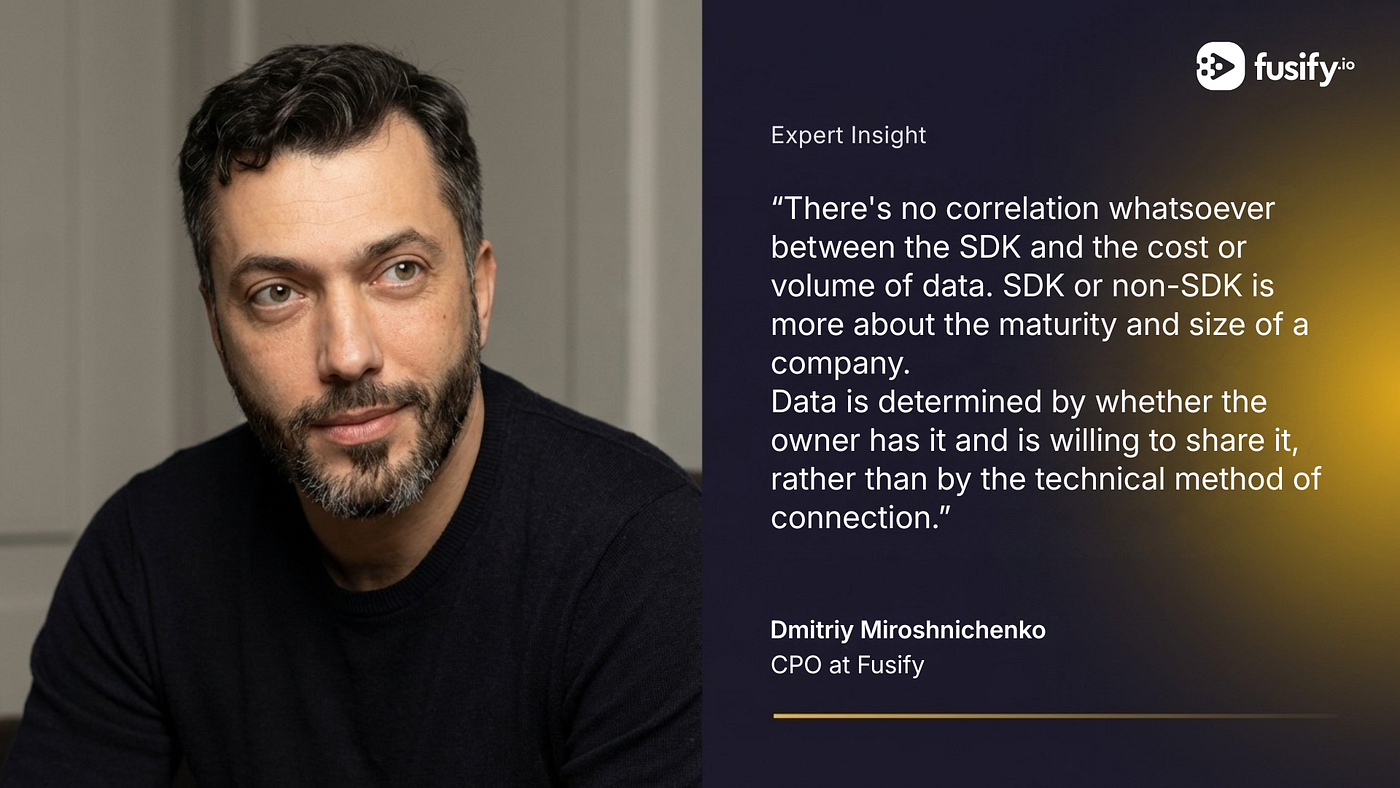
An SDK can pass data along, but it doesn’t create it. What ends up in the request comes down to two things: what information the publisher actually has (a small app knows far less than a platform with millions of users), and how much of it they choose to share. Publishers decide whether to expose the advertising ID, precise or only approximate location, in-app behaviour, device parameters, or session signals. That’s why two apps running the same SDK can pass completely different sets of data.
What This Means Once a Campaign Goes Live
These technical differences only matter in practice, and they surface most in three areas:
- Identification. On the web, it leans on cookies and standard signals constantly limited by browser settings and privacy rules. Apps can tap app-specific signals and advertising IDs — subject to consent — which, when the data lines up, gives advertisers real precision over frequency and audience exposure.
- Geotargeting. Web targeting usually relies on IP, so accuracy lands at city or regional level. In apps, user consent can unlock more precise location — critical for local campaigns.
- Fraud. The web’s weak spots are bot networks and spoofed domains; in apps it’s fake installs, emulators, and SDK-signal manipulation. This is where DSPs matter — Fusify assesses traffic quality across both environments daily to help brands spend effectively.
Why Certain Formats Thrive in Apps
Most formats technically run on the web too, but several perform far better inside apps because they draw on native events and built-in reward mechanics: interstitials fired on screen transitions, rewarded video tied to in-app bonuses, rewarded interstitials, playables in games, and app-open splash ads. They blend into the experience and appear exactly when attention is on the screen — and they’re far harder to block.
The Bottom Line
Neither traffic type has an inherent edge; SDK and non-SDK inventory compete in the same auction through different technical paths. The SDK’s real value is the standardisation and efficiency it brings — a simple way for publishers to connect their ad infrastructure, and standardised access to thousands of apps for a DSP through a single connection.
Advertisers don’t need to master every technical detail. Choosing the right traffic type for an objective, setting up the campaign, and watching inventory quality is best handled by a specialised partner. Fusify takes the technical side off your hands so you can focus on the business.
This Medium version covers the main ideas from Fusify’s full breakdown of SDK vs non-SDK traffic. The complete guide goes deeper, with detailed comparison tables, the full ad-format breakdown, and an FAQ.
Read the full article here → SDK vs Non-SDK Traffic: The Technical Difference and Why It Matters
메타데이터
- post_id
- ec588eec1376
- slug
- why-sdk-vs-non-sdk-traffic-matters-more-than-you-think-ec588eec1376
- url
- https://medium.com/@fusify/why-sdk-vs-non-sdk-traffic-matters-more-than-you-think-ec588eec1376
- canonical_url
- https://medium.com/@fusify/why-sdk-vs-non-sdk-traffic-matters-more-than-you-think-ec588eec1376
- author_url
- https://medium.com/@fusify
- status
- ok
- fetched_at
- 2026-06-21 15:33:18