How SuperYou Hit ₹100 Crore in 6 Months Without Putting Ranveer Singh’s Face on the Pack
The brand strategy playbook behind India’s fastest-growing protein brand
How SuperYou Hit ₹100 Crore in 6 Months Without Putting Ranveer Singh’s Face on the Pack
©SuperYou x Instamart
The brand strategy playbook behind India’s fastest-growing protein brand
Nikunj Biyani pitched SuperYou to Ranveer Singh via GIFs.
Not a deck. Not slides. Not a 40-page strategy document.
GIFs. Sent at some odd hour in the morning.
Ranveer’s response: “I love it, I love it, I love it.”
Six months after launch, SuperYou hit ₹100 crore ARR. 15 million units sold. Four SKUs.
Most celebrity brands fail. Most protein brands stay in the supplement aisle. SuperYou did neither.
Here’s how they actually built it.
The Whitespace Nobody Owned
Nikunj spent 8 years at Future Consumer running packaged foods. Pasta, biscuits, chips, frozen foods, namkeens. Then went to nutraceutical fairs in the US.
What he saw: a gap.
No brand owned “protein” in India the way Ching’s owns Chinese food products. The category existed. The market was massive. But no brand owned it.
India’s protein product market hit ₹38,247 crore in 2024. Expected to reach ₹1,36,327 crore by 2033 (IMARC Group).
The problem? Every protein brand was fighting in the same space.
Whey isolates. Gym aesthetics. Clinical packaging. Benefit-heavy messaging. “25g protein. Zero sugar. Builds muscle.”
All positioned as supplements. All sold in the supplement aisle. All targeting gym-goers.
SuperYou went the opposite direction.
The Product Decision: Competing with Dairy Milk, Not Whey
Most protein brands ask: “How do we make the best protein supplement?”
SuperYou asked: “How do we make protein fun?”
The format matters more than people think.
Protein bars are dense. Chewy. They feel like supplements. You eat them because you need protein, not because you want them.
SuperYou made wafers instead.
40g wafer. Layered chocolate and creme. Light, crunchy texture. You can see the layers when you bite into it thin chocolate and creme stacked, not dense.
The protein source: Saccharomyces cerevisiae. Brewer’s yeast fermented with molasses in bioreactors.
PDCAAS score of 1.0 same as whey. But gut-friendly, vegan friendly, zero common allergens. No dairy, no soy, no gluten. No bloating.
Here’s the part most brands wouldn’t do: they tested whole wheat first.
Made sense on paper. Healthier. Clean label. Better optics.
Tasted like a “healthy chocolate bar (read: not fun)”
So they scrapped it. Kept 2g maida in the entire 40g wafer. Added 3g fiber to balance it out. Got the texture right.
Most brands would launch the whole wheat version anyway. Justify it with “clean eating” messaging. Settle for “good enough”
SuperYou killed it.
“If it’s not maad tasty, it’s not SuperYou”
The Product They Killed (And Why It Matters)
Before launch, they built a 20g protein bar.
10–15 prototypes. Months of work. Got the nutrition right 20g protein in 160 calories.
100+ people tested it.
Feedback: “Too chewy. Too similar to regular protein bars.”
They scrapped it entirely.
Think about that. Months of work. 10–15 iterations. Product was finished. Ready to launch.
Most brands would launch anyway. Justify it. “The market wants high-protein products. 20g protein is a strong USP. We can position it as premium.”
SuperYou walked away.
January 2025, they came back with Mega Protein Wafer. Same 20g protein. Different format.
Atta and jowar. Chocolate wafer layers. Salted peanuts. ₹120.
Not a dense bar. Wafer format.
This is the difference between brands that scale and brands that don’t. Willingness to kill finished products because they don’t meet the standard.
“If it’s not maad tasty, it’s not SuperYou” isn’t marketing copy. It’s an operating principle.
The Packaging Decision: Building a Brand That Outlives the Endorsement
Ranveer Singh owns 50% of SuperYou.
Most celebrity brands plaster the celebrity’s face everywhere. The product is the celebrity.
SuperYou didn’t.
Look at the packaging: oversized red “SUPERYOU” wordmark stretched across the wrapper. So big it doesn’t fit. Gets cropped on both sides.
Bold, condensed typography. Extended sans serif with gentle tapering. Sleek, athletic. Not gym-bro.
The rest? Mostly negative space. “10g protein. No added sugar.” sits quiet at the bottom.
Ranveer’s face? On the marketing. On the box. In the launch content. Not on the individual wrapper.
Nikunj spent months on this logo. His quote: “I would still go to an expert and pay extra money something like a logo is going to live with you for a very long time.”
Smart move.
If Ranveer’s face is on every pack and something changes — controversy, different brand ambassador, shift in partnership — the entire packaging needs redesigning. The brand identity is tied to one person.
This way, the pack stands alone.
The logo is “larger than the pack.” Signals confidence that doesn’t need a celebrity face.
Product identity independent of celebrity identity.
Ranveer’s still involved. Every product goes through his family’s taste test. He’s a real partner. But his face isn’t the brand.
The brand can outlive the endorsement cycle.
The Pricing Perception Gap
People look at SuperYou’s packaging and assume ₹150–200.
Premium design. Clean aesthetics. Bold branding. Fermented yeast protein. Gut-friendly positioning.
It’s ₹60.
This gap matters.
Most brands do it backwards. Create budget packaging, premium product, then struggle with perception. “Why should I pay ₹150 for something that looks like it costs ₹50?”
SuperYou flipped it. Premium packaging, accessible price.
The packaging does the heavy lifting. You pick it up, it feels premium. Then you see the price and think “wait, this is actually affordable?”
Pricing anchors perception. But packaging sets expectation.
When expectation exceeds price, you get velocity.
₹100 crore ARR in 6 months. 15 million units sold.
The Distribution Strategy: Sitting Next to Dairy Milk
SuperYou didn’t go after the supplement aisle.
They went after the snack aisle.
Distributed through Blinkit, Zepto, Swiggy Instamart. 4,500+ retail outlets. Available on Amazon, Flipkart, Reliance Fresh, 7-Eleven.
The moment they’re targeting: 4pm desk snack. Post-lunch sweet tooth. Not pre-workout fuel.
You’re sitting at your desk, 4pm slump hits, you want something sweet. You reach for Dairy Milk, KitKat, or a biscuit.
SuperYou sits right there. Same aisle. Same moment. Different story.
“10g protein. No added sugar.”
You get the indulgence. You get the protein.
This is the repositioning. They’re not competing with MuscleBlaze or Optimum Nutrition. They’re competing with Cadbury.
Different competitive set. Different moment. Different purchase behavior.
Supplement aisle = planned purchase. “I need protein powder for my gym routine.”
Snack aisle = impulse purchase. “I want something sweet right now”
Impulse wins on velocity.
The Launch Strategy: Collapsing the Purchase Funnel
January 2025. SuperYou launches Mega Protein Wafer (20g protein).
Most brands do product launches like this:
- Announcement campaign (“Coming Soon”)
- Awareness push (social media, influencers, PR)
- Consideration phase (reviews, comparisons, education)
- Purchase (“Now Available”)
Traditional marketing funnel: Awareness → Consideration → Purchase.
Takes weeks. Sometimes months.
SuperYou did something different.
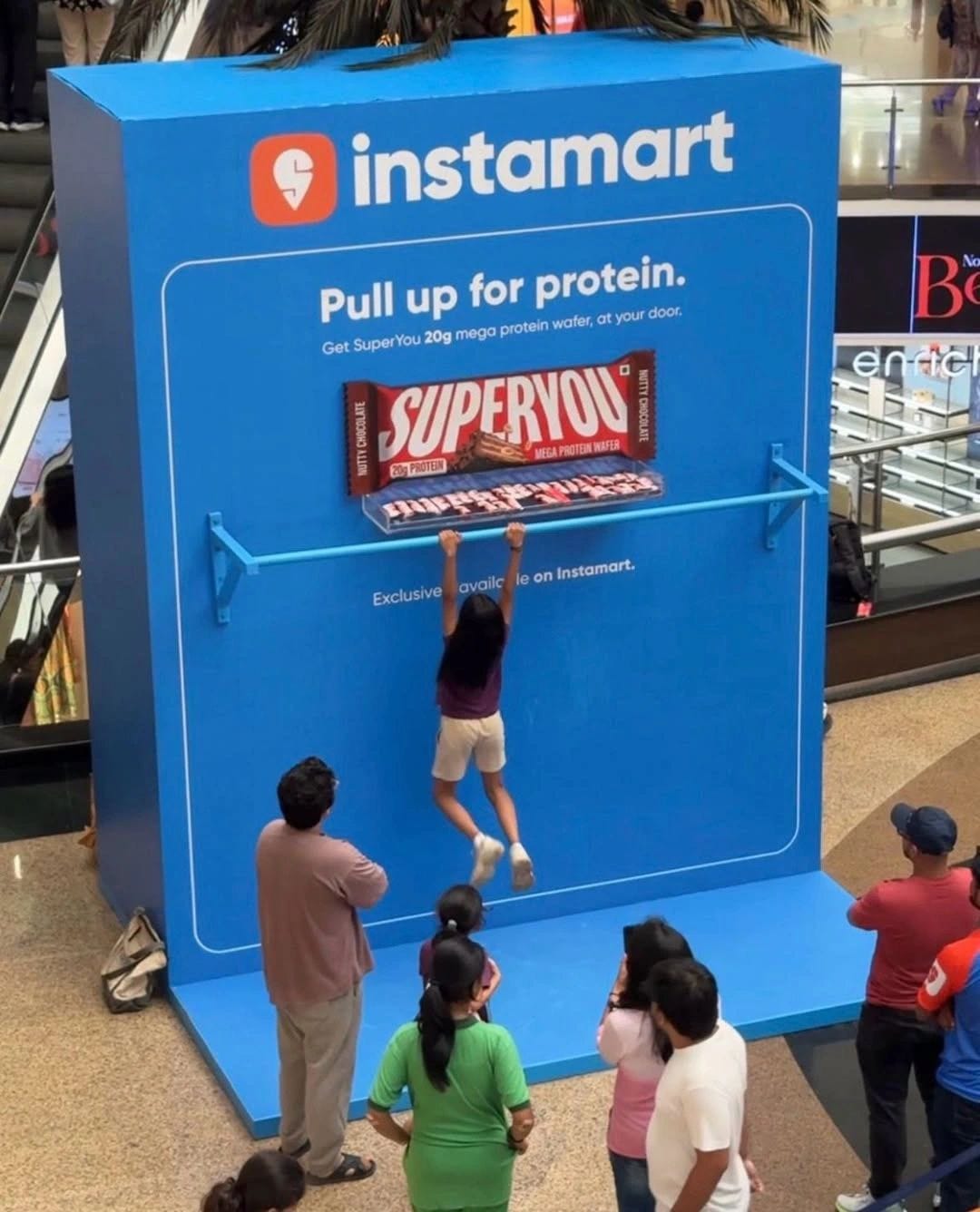
They set up a pull-up bar at a Mumbai mall.
Blue Instamart-branded setup. Pull-up bar mounted on the front. Message: “Pull up for protein. Get SuperYou 20g mega protein wafer, at your door. Exclusively available on Instamart”
Do a pull-up. Product delivered to you via Instamart in 10 minutes.
Try → film → share → order → consume.
Look at what happened: crowd watching, person mid-pull-up, product sitting on the shelf above them.
Physical activation became instant conversion.
No “link in bio.” No “sign up for early access.” No “check out our website to learn more.”
You do the pull-up, you order on the spot, product arrives in 10 minutes.
Awareness became purchase. No consideration phase in between.
This is the shift quick-commerce enabled.
Traditional marketing assumes a gap between awareness and purchase. You see the ad, you consider it, you remember it, you buy it later.
Quick-commerce killed that gap.
You see it, you want it, it’s at your door in 10 minutes.
“Pull Up for Protein” isn’t a marketing campaign. It’s product marketing + discovery + retail happening simultaneously.
Physical activation created content (people filming the pull-ups). Content drove awareness. Awareness drove orders. Orders got fulfilled in real-time.
The entire funnel collapsed into one experience.
The Quick-Commerce Playbook
SuperYou’s launch strategy only works because of quick-commerce infrastructure.
Traditional retail: you create awareness, drive people to stores, hope they find your product, hope it’s in stock, hope they buy it.
Too many variables. Too much friction.
Quick-commerce: you create awareness, they order immediately, product delivered in 10 minutes.
Zero friction between intent and purchase.
India’s Beauty & Personal Care sales grew 160% YoY on quick-commerce platforms, generating ₹8,300–850 crore monthly. Impulse categories became instant categories.
SuperYou launched Mega Protein Wafer exclusively on Swiggy Instamart first.
Not multi-platform. Not omnichannel. Just Instamart.
Why?
Test demand. Collect data. Iterate faster.
You launch on 10 platforms, you dilute focus. You can’t tell which channel works, which messaging resonates, which audience converts.
You launch on one platform, you get clear signal.
Then you expand.
This is the new D2C playbook:
- Launch exclusive on one quick-commerce platform
- Use physical activations to drive awareness + instant orders
- Collect data, iterate, refine
- Expand to other platforms once product-market fit is proven
Traditional playbook was: build brand → distribute everywhere → hope it works.
New playbook: test fast → prove demand → scale distribution.
SuperYou’s doing the latter.
The Brand Voice: “Protein Fun” Not “Protein Supplement”
Look at SuperYou’s messaging.
Not: “Fuel your workout. Build muscle. Recover faster.”
Instead: “We’re here to make protein fun and you super.”
The entire positioning is anti-supplement.
Packaging shows the wafer layers “Classic Crunchy SuperYou Protein.” Not “High-Performance Protein Bar”
Fermented yeast protein is highlighted as “Gut-Friendly” and “Peak Protein Digestibility.” Not “25g Whey Isolate.”
Even the product naming: “Mega Protein Wafer.” Not “Mega Protein Bar.”
Language matters.
“Bar” signals supplement. Dense. Functional. Work.
“Wafer” signals snack. Light. Indulgent. Treat.
Same protein content. Different framing.
Ranveer’s marketing isn’t gym-focused. It’s energy-focused. Red SuperYou tank, dynamic pose, “WE’RE HERE TO MAKE PROTEIN FUN.”
Not gym aesthetics. Not muscles. Just energy and fun.
This is intentional.
The gym market is saturated. Every protein brand fights for the same 15% of people who lift weights.
SuperYou went after the other 85%.
People who want protein but don’t want to feel like they’re eating supplements.
People who care about health but won’t sacrifice taste.
People who want the 4pm snack without the guilt.
That’s a bigger market.
What They Actually Figured Out
No brand owned “protein” in India the way Ching’s owns Chinese food products.
That’s the insight.
Ching’s didn’t just make Chinese food products. They became Chinese food in India. You want schezwan sauce, you think Ching’s. You want hakka noodles, you think Ching’s.
Category ownership.
SuperYou’s going after the same thing with protein.
Not “best protein bar.” Not “highest quality whey.”
Just “protein”
You want protein, you think SuperYou.
That only works if you’re in the snack aisle, not the supplement aisle.
That only works if you taste like indulgence, not discipline.
That only works if your packaging signals confidence, not benefits.
That only works if the brand can stand without the celebrity face.
SuperYou’s building for the long game.
The Bigger Shift: Phygital as the New Launch Playbook
“Pull Up for Protein” is the case study everyone will reference.
Not because of the pull-up bar. Because of what it represents.
Traditional product launch:
- Announcement
- Digital ads
- Influencer seeding
- PR coverage
- Retail distribution
- Hope people buy
Timeline: 3–6 months from announcement to meaningful sales.
SuperYou’s launch:
- Physical activation at mall
- Creates immediate content (people filming)
- Drives instant orders (Instamart delivery in 10 minutes)
- Confirmed users + product trials on day one
Timeline: Immediate.
This is the shift.
Physical activations used to be brand-building exercises. Create buzz, get impressions, hope it converts later.
Now they’re conversion engines.
You don’t just create awareness. You create customers.
The pull-up bar isn’t a stunt. It’s distribution.
People do the pull-up → they order → product arrives → they try it → they either reorder or don’t.
The entire customer journey happens in 15 minutes.
Compare that to traditional marketing where weeks pass between awareness and first purchase.
Quick-commerce collapsed the funnel.
Smart brands are redesigning their launch playbooks around this reality.
The Mistakes Most Celebrity Brands Make (That SuperYou Avoided)
Mistake 1: Celebrity face on everything
Makes the product dependent on the celebrity. If partnership ends, brand identity dies.
SuperYou: Celebrity on marketing, not on packaging. Brand can outlive endorsement.
Mistake 2: Premium positioning with premium pricing
Limits market size. Only affluent consumers can access.
SuperYou: Premium packaging, accessible pricing (₹60). Expands addressable market.
Mistake 3: Launch everywhere at once
Can’t collect clean data. Can’t iterate fast. Diluted focus.
SuperYou: Exclusive launch on one platform (Instamart). Test, learn, scale.
Mistake 4: Supplement category positioning
Competes with established players (MuscleBlaze, Optimum Nutrition). Limited market.
SuperYou: Snacking category positioning. Competes with Dairy Milk. Bigger market.
Mistake 5: Traditional awareness → consideration → purchase funnel
Slow. High drop-off between stages. Expensive customer acquisition.
SuperYou: Collapsed funnel. Awareness = purchase. Physical activation + instant delivery.
Mistake 6: Product-market fit assumed, not tested
Launch products because “market wants high-protein.” Don’t validate taste/format first.
SuperYou: Killed 20g bar because testers said “too chewy.” Came back with right format.
The Framework: How to Apply This to Your Brand
1. Find the whitespace in category ownership, not product features
Don’t ask: “How do we make the best [product]?”
Ask: “What category can we own?”
Ching’s didn’t make the best schezwan sauce. They owned “Chinese food products in India.”
SuperYou isn’t making the best protein bar. They’re owning “protein as snacking.”
2. Format determines competitive set, not features
SuperYou’s protein content is comparable to competitors.
But wafer format puts them next to KitKat, not MuscleBlaze.
Different aisle. Different moment. Different purchase behavior.
What you compete with matters more than what you contain.
3. Packaging should signal confidence, not benefits
Oversized logo that can’t fit the pack = confidence.
Quiet protein claim at the bottom = confidence.
Ranveer’s face off the wrapper = confidence.
Brands that scream benefits lack confidence in the product itself.
4. Pricing perception gap drives velocity
Look expensive, cost less = velocity.
Look cheap, cost more = friction.
The gap between expectation and price determines purchase momentum.
5. Kill finished products if they don’t meet the standard
“If it’s not maad tasty, it’s not SuperYou” is an operating principle, not marketing copy.
Most brands launch “good enough” products. They fail slowly.
Great brands kill products that aren’t right. They come back stronger.
6. Collapse the purchase funnel with phygital activations
Physical activation + instant delivery = awareness becomes purchase.
No consideration phase. No “I’ll think about it.”
You see it, you try it, you order it, it arrives.
Design launches around this reality.
7. Build brand identity independent of celebrity identity
Celebrity on marketing = amplification.
Celebrity on packaging = dependency.
One helps you scale. The other makes you fragile.
What Happens Next
SuperYou hit ₹100 crore ARR in 6 months with four SKUs.
Most brands would scale by adding more SKUs. More flavors. More formats. More, more, more.
SuperYou’s doing something smarter.
They launched protein chips in May 2025. 40g pack, 10g protein, 3g fiber, no added sugar, no palm oil. ₹50.
Going after India’s ₹25,000 crore chips and savouries market.
Same playbook:
- Premium packaging, accessible pricing
- Snack positioning, not supplement
- Fermented yeast protein
- Sits next to Lay’s, not protein bars
They’re not building a protein bar company.
They’re building a protein snacking company.
Every category in snacking becomes addressable.
Wafers. Chips. Cookies. Bars. Biscuits.
All with protein. All positioned as snacks. All priced accessibly.
That’s how you own “protein” as a category.
Not by making the best protein powder.
By making protein the default choice in every snacking moment.
The Real Lesson
Nikunj pitched SuperYou via GIFs at some odd hour in the morning.
Six months later, ₹100 crore ARR.
The lesson isn’t “use GIFs to pitch.”
The lesson is: understand your audience so well you know they won’t sit through pitch decks.
Understand your market so well you know where the whitespace is.
Understand your product so well you’ll kill it if it’s not right.
Understand your distribution so well you can collapse the purchase funnel.
Understand your brand so well it can outlive the celebrity.
That’s what SuperYou got right.
GIF pitch to pull-up bar activation it’s the same principle.
Your audience isn’t sitting through long, traditional processes.
Give them what they want. Instantly. In the format they’ll actually engage with.
That’s the playbook.
메타데이터
- post_id
- ee2e67983686
- slug
- how-superyou-hit-100-crore-in-6-months-without-putting-ranveer-singhs-face-on-the-pack-ee2e67983686
- url
- https://medium.com/@aadilsyed/how-superyou-hit-100-crore-in-6-months-without-putting-ranveer-singhs-face-on-the-pack-ee2e67983686
- canonical_url
- https://medium.com/@aadilsyed/how-superyou-hit-100-crore-in-6-months-without-putting-ranveer-singhs-face-on-the-pack-ee2e67983686
- author_url
- https://medium.com/@aadilsyed
- status
- ok
- fetched_at
- 2026-06-09 15:37:30