The Monk, the Microscope, and the Missing Half of Life
Why science has spent 70 years trying to answer a question that can’t be answered — and what happens when you ask the right one instead.
The Monk, the Microscope, and the Missing Half of Life
Master Zhaozhou — Not Yes Not No
Why science has spent 70 years trying to answer a question that can’t be answered — and what happens when you ask the right one instead.
A thousand years ago, in a monastery in southern China, a student approached his teacher with a question.
“Master Zhaozhou,” he said. “Does a dog have Buddha-nature?”
It was a reasonable question. Buddhist scripture taught that all sentient beings possessed Buddha-nature — the seed of awakening. A dog is a sentient being. Surely the answer was yes.
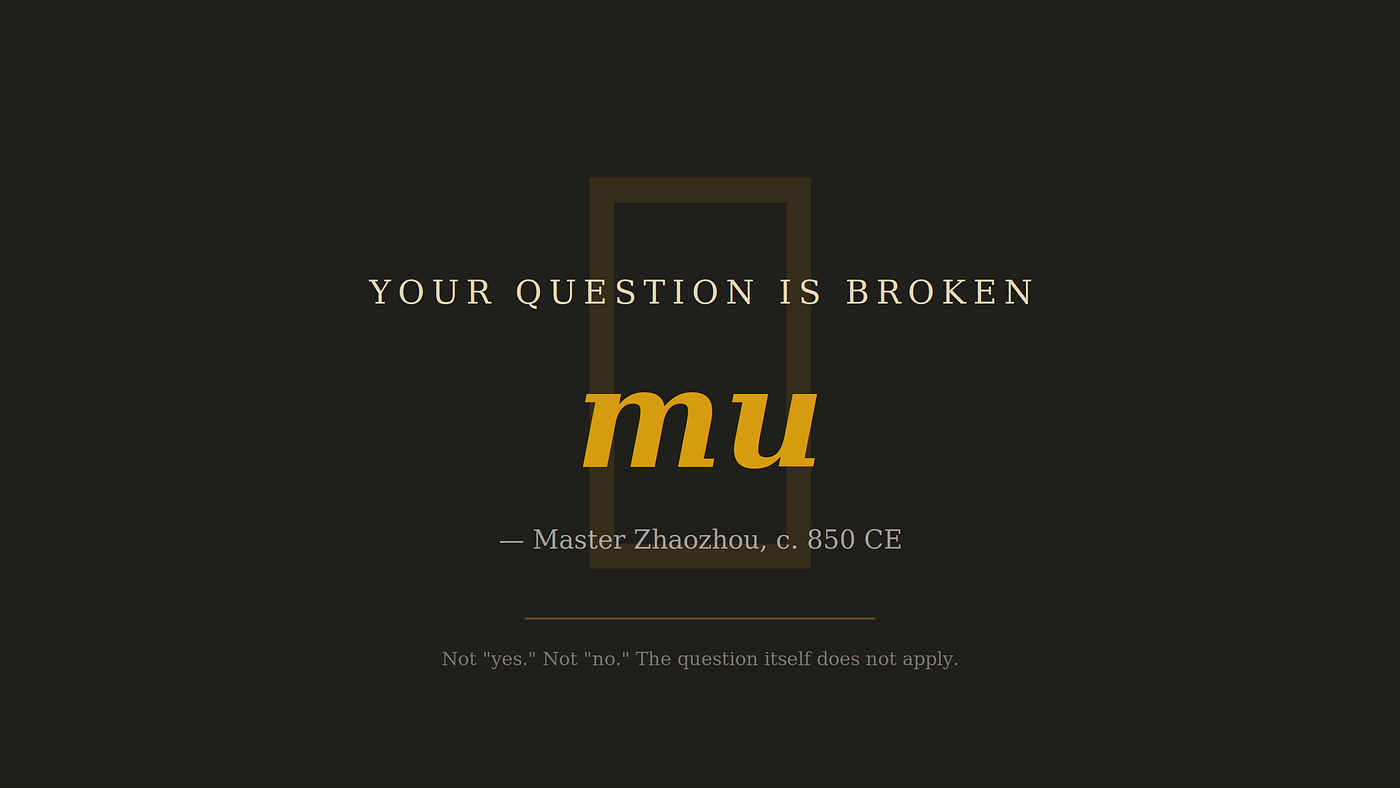
Zhaozhou looked at the student and said one word:
Mu.
Not “yes.” Not “no.” Something else entirely. A word that means, roughly, “your question is broken.” The student had asked a perfectly logical question, and the master had refused to answer it — not because the answer was unknown, but because the question itself was built on a foundation that didn’t hold. To answer “yes” or “no” would be to accept the premise, and the premise was wrong. The only honest response was to reject the question and force the student to find a better one.
Mu has no direct English translation. The closest might be “unask the question.” It’s what happens when you put infinity into a formula that describes something finite — you don’t get an infinitely large answer, you get a signal that you’ve left the domain where your formula works. The math isn’t broken. Your question is.
This concept — mu, the broken question — turns out to be the key to solving one of the biggest mysteries in modern biology.
The Mystery of the Dark Proteome
Here’s something that should bother you more than it probably does: we don’t know what roughly half of your proteins look like.
Not because we haven’t tried. We’ve been trying for seventy years, with increasingly spectacular technology. X-ray crystallography. Cryo-electron microscopy. Nuclear magnetic resonance. And most recently, AlphaFold — the AI system that won the Nobel Prize for predicting protein structures with remarkable accuracy.
And yet. Half the proteome remains “dark.”
The numbers are stark. In bacteria and archaea — the simple, ancient single-celled organisms — structural biology has been a triumph. We know the shapes of roughly 87% of their proteins. But in eukaryotes — the complex organisms, the ones with nuclei and organelles and immune systems, the ones that include you and me and every plant and animal on Earth — we can only account for about 46%. The rest is… nothing. Blank. Invisible to every instrument we’ve built.
Scientists call this the “dark proteome,” borrowing the language of astrophysics, where “dark matter” refers to the stuff that must be there but can’t be seen. The metaphor is deliberate: it implies that the darkness is a problem of detection. Build a better telescope — or in this case, a better microscope, a better algorithm, a better database — and the darkness will yield to light.
But what if the darkness isn’t a problem of detection?
What if the question is mu?

The Dark Proteome
What We’re Actually Asking
When a structural biologist says they want to know the “structure” of a protein, they mean something very specific: they want to know the three-dimensional arrangement of every atom. They want coordinates. X, Y, Z. A fixed shape that they can deposit in the Protein Data Bank, rotate on their computer screen, and show to their students.
This works beautifully for some proteins. Hemoglobin, the protein that carries oxygen in your blood, has a gorgeous, stable, four-part structure that was first solved in the 1960s and looks the same every time you crystallize it. Lysozyme, the antibacterial enzyme in your tears, folds into a compact little shape that fits a sugar molecule the way a hand fits a glove. These proteins have structures in the way that buildings have blueprints. The question “what does it look like?” has a clear answer.
But then there are the other proteins. The ones that refuse to crystallise. The ones that show up as a blur in the electron microscope. The ones where AlphaFold throws up its hands and says, with characteristic digital politeness, “low confidence.” These proteins don’t have a shape. Not because we haven’t figured it out yet — but because they are not shaped. They exist as clouds of rapidly interconverting configurations, flickering between states too fast and too varied to freeze into a single snapshot.
The conventional scientific response is: we need better tools. More resolution. More computing power. More data.
The mu response is: you’re asking the wrong question.
“What is the three-dimensional structure of an intrinsically disordered protein?” is like asking, “What is the color of the number seven?” The question has the grammatical form of a real question — subject, verb, object, question mark. But it assumes that the number seven has a colour, and it doesn’t. No amount of better color-measuring equipment will solve the problem. The question isn’t hard. It’s broken.
Two Channels, Not One
So what’s the right question?
Here’s where things get interesting. There’s a branch of mathematics — tensor geometry — that describes systems with two independent properties that combine in a specific way. Think of it like a radio signal: every broadcast has both a magnitude (how loud it is) and a frequency (what station it’s on). If you only measure the magnitude, you can tell that something is broadcasting, but you can’t tell what it’s saying. You need both channels.
Proteins, it turns out, work the same way. Every amino acid — the building blocks that chain together to form a protein — has two independent properties that matter for its behaviour:
Channel one: How sticky is it? Some amino acids are oily and repel water. They want to hide inside the protein, away from the watery cell interior. Biochemists call this “hydrophobicity.” Leucine, isoleucine, valine, phenylalanine — these are the wallflowers of the molecular world, happiest when buried deep in the protein’s core, clinging to each other and avoiding water at all costs.

Two Channels Not One
Channel two: How sociable is it? Other amino acids are charged or polar — they love water, they love interacting with other molecules, they’re flexible, they move. Arginine, lysine, glutamate, proline — these are the extroverts, always on the surface, always reaching out, always changing partners.
Here’s the crucial part: these two properties are mathematically orthogonal. They point in completely different directions. A protein’s total behaviour is the combination of both channels — not one or the other. And the balance between them determines whether the protein folds into a fixed shape or stays flexible.
When channel one dominates — when the sticky, oily amino acids outnumber the sociable ones — the protein collapses inward. The hydrophobic residues find each other, squeeze out the water, and lock into a compact, stable fold. This is the “structured” proteome. The part we can photograph.
When channel two dominates — when the charged, flexible amino acids are in the majority — the protein can’t collapse. There’s too much charge repelling itself, too much flexibility, too much affinity for water. Instead of folding into a shape, it dances. It exists as an ensemble of conformations, flickering between states, always moving, never settling.
This isn’t a failure to fold. It’s a different kind of being.
And here’s what the structural biologists have been missing: the instruments they use — X-ray crystallography, cryo-EM, even AlphaFold — only measure channel one. They see the magnitude. They see the shape. But the flexible proteins operate primarily in channel two, which carries information through dynamics rather than coordinates. Asking for the “structure” of a channel-two protein is like measuring the volume of a radio broadcast and concluding that the station isn’t transmitting any music. The music is there. You’re holding the wrong instrument.
The Dividing Line

The Dividing Line
In 2000, a Russian-born biochemist named Vladimir Uversky published a paper that changed the field. He showed that you could predict whether a protein was structured or disordered just by plotting two numbers: its average “oiliness” (hydropathy) on one axis and its average electrical charge on the other. Structured proteins are clustered in one region. Disordered proteins clustered in another. A simple straight line separated them.
This was a purely empirical discovery. Uversky drew the line because it worked, not because anyone could explain why it was a straight line or why it had the specific slope it did.
The tensor geometry explains both.
The line is straight because the transition between “folds” and “doesn’t fold” depends on the angle between the two channels — the ratio of sociability to stickiness — not on their absolute amounts. A big protein with the right ratio folds; a small protein with the right ratio folds. A big protein with the wrong ratio doesn’t; a small protein with the wrong ratio doesn’t. The dividing angle is 45 degrees — exactly where the two channels contribute equally.
The slope (2.785, if you’re curious) comes from the scaling between the two channels — essentially, the conversion factor between the units biochemists use to measure oiliness and the units they use to measure charge. It’s not a magic number. It’s a unit conversion.
What Uversky found with data, the geometry derives from first principles. The boundary was always there, written into the mathematics of how two-channel systems behave. He discovered it the way an explorer discovers a mountain — the mountain was always there, but someone had to be the first to see it.
Why Life Needs the Darkness
Here’s the part that transforms the whole picture: the “dark” proteins aren’t broken or primitive or incomplete. They’re essential. And the more complex an organism is, the more of them it needs.
Bacteria, the simplest living things, are about 87% structured. They’re molecular machines — enzymes that chop things up, pumps that move things around, structural proteins that give the cell its shape. For this kind of work, fixed shapes work perfectly. A wrench needs to be the right shape. An enzyme needs to be the right shape. Channel one handles it.
But you are not a bacterium.

Hardware and Software
You have an immune system that recognizes millions of different invaders it has never seen before. You have a heart whose stiffness adjusts beat by beat depending on how hard you’re exercising. You have cells that decide, moment by moment, whether to grow, or to divide, or to die. These decisions require something that fixed shapes cannot provide: flexibility. The ability to change conformation depending on context. The ability to bind one partner in one situation and a different partner in another. The ability to integrate multiple signals simultaneously and produce an ultrasensitive, switch-like response.
This is what channel-two proteins do. They’re the regulators, the switches, the integrators, the signal processors. They’re the software running on the hardware of structured proteins. And eukaryotes — complex organisms like you — need more software than bacteria do. A lot more. Hence, the 54% “darkness.”
The darkness isn’t a gap in knowledge. It’s a feature of complex life.
The Diseases of Darkness
This reframing changes everything about how we approach disease.
Take Alzheimer’s. The amyloid plaques that characterise Alzheimer’s disease are formed when normally flexible, channel-two proteins lose their flexibility and aggregate into rigid, insoluble deposits. In geometric terms, the proteins undergo too many interaction steps — more than the system can handle — and crash through a mathematical floor we call 𝔊₀ (approximately 0.118). Below this floor, the system can’t maintain its liquid, dynamic state. It solidifies. The condensate becomes a plaque.
The conventional approach to Alzheimer’s has been to dissolve the plaques — to break up the solidified protein. The geometric framework suggests this may be the wrong strategy. The plaques are a symptom of cascade overflow, not the disease itself. The right strategy is to prevent the overflow — to keep the system within its first five interaction steps, where the condensate remains liquid and functional.
Or take cancer. The most important cancer genes — p53, MYC, EWS-FLI1 — encode proteins that are intrinsically disordered. Channel-two proteins. For decades, drug companies have tried to find small molecules that bind to these proteins the way a key fits a lock. They’ve failed, because there is no lock. The proteins don’t have a fixed shape with a pocket for a drug to sit in. The industry calls these targets “undruggable.”
But they’re not undruggable. They’re druggable in channel two instead of channel one. Instead of looking for a pocket, you need to look for a molecule that shifts the balance between the two channels — that rotates the protein’s behavior toward or away from a critical threshold. It’s a completely different kind of drug design, and it’s already starting to work: recent breakthroughs in Ewing sarcoma have used small molecules to forcibly relocate the disordered EWS-FLI1 protein, essentially reprogramming the cancer cell’s own machinery to kill itself.
The Lesson of Mu
The monk’s mu is not nihilism. It’s not “there is no answer.” It’s “there is no answer to that question.” The answer exists — it’s just in a different place than the question is pointing.
For seventy years, structural biology has been asking “what is the shape?” and interpreting silence as ignorance. The geometric framework says the silence is an answer. It says: this protein doesn’t have a shape, because its function isn’t about shape. Its function is about dynamics, flexibility, partnership, context — all the things that live in the phase channel, the second dimension of the tensor state, the part of the signal that carries the music rather than the volume.
When you ask the right question — “what are the two-channel parameters of this protein?” — every protein has a definite, measurable, complete answer. The structured ones and the disordered ones alike. There is no darkness. There are two channels, and we’ve been measuring only one.
The geometry was always there.
We were just asking the wrong question.

There is no dark proteome!
Mark S. Hewitt, Ph.D., is the principal investigator of Tribernachi Theory and founder of The Tribernachi Foundation. His research applies discrete geometric frameworks to problems in physics, biology, and information science.
The technical paper underlying this article — “The Geometric Proteome: Resolving Structural Indeterminacy Through Tensor State Decomposition” (TTI.RES.DARKPROT-001) — is available from The Tribernachi Foundation.
메타데이터
- post_id
- f8f2a043230c
- slug
- the-monk-the-microscope-and-the-missing-half-of-life-f8f2a043230c
- url
- https://medium.com/@mark-hewitt/the-monk-the-microscope-and-the-missing-half-of-life-f8f2a043230c
- canonical_url
- https://medium.com/@mark-hewitt/the-monk-the-microscope-and-the-missing-half-of-life-f8f2a043230c
- author_url
- https://medium.com/@mark-hewitt
- status
- ok
- fetched_at
- 2026-06-15 20:49:13