State of the Art of Protein Structure Prediction as of 2025, as Evaluated by CASP16
Advancements in modeling complexes involving proteins, nucleic acids, small molecules ligands, and more
State of the Art of Protein Structure Prediction as of 2025, as Evaluated by CASP16
Advancements in modeling complexes involving proteins, nucleic acids, small molecules ligands, and more

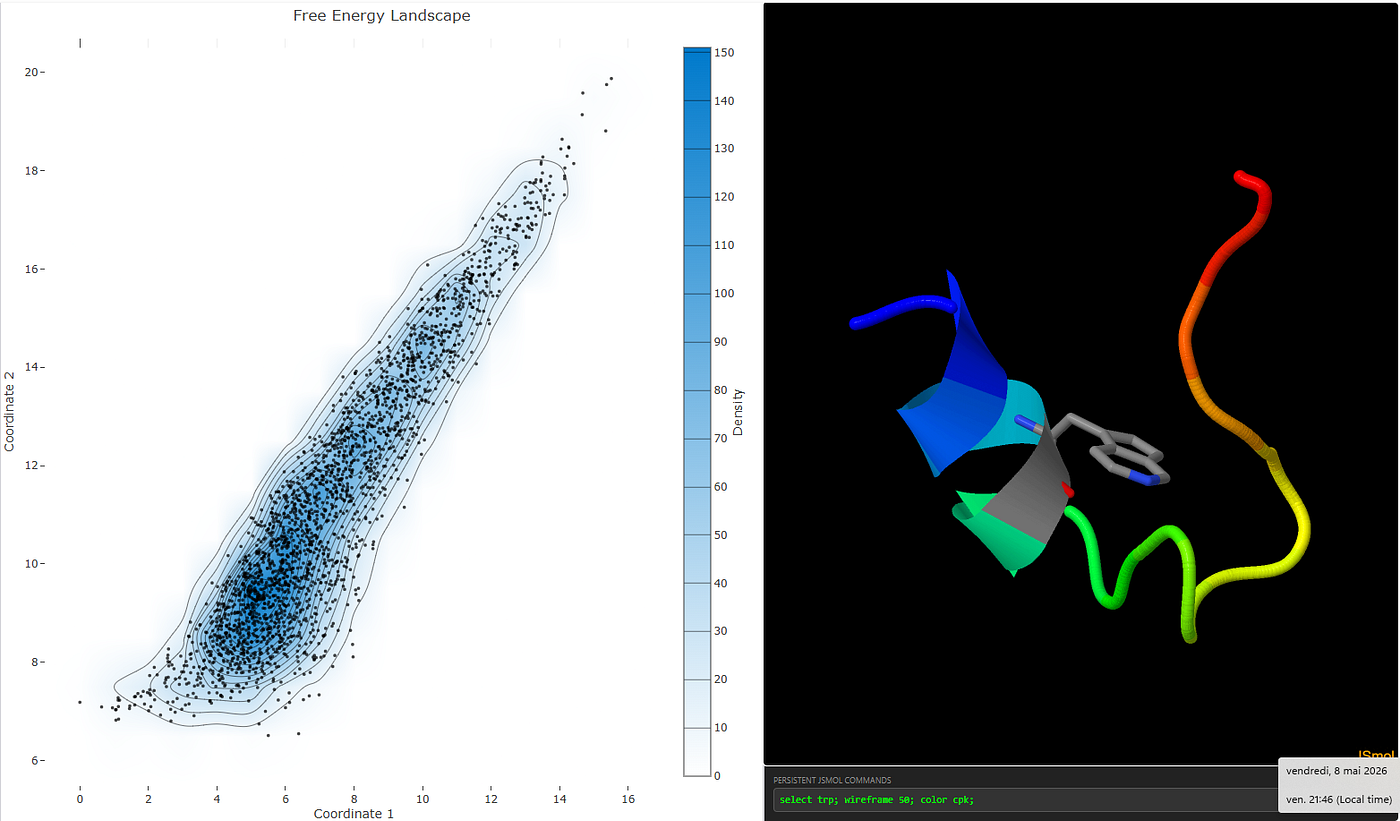
Figure composed by the author from screenshots of publicly available plots and presentations.
I recently came across a great blog post by a company called Nexco Analytics, whose experts in molecular modeling took the time to summarize all the outcomes of CASP16 which took place in late 2024:
The article is very detailed, so I made a small semi-automated summary of it— and then I encourage you to go read Nexco’s post in detail to find out all numbers, statistics, and also several examples of structure predictions that reflect what works well and what works bad. Here I go!
Short Introduction
CASP16 reaffirmed the dominance of deep learning, particularly AlphaFold2 and AlphaFold3, in biomolecular structure prediction, achieving high reliability in protein domain folding, considered largely a solved problem. However, challenges persist in modeling large, complex assemblies and achieving the high local accuracy needed for applications like drug design, especially without good templates. While co-folding approaches for protein-ligand docking show promise, especially with AlphaFold 3, consistent and reliable structure prediction for these complexes remains elusive, and binding affinity prediction proved remarkably poor. Nucleic acid structure prediction lagged significantly behind proteins, still heavily reliant on good templates and expert intervention, with limited AI impact. Overall, CASP16 highlights the transformative power of AI while underscoring remaining limitations in complex systems and the ongoing need for advancements in areas like ligand binding and nucleic acid modeling.
Overall AI Dominance & Landscape
- Cutting-edge deep learning methods, especially AlphaFold2 and AlphaFold3, dominate biomolecular structure prediction.
- These AI methods are often at the core of top-performing protocols and pipelines.
- No protein domain was incorrectly predicted, highlighting the reliability of modern AI-driven methods at this resolution.
- All groups ranking above the raw AlphaFold 3 server used AlphaFold 2 and/or 3 with enhancements. I find that very interesting, because it means that if you use plain AlphaFold you’re kind of already good!
- Winning strategies often involved improving multiple sequence alignments (MSA) fed to AlphaFold, though this was slightly less critical than in CASP15.
- Enhancing sampling of structural models and developing better scoring protocols were also crucial. Regarding this point, it was interesting how MassiveFold played in.
Limitations and Challenges
- Full modeling of large multidomain proteins and assemblies remains difficult for very complex topologies without good templates.
- Even with known stoichiometry, modeling large multicomponent complexes is still a hard problem.
- High-accuracy structural models for applications like virtual drug screening and molecular docking require reasonable expectations depending on the target and local homology to templates.
- The idea that AlphaFold is perfect at the domain level is incorrect; many models have correct folds but inaccuracies in details.
Protein-Ligand Docking
- “Co-folding” methods (simultaneous prediction of protein and ligand structure), enabled by AI like AlphaFold 3, were a hot topic.
- Co-folding’s advantage is not needing to explicitly sample protein conformations, which might differ between ligand-free and bound states.
- A dedicated CASP16 track focused on protein-ligand docking and affinity prediction with realistic drug-like ligands provided by a pharma company.
- While some tools, including co-folding programs, can produce good structural models of protein-ligand complexes in many cases, this is not consistently reliable.
- Affinity estimation for protein-ligand complexes remains “terrible,” with simple ligand properties sometimes correlating better than prediction tools.
- Baseline testing showed AlphaFold 3 and ClusPro performing well in protein-ligand structural modeling on a limited dataset.
- Major expert developers of traditional protein-small molecule docking software were largely absent from this CASP track.
Biomolecular Assemblies
- CASP16 showed progress in modeling complexes, but overall predictions are not as good as for protein domains.
- Top approaches for assembly prediction also used AlphaFold 2-Multimer and/or AlphaFold 3 with optimizations.
- Splitting extremely large targets into overlapping parts for prediction and then assembling them is a common strategy, but not always perfect.
- Knowing the correct stoichiometry of a complex upfront substantially improves modeling efforts.
- Antibody-antigen complex prediction showed limited performance, but one protocol (ClusPro augmented with AlphaFold) stood out.
Nucleic Acids
- CASP16 had the largest-ever set of nucleic acid targets (DNA, RNA, complexes with proteins and ligands).
- AI for RNA structure prediction is not as good as for proteins; good models often require good templates for homology modeling.
- Nucleic acid multimers and ribonucleoproteins remain particularly difficult to model.
- Disappointingly, no significant improvement in nucleic acid modeling was observed compared to CASP15.
- Top-performing nucleic acid predictors often relied on good templates and significant human intervention rather than AI.
- AlphaFold 3 ranked lower for nucleic acid prediction accuracy compared to its performance on proteins.
Other Frontiers
- CASP16 continued exploring modeling conformational dynamics, predicting bound waters and ions, and integrative modeling using low-resolution data. But without much data being available, and even the available cases not being very standardized, these tracks remain experimental and their results anecdotical.
- These areas remain experimental with occasional interesting findings (e.g., atomistic MD for bound waters/ions).
AlphaFold-Specific Points
- AlphaFold 2 was widely used, while AlphaFold 3’s full impact was analyzed based on preprints.
- Enhancements to AlphaFold often involved improving MSAs and careful template selection.
- Extended sampling with AlphaFold (like through MassiveFold) can lead to models closer to the target, especially for assemblies, but scoring functions still struggle to identify these best models reliably.
- While top methods show slight improvements over baseline AlphaFold on certain metrics, the actual average accuracy differences for domains are often small.
- For non-experts, AlphaFold 3 is a stable, easily accessible, and generally good option.
- Local use of AlphaFold 3 offers more control and applicability, including the ability to add ligands, which is essential to carry out co-folding.
메타데이터
- post_id
- 0c423636bc97
- slug
- state-of-the-art-of-protein-structure-prediction-as-of-2025-as-evaluated-by-casp16-0c423636bc97
- url
- https://medium.com/advances-in-biological-science/state-of-the-art-of-protein-structure-prediction-as-of-2025-as-evaluated-by-casp16-0c423636bc97
- canonical_url
- https://medium.com/advances-in-biological-science/state-of-the-art-of-protein-structure-prediction-as-of-2025-as-evaluated-by-casp16-0c423636bc97
- author_url
- https://medium.com/@lucianosphere
- status
- ok
- fetched_at
- 2026-06-15 22:55:51