Two upcoming “AlphaFold moments”: design of protein binders and prediction of conformational states
And brainstorming a future of super-multimodal foundational AI models for biology.
Two upcoming “AlphaFold moments”: design of protein binders and prediction of conformational states
And brainstorming a future of super-multimodal foundational AI models for biology.
Here’s a blog post version of the peer-reviewed comment I published today in Communications Biology from the Nature Publishing Group (open access!):
The closely related communities of structural biology and molecular modeling coined the term “AlphaFold Moment” to refer to the irruption of AlphaFold 2 in biology and associated areas and to potential future events of comparable magnitude and relevance. The term refers to one of those rare, seismic shifts where a problem deemed impossible for decades is suddenly almost irrevocably solved. In the case of DeepMind’s AlphaFold 2, the “moment” was the breakthrough in predicting the most stable folded forms of protein domains and monomers, a problem that suddenly became “largely solved”. A smaller “moment” took place later when new AI models came out that can predict the folded structures of assemblies made of multiple protein components plus nucleic acids, ligands and ions, such as the RoseTTAFold-AllAtoms, Chai, Boltz and AlphaFold 3 models (Interesting note: this problem is actually still far from solved, with much space for improvement as shown by CASP16: nucleic acid prediction is stuck in a pre-AI era, prediction of ligands docking to proteins suffers from many problems including excessive dependence on memorization and therefore very wrong physics, and even protein-only multimers aren’t yet predicted at high accuracy and reliability).
But as I advanced in my 2024 piece here, and as CASP and the broader community continuously stress, solving structures of the most stable folded states is merely the preamble. The real story of life lies in dynamics: how molecules move, how they change shape, and how they interact with others to execute a function. In addition, our understanding of the physics and chemistry that govern structure and dynamics can only be considered truly maximal if we known them well enough to design new molecules — quoting Richard Feynman’s phrase “What I cannot create, I do not understand”.
In this new perspective I brainstorm around the idea that today we are standing at the doorsteps of a new “moment” that will probably make less noise than the original “AlphaFold 2 moment” yet will be as or even more impactful. We are approaching an “AlphaFold Moment” for two critical frontiers in the field: de novo protein design, at least for protein binders, and prediction of conformational landscapes.
Predicting whole conformational ensembles
Now that the 3D structures of domains and monomeric proteins can be predicted so accurately and confidently, and that the modeling of assemblies has advanced so much, CASP is pushing for the next prediction frontier: not just the stable well-folded structure of a protein but actually its whole conformational landscape. As such, CASP15 and 16 created new tracks dedicated to the new pursues and even a whole “Special Interest Group on Modeling Ensembles and Alternative Conformations of Proteins”. The results on this track were not outstanding, but they at least did motivate researchers to work on the problem and as a consequence some new approaches came out during 2025, which was too late to see them impact CASP16 but make them ready to compete in CASP17.
In the long term when predicting molecular structure, what one ideally aims for is predicting all the conformations a protein or biomolecular complex can adopt, weighed by their Boltzmann probabilities — or free energies G, in other terms. While the field is slowly getting there, as I will review below, the ultimate dream is to predict also how landscapes are affected by e.g. ligand binding or post-translational modifications, for the moment not tractable by any large-scale method other than slow and computer-intensive MD simulations. From such predicted free energy landscapes one could compute folding free energies, binding affinities, populations of interesting alternative states, how post-translational modifications and interactions tune protein function, and more, as well as running direct comparisons to detailed atomic data such as that coming from NMR experiments measuring dynamics — typically very rich but hard to interpret in structural terms.
A recent review by Cui et al. describes several systems developed recently with the goal of predicting either whole proper conformational landscapes, or at least sets of feasible alternative conformations. But probably the “AlphaFold Moment” for protein conformational landscapes is being driven by what MicroSoft’s researchers called BioEmu, a short for Biomolecular Emulator. There are two main features that distinguish BioEmu from its predecessors and from alternate models out there. First, its training included large volumes of PDB and AlphaFold models plus 200 milliseconds of all-atom MD simulations. Second, BioEmu uses a generative diffusion framework which is inherently built not to predict “a” structure but rather to sample across a distribution, which the BioEmu developers tuned attempt to make it sample the Boltzmann distribution underlying the conformational landscape.
By design, then, when BioEmu runs on a protein’s sequence it predicts thousands of models, each of which will be different but drawn (in principle) from probabilities dictated by the free energy landscape. This means that the most stable states are more represented among the models, such that you can get to see not only what the most stable conformation/s look like but also estimate how different they are in free energy:
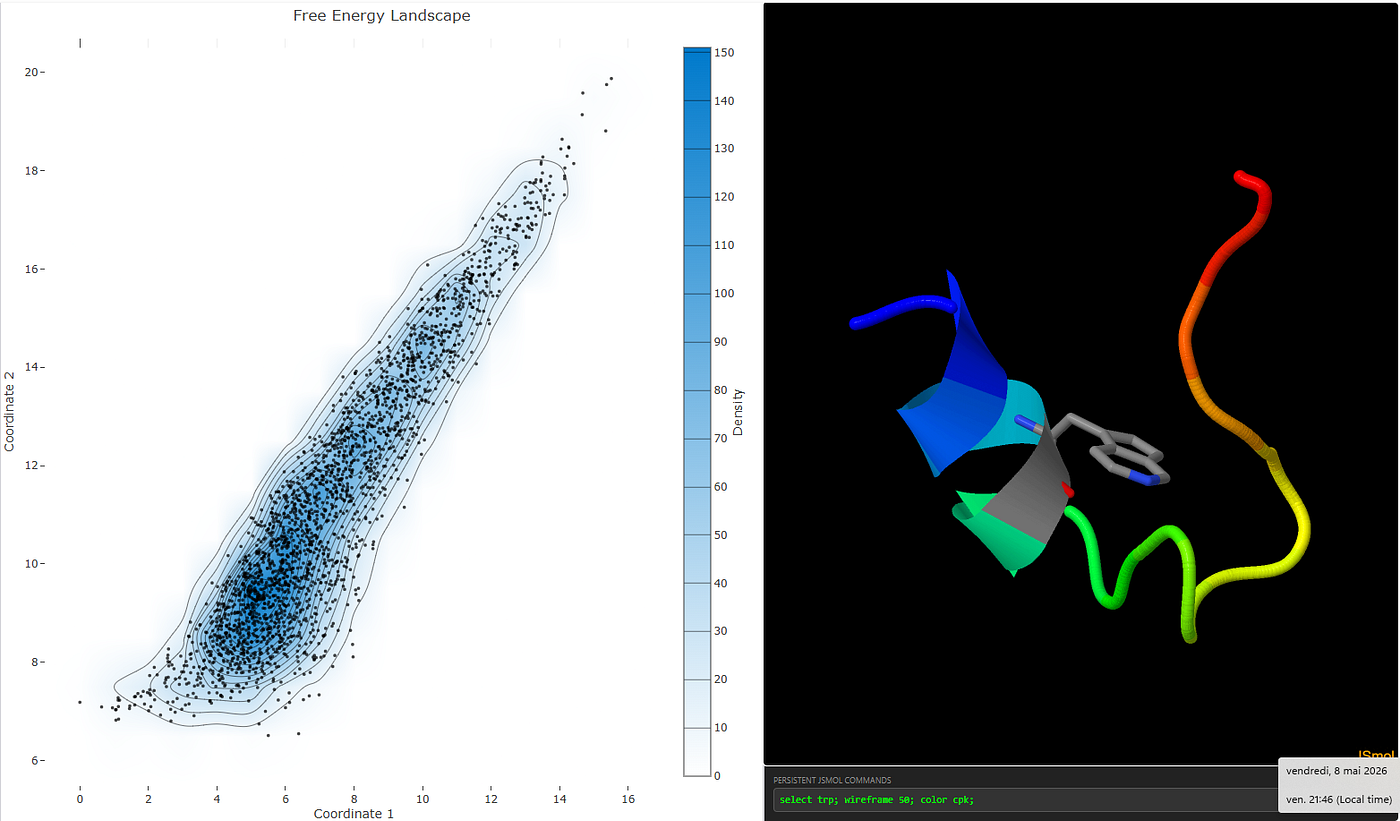
Screenshot of the free energy of folding predicted with BioEmu for the Trp cage miniprotein, as seen interactively with the Conformational Ensemble Inspector at the PDB Manipulation Suite (https://chemrxiv.org/doi/10.26434/chemrxiv.15001752)
Essentially, BioEmu’s result is expected to be similar to that of a large array of atomistic MD trajectories started from a large number of seed models and run for orders of magnitude longer times than currently possible. Approximations reported in the BioEmu paper are that what would take 100,000 GPU hours of atomistic MD can be emulated in minutes.
What’s best about BioEmu is that, contrary to other models which have remained closed or are merely conceptual, it is very easy to use and thus groups are pushing its capabilities and limitations pretty much like the community did with AlphaFold 2 when it came out. In the section “A parallel revolution makes new tools readily accessible” I present one particularly simple way to run BioEmu on the web without the need for installs, together with web-based tools for the analysis of the resulting models, clustering, and conformational landscapes.
Design as the ultimate test of understanding
The other frontier, away from CASP because they historically haven’t dealt with it yet very closely related, is that of designing protein sequences that fold (and ideally work) as expected. Together with DeepMind’s AlphaFold breakthrough, the field of protein design was the other big target of 2024’s Nobel Prize in Chemistry. Paralleling Richard Feynmann’s quote, Nobel Laureate D. Baker explains how being capable of designing proteins implies their deep understanding:
In the classical problem of predicting structures we are given a sequence and asked for the structure, largely solved for monomers at least, and quite advanced for multimers, or now for a whole conformational landscape that as I described above is “in progress”. In turn, in the “Design Problem” we are given a function — a target to bind, a reaction to catalyze, etc.— and asked for the sequence. Each target goal calls for specific problems, and thus for years this whole field was the domain of a few elite labs often specialized in specific kinds of proteins and/or designed functions (structural proteins vs. enzymes or binders, helical assemblies vs globular proteins, etc.). But the wall is crumbling, especially regarding the target of designing protein binders which seems to be undergoing its AlphaFold moment right now.
Historically, finding a binder for a protein would take months of library screening or animal immunization, and of course the output would be limited to antibody or antibody-like proteins. Today, tools like BindCraft from the Correia lab at EPFL are turning this into an engineering discipline, with increased success rates and far simpler to operate than regular pipelines with broader scope for design. BindCraft leverages the very architectures that made AlphaFold successful, using them as a “fitness oracle” to guide the de novo creation of high-affinity binders. The proof is in the wet-lab results reported by its developers and, most interestingly I argue, in the results reported by third parties that run well-controlled contests and remain neutral. A startup by the name of Adaptyv Bio, for example, applied its automated, high-throughput foundry for biological testing to two targets against which the participants had to design binders. The results are startling: we have reached a point where de novo-designed binders with nM affinity are not just “plausible” on a screen, they are working in the lab at high success rates. And BindCraft, winner of Adaptyv Bio’s first contest aimed at designing binders to the EGFR, is not alone in this: said contest crowned two more groups (https://proteinbase.com/collections/adaptyv-egfr-competition-round-1) while in a follow-up the startup Cradle secured a first place by optimizing an existing antibody with a protein language model, (https://proteinbase.com/collections/adaptyv-egfr-competition-round-2) and the latest contest — designing binders to neutralize the high-mortality Nipah virus (https://proteinbase.com/collections/nipah-binder-competition-results)— revealed a >8% hit rate over the full set of submissions, meaning 99 novel binders including 26 single-digit nM or stronger binders and groups like startup Escalante who got 90% success rates with open source models based on Boltz-2. More impressively, Adaptyv Bio made in this contest its own contributions through a pipeline managed by an AI agent built from Claude to control , initially limited to demonstrating a close-loop circuit coupling in silico design with wet-lab testing but actually resulting in one binder with nM affinity.

Scheme showing how modern AI tools can effectively and efficiently create new protein binders to specifically target other biomolecules.
The evidence above is clearly the hallmark of an AlphaFold moment for protein binder design: when a task moves from “highly speculative” to “systematically repeatable”. Plus, many options are open-source and easy to use, thanks to the revolution I touch upon below.
A parallel revolution makes new tools readily accessible
Right after the original AlphaFold revolution, or rather almost in parallel to it, there was another revolution: that of advanced models that become easy to use. For AlphaFold 2 in particular this was materialized by ColabFold, developed by M. Mirdita, M. Steinegger and S. Ovchinnikov up from DeepMind’s original release of AlphaFold 2’s code and model weights. As released by DeepMind, AlphaFold 2 was cumbersome to download, install and execute, but the trio’s great idea was to bundle everything together with a powerful system for MSA generation directly into a Google Colab Notebook. This made the system instantly available across the world in web browsers, for free, and without even requiring any specialized hardware such as GPUs or TPUs. When ColabFold was released, that was also the moment when AlphaFold 2 became really accessible.
From that point on, a culture of sharing code built into platforms for easy deployment such as HuggingFace for AI models, that was by that time already popular among computer scientists for a long time, became mainstream in the fields of computational biology and computational chemistry. This allowed scientists developing new methods, software tools and AI models to more easily make them available, at the same time as they reduced time and costs when compared to deploying full servers. For users, this meant that a larger array of tools becoming available, still rather easy to use (perhaps with a slightly higher barrier than using servers, yet not requiring installations and the such). And for advanced users, both the HuggingFace-like and Colab-like formats still allow for quite some flexibility as the code can be modified before running the models or notebooks, meaning that developments could evolve and be shared faster.
Next, online systems operated for profit but with generous budgets for free use came into the play, making it all even easier to use either right online in web browsers or programmatically through APIs — but in both cases without the need to install anything locally. NVidia, for example, optimized several open-source programs and made them available for free use in their platform, even with built-in visualization of the results, including biology-related AI tools like OpenFold 3, ProteinMPNN, RoseTTAFold-Diffusion, diffdock and Evo 2 among others. Likewise, a platform specialized in services for biology called Tamarind.bio has streamlined the use of a large number of tools in their hardware, including BioEmu and Bindcraft described in the former sections as well as those listed above provided by NVidia and numerous others. Even with the free tier, one can in Tamarind.bio run for example a whole prediction of the conformational landscape for a small protein with BioEmu, obtaining converged results. All this in minutes without ever touching a Linux terminal, although both Tamarind.bio and NVidia also offer programmatic access via Python. And even programmatic access will become easier as AI-based agents are developed who can properly translate the user’s intentions into code or even couple directly to more complex setups as reported above for Adaptyv Bio using Claude to control Boltz-2 and submit sequences for wet-lab testing.
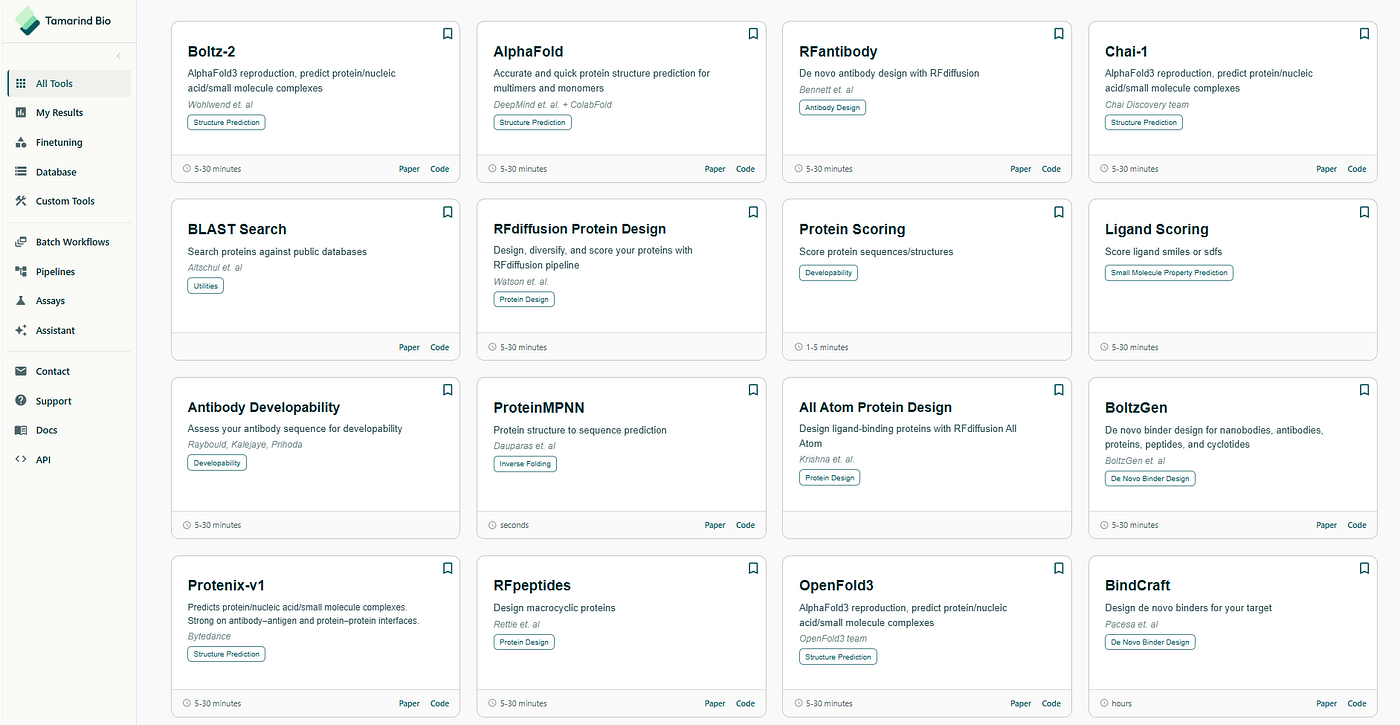
Screenshot from tamarind Bio’s website, showing some of the tools they support.
A future of “super-multimodal” AI systems for chemistry, biology, biotechnology and medicine
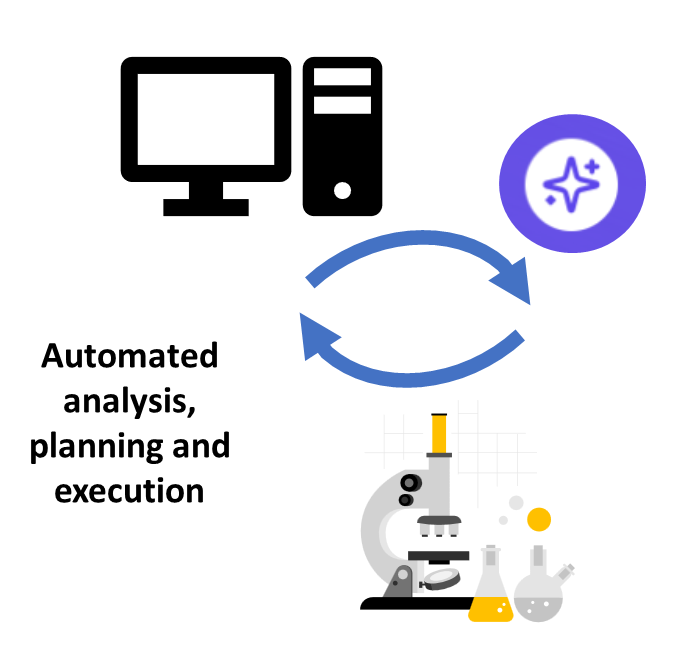
As we look at the trajectory of CASP, the trend is clear. We have moved from protein monomers to multimers, then multimers that include also nucleic acids and small molecules, and now also into dynamics. In parallel, the path to understanding biomolecules in deep detail is in turn allowing us to tune them at will or even to design them from the bottom up. AI systems get more complex (the paper reporting AlphaFold 2 itself included several elements new and complex even to the computer scientists, at the moment) but platforms evolve to make them accessible. And in parallel to this, (conversational) AI agents are becoming powerful enough to help users to utilize new tools, properly interpret their answers, or even automate full pipelines:
Further “AlphaFold Moments” beyond those two I propose we are experiencing right now are less clear, but it is always a good exercise to brainstorm in order to advance ideas — as when we proposed CASP to stress on model confidence metrics and suggested adding two-dimensional scores, after which DeepMind introduced the PAE plots. Dreaming awake, future systems will be able do comprehensive predictions of conformational landscapes for full biological assemblies, and of how they are perturbed by modification of the conditions — pH, temperature, viscosity — as well as by post-translational modifications, the addition or removal of interactors, and more. Along the design axis, this will enable condition-specific design, that is the design of proteins that change their conformation in response to pH, temperature, or the presence of a specific ligand. We will thus design enzymes that work only when prompted to, binders that specifically stabilize a functional state identified by an AI emulator, and more.
Dreaming a bit beyond, we might advance super-multimodal systems that merge the frontiers between genomics, cell biology, and structural biology. While we covered here how AI models started by handling proteins for prediction and design to then embrace all other types of biologically relevant molecules, an orthogonal subfield of AI for biology has been evolving that leverages applications to genomics. Along this line, foundational models like Evo (by Arc Institute, Stanford and NVidia, currently in version 2) and now AlphaGenome (DeepMind) can analyze and predict DNA sequences and their connection to the other fundamental pieces underpinning the central dogma of biology, that is RNA and proteins. Evo 2 focuses on broad-spectrum, generative, and cross-species modeling, while AlphaGenome specializes in high-accuracy, multimodal, human/mouse-specific, and clinical variant evaluation; both running zero-shot or with fine-tuning. Both models utilize a 1-million-token (nucleotide) context window to understand long-range regulatory interactions, such as enhancer-promoter communication, but retain single-base resolution. But while they are capable of predicting effects of mutations and molecular phenotypes such as chromatin accessibility or gene expression, by internally understanding chromatin “structure”, they possess absolutely no “knowledge” about or capability to treat molecular structures.
Achieving an integration of these foundational models with those that can handle, understand and design molecular structures, would take it all to new levels, to certainly yet a new, major AlphaFold moment.
메타데이터
- post_id
- 4eab561d1866
- slug
- two-upcoming-alphafold-moments-design-of-protein-binders-and-prediction-of-conformational-states-4eab561d1866
- url
- https://medium.com/advances-in-biological-science/two-upcoming-alphafold-moments-design-of-protein-binders-and-prediction-of-conformational-states-4eab561d1866
- canonical_url
- https://medium.com/advances-in-biological-science/two-upcoming-alphafold-moments-design-of-protein-binders-and-prediction-of-conformational-states-4eab561d1866
- author_url
- https://medium.com/@lucianosphere
- status
- ok
- fetched_at
- 2026-06-15 22:55:51






