Everyone uses BLAST, but do you really use it correctly?
My honest opinion on the most fundamental tool in bioinformatics and the three ways people get it completely wrong.
Everyone uses BLAST, but do you really use it correctly?
My honest opinion on the most fundamental tool in bioinformatics and the three ways people get it completely wrong.
BLAST was the first bioinformatics tool I truly fell in love with.
I remember the first time I typed a DNA sequence into the NCBI BLAST search box and hit run. Within seconds, results came back matches from organisms I had never thought about, evolutionary relatives I did not know existed, functional clues hiding inside a single sequence.
It felt like magic. A sequence connecting you to the entire tree of life in under a minute.
But here is the thing about BLAST that nobody tells you when you first start using it.
Knowing how to run BLAST and knowing how to use BLAST are two completely different things.
I have watched students copy a sequence, paste it into NCBI, click submit, look at the first result, and say, “Found it.” Without reading the E-value. Without checking the query coverage. Without asking whether the database they searched was even the right one.
That is not bioinformatics. That is pressing buttons and hoping.
So today I want to talk about what BLAST actually is, what it actually does, and the three ways I see people misuse it constantly, including ways I wish someone had corrected me on earlier.
What BLAST actually does
BLAST: Basic Local Alignment Search Tool -takes your sequence and finds similar sequences in a database. It does this by breaking your query into short fragments, finding exact matches for those fragments in the database, and then extending those matches in both directions to find the best alignment.
The keyword is local. BLAST does not try to align your entire sequence to the entire database sequence. It finds the regions of strongest similarity. This makes it fast. It also means you need to understand what you are looking at when you read the results.
Every BLAST result gives you several things:
The alignment score -how well the sequences match in the aligned region.
The E-value is the most important number in the output.
The query coverage: how much of your sequence was actually aligned.
The percent identity -how similar the matched region is.
Most beginners look at the percent identity and ignore everything else. That is the first mistake.
Misconception 1 -A good score always means a good match
The E-value is the number that actually tells you whether a BLAST result is meaningful.
E stands for Expect. The E-value tells you how many matches this good you would expect to find by random chance in a database of this size.
An E-value of 1e-50 means you would expect to find a match this good by random chance once in every 100,000,000,000,000,000,000,000,000,000,000,000,000,000,000,000,000 searches. That is a real match.
An E-value of 0.5 means you would expect to find a match this good by chance once in every two searches. That is almost certainly noise.
I hold to this rule firmly; anything above 1e-5 needs to be treated with serious scepticism. Anything above 0.01 I do not report as a meaningful hit without very strong additional evidence.
The score looks impressive. The E-value tells the truth.
Misconception 2 -The first result is the best result
BLAST returns results ranked by score. The first result has the highest score. But highest score does not always mean most biologically meaningful.
Here is a situation I have seen repeatedly. Someone BLASTs a human gene sequence and the top hit comes back as another human sequence with 99% identity. Great. But it is a hypothetical protein with no known function, annotated only because a genome sequencing project deposited it automatically.
The fifth result is a well-characterised protein in a model organism with decades of experimental evidence behind it. Same gene family. Functionally described. Experimentally validated.
Which result is more useful for understanding your gene?
The answer is obvious. But if you stop at result one you never get there.
Always read beyond the first hit. Look at what is known about the matched sequences. Check whether the top hits are experimentally characterised or computationally predicted. The annotation quality of the match matters as much as the alignment score.
Misconception 3 -People do not know when NOT to use BLAST
This is the one I feel most strongly about.
BLAST is a local alignment tool. It is brilliant for finding similar sequences in a database. It is not the right tool for everything.
If you want to align two full genome sequences, BLAST is not the right tool. Use MUMmer or LAST.
If you want to find remotely homologous proteins where sequence similarity is low, BLAST will miss them. Use HMMer or PSI-BLAST instead.
If you want to quantify gene expression from RNA-seq data , BLAST is not the right tool. Use HISAT2 or STAR for alignment, then DESeq2 for quantification.
I have seen people try to use BLAST for things it was never designed to do, and then conclude their data has no useful information when actually they just used the wrong tool.
Knowing when not to use a tool is as important as knowing how to use it. This applies to BLAST more than almost anything else in bioinformatics because it is so well known that people default to it for everything.
The right way to use BLAST
Before you run BLAST, ask yourself three things.
First : Which database? BLAST searches against different databases for different purposes. nr is the non-redundant protein database broad but noisy. RefSeq is curated and more reliable. SwissProt is manually reviewed and the most trustworthy but smallest. Choosing the right database changes your results significantly.
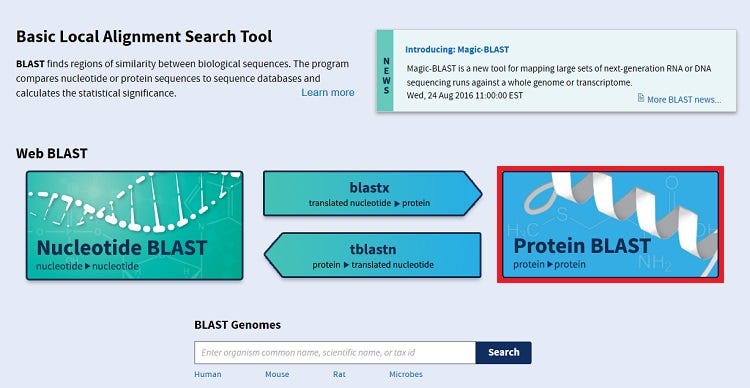
Second: Which BLAST program? BLASTn for nucleotide against nucleotide. BLASTp for protein against protein. BLASTx for nucleotide query translated against protein database. tBLASTn for protein query against translated nucleotide database. Using the wrong program gives you meaningless results.
Third: What does the E-value actually tell you? Set a meaningful threshold before you look at the results. Decide in advance what level of evidence you need. Then apply it consistently.
BLAST is a brilliant tool. It is one of the most important tools in the entire field. But like every tool in bioinformatics and in the wet lab, the quality of what you get out depends entirely on how thoughtfully you put things in.
Mini challenge, run this yourself, right now
This will take 15 minutes and will teach you more about BLAST than an hour of reading.
Step 1: Your query sequence
Go to https://blast.ncbi.nlm.nih.gov and select nucleotide BLAST (BLASTn).
Paste this sequence into the query box:
ATGGAGGAGCCGCAGTCAGATCCTAGCGGTAATCTCCGAAGAAATCGAGCGG
CTGCTGCCCCTGGAGAGCGAGTTCCTGGACAGTGACAGTGATGGTGGTCATG
GCGGCATGGAGGCATCAGAGGCGCACAGAGGAAGAGAATCTCCGCAAGAAAG
GGAGCCTCACCACGAGCTGCCCCCAGGGAGCACTAAGCGAGCACTGCCCAAC
AACACCAGCTCCTCTCCCCAGCCAAAGAAGAAACCACTGGATGGAGAATATTT
Step 2: Set your parameters carefully
Before running, change these settings:
- Database: RefSeq RNA (not nr RefSeq is curated and more reliable for this exercise)
- Organism: leave blank, do not restrict it, you want to see what comes back across all life
- Max target sequences: 50
- E-value threshold: 0.001
- Word size: 11 (default for BLASTn)
Write down your prediction before you hit search. What gene do you think this is? Which organism?
Step 3: Interpret the results scientifically
Once results come back, work through these questions in order:
First, look at the top hit. Record the E-value, percent identity, and query coverage. Is the E-value below 1e-10? Is query coverage above 90%? If both are yes, you have a high confidence match.
Second, look at results 2 through 10. Are they the same gene in different organisms? If yes, this gene is evolutionarily conserved it has been maintained across species because it does something critical. What does that tell you about its biological function?
Third, click on one of the non-human hits. Go to the linked sequence record. Is this sequence experimentally characterised or computationally predicted? This is the difference between evidence-based annotation and automated annotation, and it matters enormously when you are drawing biological conclusions.
Fourth, now change the database from RefSeq RNA to nr and run again. Compare the top 5 results. Are they the same? Different? What does that tell you about database choice?
Step 4: The biological question
The sequence above is from a gene that is mutated in more than 50% of all human cancers. Based on your BLAST results, what gene is it? What is its function? And what does its conservation across species tell you about why mutations in this gene are so catastrophic?
Write your answer in three sentences before you scroll down.
The answer is TP53, the guardian of the genome. Tumour suppressor. Cell cycle controller. And one of the most studied genes in the history of molecular biology.
If your BLAST results told you that, you just did real bioinformatics.
Final thought
The first time BLAST connected one of my sequences to an organism I had never considered, I understood why I loved this field. That moment of biological discovery through computation, there is nothing quite like it.
But discovery requires rigour. Understanding your E-values. Reading beyond the first hit. Knowing which database, which program and why.
The magic is real. You just have to earn it.
Jeevitha CM, Bioinformatician
Most of what I write here, nobody told me. Now I’m telling you.
메타데이터
- post_id
- 71fd40f936fd
- slug
- everyone-uses-blast-but-do-you-really-use-it-correctly-71fd40f936fd
- url
- https://medium.com/@jeevithacm21/everyone-uses-blast-but-do-you-really-use-it-correctly-71fd40f936fd
- canonical_url
- https://medium.com/@jeevithacm21/everyone-uses-blast-but-do-you-really-use-it-correctly-71fd40f936fd
- author_url
- https://medium.com/@jeevithacm21
- status
- ok
- fetched_at
- 2026-06-22 17:31:34