Single-Cell RNA-Seq (Why bulk RNA-Seq is not Enough…)
We have spent the last few days going deep into RNA-seq, if you haven’t checked, see the previous writeups. The pipeline. The tools. The…
Single-Cell RNA-Seq (Why bulk RNA-Seq is not Enough…)
We have spent the last few days going deep into RNA-seq, if you haven’t checked, see the previous writeups. The pipeline. The tools. The visualisations and I hope by then you understand why bulk RNA-seq is such a powerful technique.
But today I want to tell you about its most fundamental limitation.
And why that limitation led to one of the most exciting technological developments in modern biology.
PC: Gemini AI
The problem with bulk RNA-seq
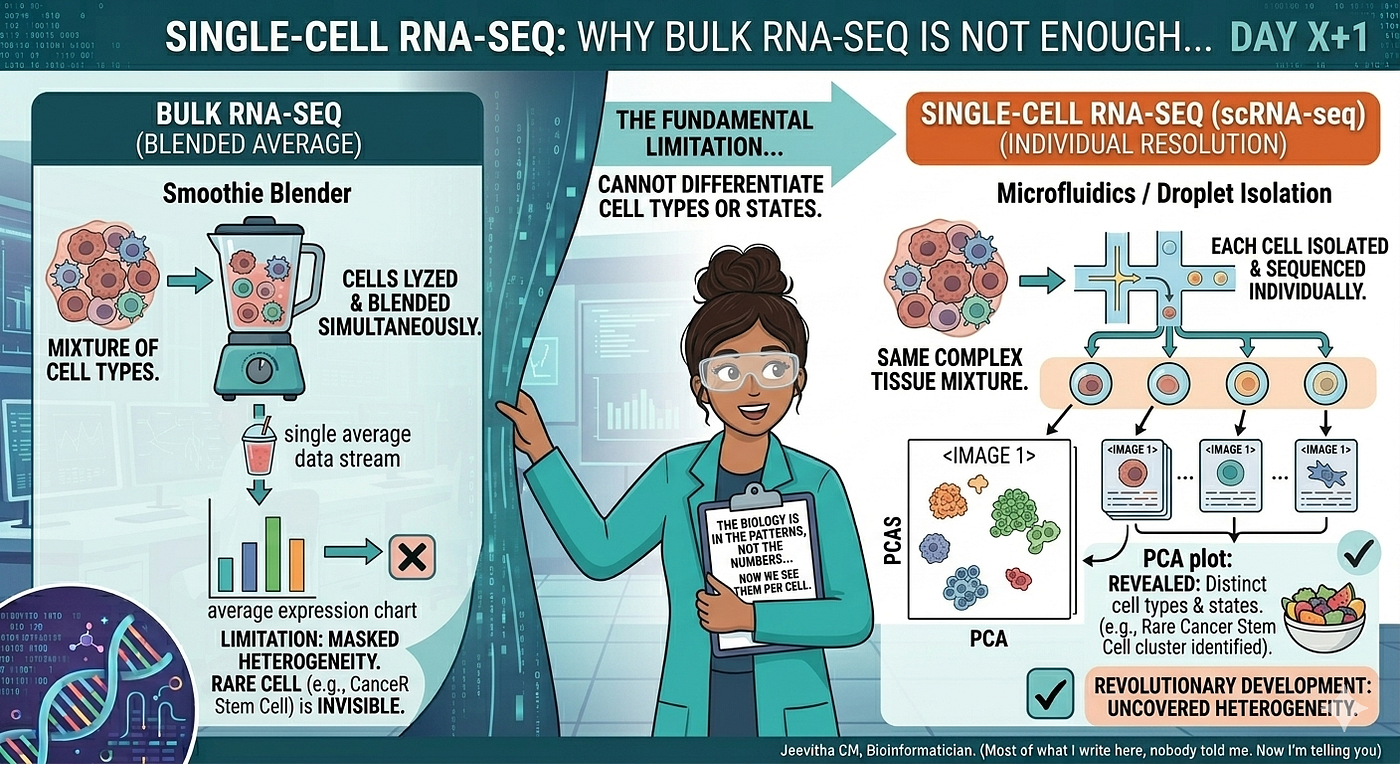
When you run a bulk RNA-seq experiment you extract RNA from a tissue sample. That sample contains thousands sometimes millions of cells. All mixed together.
The expression counts you get back are an average across all of those cells.
Now think about what that means in practice.
A liver tumour is not a uniform mass of identical cancer cells. It contains cancer cells at different stages of progression. It contains immune cells that have infiltrated the tumour. It contains stromal cells fibroblasts, endothelial cells that make up the tumour microenvironment. It contains a small population of cancer stem cells that drive tumour growth and resistance to treatment.
In bulk RNA-seq, all of these cells are pooled together and averaged. The signal from a rare but critically important subpopulation say, a small cluster of drug-resistant cells gets drowned out by the majority.
You might have 5% of your tumour cells expressing a completely unique gene expression programme that drives metastasis. In bulk RNA-seq, that 5% is invisible. Averaged away.
This is not a small problem. It is fundamental. And it is what single-cell RNA-seq was designed to solve.
What single-cell RNA-seq actually does
Single-cell RNA-seq scRNA-seq measures gene expression in individual cells rather than bulk tissue.
Instead of extracting RNA from thousands of cells at once, you separate them first either by microfluidics, droplet-based systems, or plate-based methods and sequence the RNA from each cell individually.
The result is not one expression profile. It is thousands of expression profiles one per cell.
From a single experiment on a tumour sample you might get expression data for 10,000 individual cells. Each one with its own unique pattern of gene expression. Each one telling you something about what that specific cell was doing at the moment it was captured.
What single-cell reveals that bulk cannot
This is where it gets genuinely extraordinary.
- Cell type identification. In a bulk experiment you know you had liver cells. In a single-cell experiment you can identify exactly which types of cells were present — hepatocytes, Kupffer cells, stellate cells, endothelial cells, T cells, B cells, NK cells — based on their gene expression profiles alone. No antibodies. No cell sorting. Just the transcriptome.
- Rare cell populations. That 5% of drug-resistant cancer cells that bulk RNA-seq averaged away? In single-cell data they appear as a distinct cluster with their own expression signature. You can find them, characterise them, and ask what makes them different.
- Cellular trajectories. Single-cell RNA-seq can reveal how cells change over time how a stem cell differentiates into a mature cell type, how a cancer cell progresses from early to late stage. By ordering cells along a trajectory based on their expression profiles, you can reconstruct a developmental or disease progression timeline from a single snapshot in time.
- Tumour heterogeneity. Two patients with the same cancer diagnosis can have completely different cellular compositions in their tumours. Single-cell RNA-seq makes this visible in a way bulk never could and understanding that heterogeneity is critical for designing treatments that work for the specific patient in front of you.
The tools : Seurat and Scanpy
The two dominant tools for single-cell RNA-seq analysis are Seurat in R and Scanpy in Python.
- Seurat is the most widely used. It handles the full single-cell analysis workflow quality control, normalisation, dimensionality reduction, clustering, cell type annotation, and differential expression between clusters. If you are working in R and starting with single-cell analysis, Seurat is where you begin.
- Scanpy is the Python equivalent part of the scverse ecosystem. It is fast, memory-efficient, and integrates well with other Python tools. If your pipeline is Python-based, Scanpy is your tool.
Both tools produce UMAP plots the signature visualisation of single-cell RNA-seq. A UMAP is a dimensionality reduction plot like PCA, but optimised for the high-dimensional, sparse data that single-cell experiments produce. Each dot is one cell. Cells with similar expression profiles cluster together. Different cell types appear as distinct islands.
A well-annotated UMAP of a tumour sample is one of the most information-rich visualisations in modern biology showing you the entire cellular landscape of a tissue in a single image.
My honest opinion on where this is going
Single-cell RNA-seq is not a niche technique anymore. It is becoming standard in cancer biology, immunology, developmental biology, and neuroscience. The Human Cell Atlas project is using it to map every cell type in the human body — a biological reference that will change medicine in ways we are still working out.
But it comes with real challenges that I want to be honest about.
The data is sparse. Most genes in most cells have zero counts not because they are not expressed, but because sequencing depth per cell is low. Handling this sparsity correctly requires specific normalisation methods that do not apply to bulk RNA-seq.
Batch effects are severe. Cells processed in different labs, on different days, with different protocols can show technical differences that look like biological differences. Integrating data across experiments requires dedicated tools like Harmony or BBKNN.
Cell type annotation is still partly subjective. You cluster your cells computationally and then you have to decide what each cluster is which requires biological knowledge, marker gene databases, and sometimes genuine uncertainty.
These are not reasons to avoid single-cell. They are reasons to learn it properly which is true of every powerful tool.
Mini challenge: explore a real single-cell dataset
The Human Cell Atlas data portal at https://data.humancellatlas.org has publicly available single-cell RNA-seq datasets from real human tissues.
Browse the portal and find a dataset from a tissue type you are interested in. Read the associated publication. Look at the UMAP in the paper how many distinct cell clusters are there? What cell types were identified?
Now look at the methods section. What platform was used to capture single cells — 10x Genomics Chromium? Smart-seq? What was the median number of genes detected per cell? What tools were used for analysis?
Finally find one cell type cluster in the UMAP that surprised the authors or that had not been described in that tissue before. What marker genes defined it? What biological function did the authors propose for it?
Write three sentences summarising what this single-cell dataset revealed that bulk RNA-seq could not have shown. That distinction what single-cell adds is the most important thing to understand about this technology.
Jeevitha CM, Bioinformatician
Most of what I write here, nobody told me. Now I’m telling you.
메타데이터
- post_id
- afea05fc56b9
- slug
- single-cell-rna-seq-why-bulk-rna-seq-is-not-enough-afea05fc56b9
- url
- https://medium.com/@jeevithacm21/single-cell-rna-seq-why-bulk-rna-seq-is-not-enough-afea05fc56b9
- canonical_url
- https://medium.com/@jeevithacm21/single-cell-rna-seq-why-bulk-rna-seq-is-not-enough-afea05fc56b9
- author_url
- https://medium.com/@jeevithacm21
- status
- ok
- fetched_at
- 2026-06-09 15:37:30