How Proteins Fold and Why AlphaFold Changed Everything
In 1972, a biochemist named Christian Anfinsen won the Nobel Prize for proving that a protein’s shape is entirely determined by its…
How Proteins Fold and Why AlphaFold Changed Everything
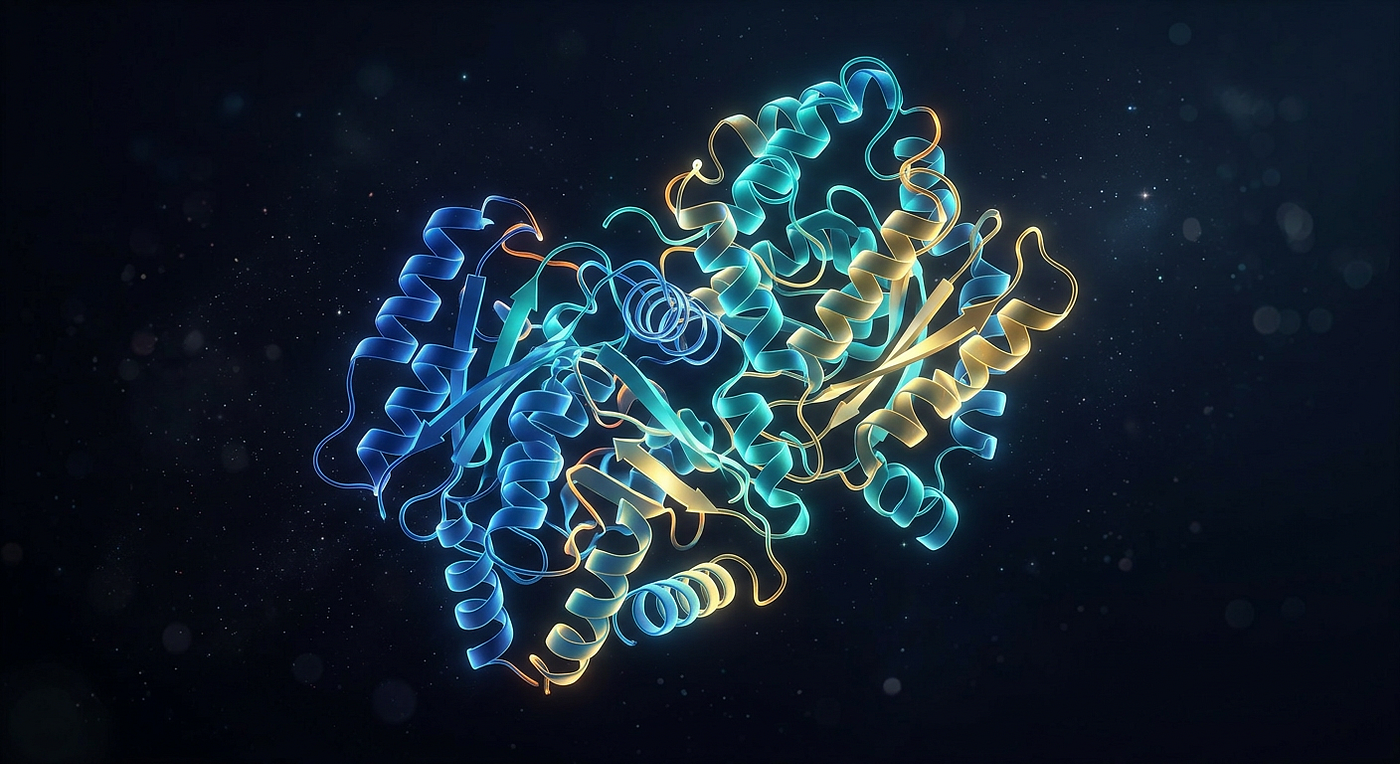
AI‑generated illustration
In 1972, a biochemist named Christian Anfinsen won the Nobel Prize for proving that a protein’s shape is entirely determined by its sequence of amino acids. The folding instructions were already written inside the molecule itself.
It was a beautiful idea.
It was also the beginning of one of the most stubborn unsolved problems in all of science. For the next fifty years, it stood at the centre of biology like an unanswered question on an exam paper.
Then, in 2020, a machine learning model called AlphaFold solved it. Not partially. Not approximately. With accuracy that matched experimental methods developed over decades.
This is that story.
What Is a Protein, and Why Does Its Shape Matter?
Let's start with the basics. A protein is a chain of amino acids. The sequence of those amino acids is encoded in your DNA. That chain folds into a three-dimensional shape. And that shape is everything.
A protein’s shape determines what it can bind to, what reaction it can catalyse, what job it does in your body. Change the shape even slightly, and the protein may stop working entirely. Many diseases — Alzheimer’s, Parkinson’s, cystic fibrosis — involve proteins that fold incorrectly and malfunction as a result.
Understanding how proteins fold is not an academic exercise. It is directly tied to understanding disease, designing drugs, and engineering biology.
The Fifty-Year Problem
The task sounds simple: given a sequence of amino acids, predict the final folded shape.

AI‑generated illustration
The reason it took so long to find a solution is a matter of mathematics. A typical protein has hundreds of amino acids. Each one can rotate and position itself in multiple ways relative to its neighbours. The number of possible folding configurations is astronomical.
Nature solves this in milliseconds. Proteins fold spontaneously, reliably, every time, inside the chaotic environment of a living cell.
That was the question. For fifty years, nobody had the answer.
Then came AlphaFold.
What AlphaFold Actually Did
DeepMind’s AlphaFold, developed by a team led by Demis Hassabis and John Jumper, approached protein folding not as a physics simulation but as a pattern recognition problem.
Trained on the Protein Data Bank — a repository of experimentally determined protein structures built up over decades. AlphaFold learned the deep relationships between amino acid sequences and their resulting shapes, not by simulating the physics of folding, but by recognising patterns across an enormous dataset of known examples.
The outcome, assessed during CASP14 (the biennial event that benchmarks protein structure prediction techniques), was so precise that a senior scientist referred to it as “a solution to a fifty-year-old grand challenge in biology.”
What This Means for Biology and Bioinformatics
In 2022, DeepMind released predicted structures for over 200 million proteins, essentially the entire known protein universe — freely available to the scientific community. Ready to use.
For drug discovery, this is significant. You cannot design a molecule to interact with a protein if you do not know what that protein looks like. Experimental structure determination — X-ray crystallography, cryo-EM — can take years. AlphaFold gives you a highly accurate starting point in minutes.
For rare disease research, it removed a real barrier. Many disease-relevant proteins were structurally unknown simply because the research community was too small to justify the cost of experimental determination. That is no longer a limitation.
For synthetic biology — designing new proteins for specific purposes — it opened up iterative design in a way that simply was not practical before.
For bioinformatics specifically, it changed the landscape of what is possible in structural analysis. Tools that once required expensive experimental data as input can now work from predicted structures.

AI‑generated illustration
What It Tells Us About Where Science Is Going
AlphaFold is not just a biology story. It is a story about what happens when Artificial Intelligence meets a hard problem with enough data behind it.
Fifty years of experimental data in the Protein Data Bank made AlphaFold possible. The lesson is not that AI is magic. It is that decades of careful, unglamorous data collection created the foundation for a sudden leap forward.
That pattern is repeating across science right now. Genomics. Drug design. Climate modelling. Materials science.
The protein folding problem was one of the first dominoes. It showed what is possible.
The rest is still unfolding.
References
- Jumper, J. et al. (2021). Highly accurate protein structure prediction with AlphaFold. Nature, 596, 583–589. https://doi.org/10.1038/s41586-021-03819-2
- Anfinsen, C.B. (1973). Principles that govern the folding of protein chains. Science, 181(4096), 223–230. https://doi.org/10.1126/science.181.4096.223
- Callaway, E. (2020). ‘It will change everything’: DeepMind’s AI makes gigantic leap in solving protein structures. Nature News. https://doi.org/10.1038/d41586-020-03348-4
- Tunyasuvunakool, K. et al. (2021). Highly accurate protein structure prediction for the human proteome. Nature, 596, 590–596. https://doi.org/10.1038/s41586-021-03828-1
- AlphaFold Protein Structure Database. https://alphafold.ebi.ac.uk
- RCSB Protein Data Bank. https://www.rcsb.org
메타데이터
- post_id
- ce37dfb248fa
- slug
- how-proteins-fold-and-why-alphafold-changed-everything-ce37dfb248fa
- url
- https://medium.com/@spikyvato1/how-proteins-fold-and-why-alphafold-changed-everything-ce37dfb248fa
- canonical_url
- https://medium.com/@spikyvato1/how-proteins-fold-and-why-alphafold-changed-everything-ce37dfb248fa
- author_url
- https://medium.com/@spikyvato1
- status
- ok
- fetched_at
- 2026-07-13 21:43:11





